
Posted on Leave a comment

Talking Stainless Steel Valves – Material Is Everything

Arguably the most significant factor in a high-performance or all-out racing engine is its ability to breathe. Whether air/fuel flows into the combustion area or exits as exhaust, the engine’s valves play an integral role in the flow efficiency needed for raw horsepower. When you visit a leading builder of racing engines, you will probably see more time invested on the flow bench than any other research and development tool, because airflow is everything.

Stainless steel valves are not necessarily produced with the same base materials across different manufacturers.

We investigated some of the latest engine valve designs to see how they handle the ever-increasing demands to provide more flow and durability. To raise the dynamometer needle constantly higher, increased cam lifts and larger doses of compression or even “boosted” engines tax your intake and exhaust valves more, as well.

Notably, many professional engine builders use Erson manufactured valves for their builds. We visited with Jack McInnis, Marketing Director for Erson, to review the latest technology in its various performance/racing engine valve lines.

 The materials used in valves today offer the biggest jump in technology related to longevity. The alloys used for stainless steel valves today can vary greatly; assuming they are all the same is not a good practice. – Jack McInnis, PBM/Erson

Raw Materials

We pored over various valves offered by manufacturers and confirmed that metallurgy could vary significantly between brands from those who provide the raw material specifications for their valves. It is personally alarming that with so many stainless steel varieties varying in strength, one must question the materials used from a manufacturer offering no more details in their description than just “stainless valves.”

“The Erson 2000-Series are what we call our race series valve,” McInnis explains. “These are what we specify as your kind of street/strip and sportsman racing type of stainless valve. We start with a one-piece forging from an EV-8 stainless alloy. This alloy contains a little more nickel and chromium in the raw forging, so they’re extraordinarily strong.”

Martensitic steel is a material used by automotive manufacturers in original equipment engine valves. It offers features like corrosion resistance but lacks in strength for a performance application. McInnis adds, “The martensitic steel is strong at room temperature compared to stainless steel alloys, but as the temperature goes up related to horsepower, it loses some tensile strength while stainless gains strength.”

SAE Specifications

Some of the specs you want to look for in performance and racing valves come from a “code system” qualified by the Society of Automotive Engineers (SAE.) An EV8 or EV-8 description for stainless steel valves is not a specific metal but is based on the use of accumulative alloys.

Such examples by the SAE code include an “NV” code for a low-alloy intake valve and an “HNV” code for a high alloy intake valve material. Another material code commonly used is specified as “EV,” a valve alloy with 16- to 30-percent chromium and 2- to 20-percent nickel for enhanced surface quality, formability, and wear resistance.
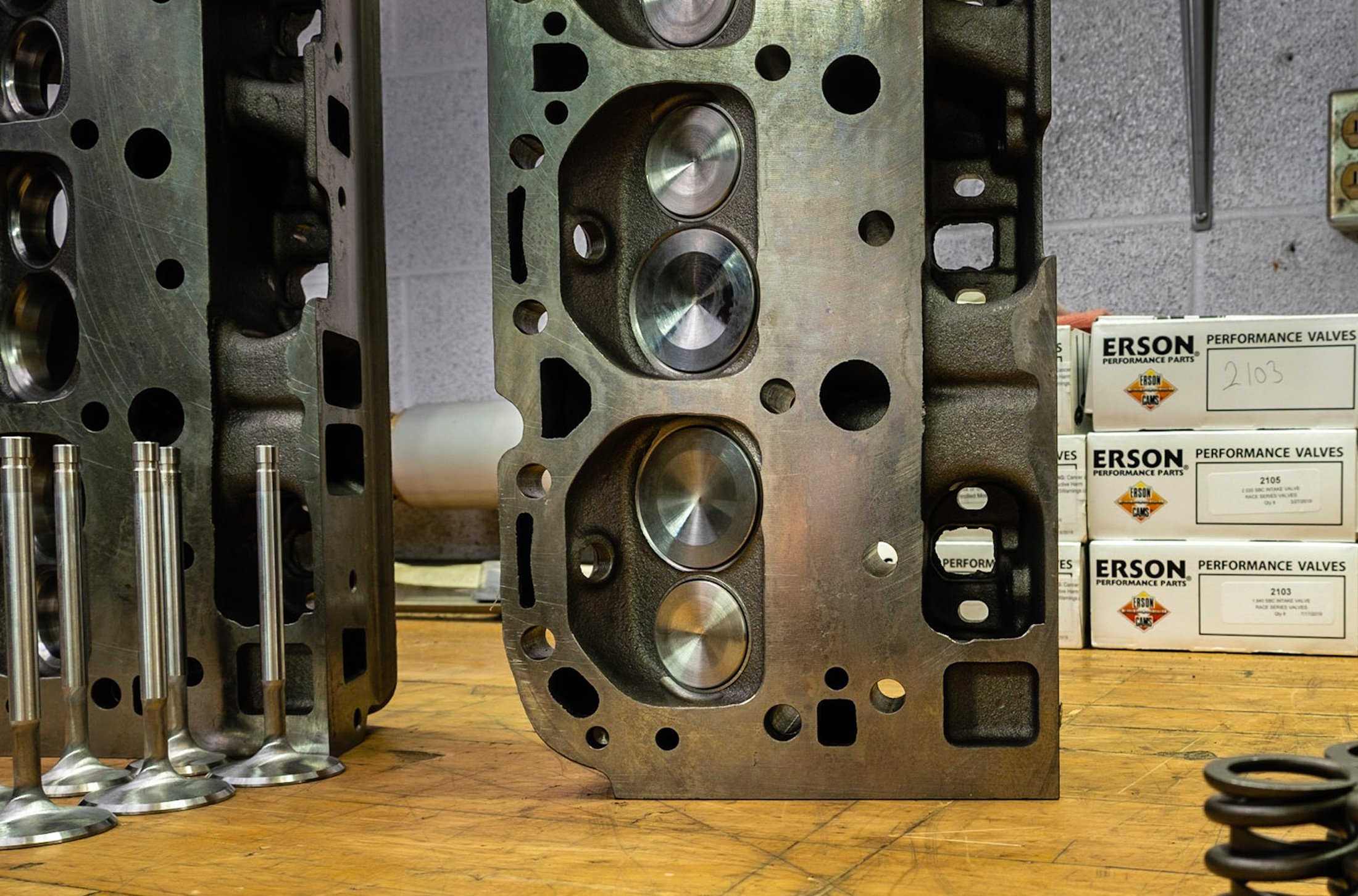
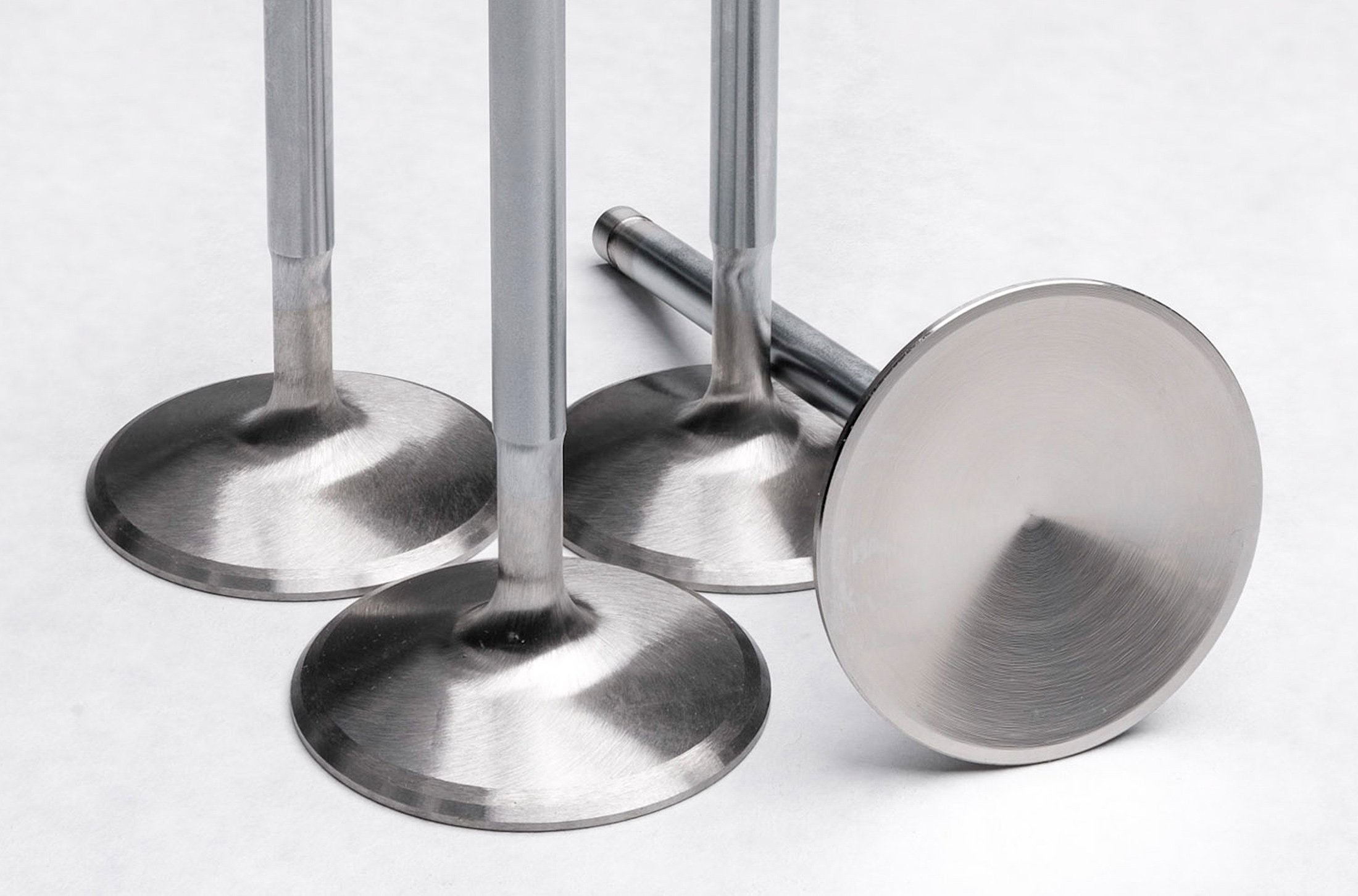
The SAE describes this EV-coded alloy as a material popular for use in performance exhaust valve applications. What gives the Erson 2000-Series valves their durability? It is the use of this EV-8 stainless alloy for both its intake and exhaust valves.

On Another Level

The second and higher level of valves manufactured by Erson is specified for all-out competition applications.

“Our 1000-Series valves are forged from a PS824 stainless material,” McInnis explains. “That is a higher grade stainless steel valve material. It is what we generally recommend for any application where any combination of a high lift roller cam, higher valve spring pressures, and/or a higher RPM operation is applied.”

Unlike the 2000-Series using the SAE described EV-8 material classification, the 1000-Series valves utilize a specific PS824 stainless alloy offering high fatigue resistance and tensile strength, again under high-performance combustion temperatures.
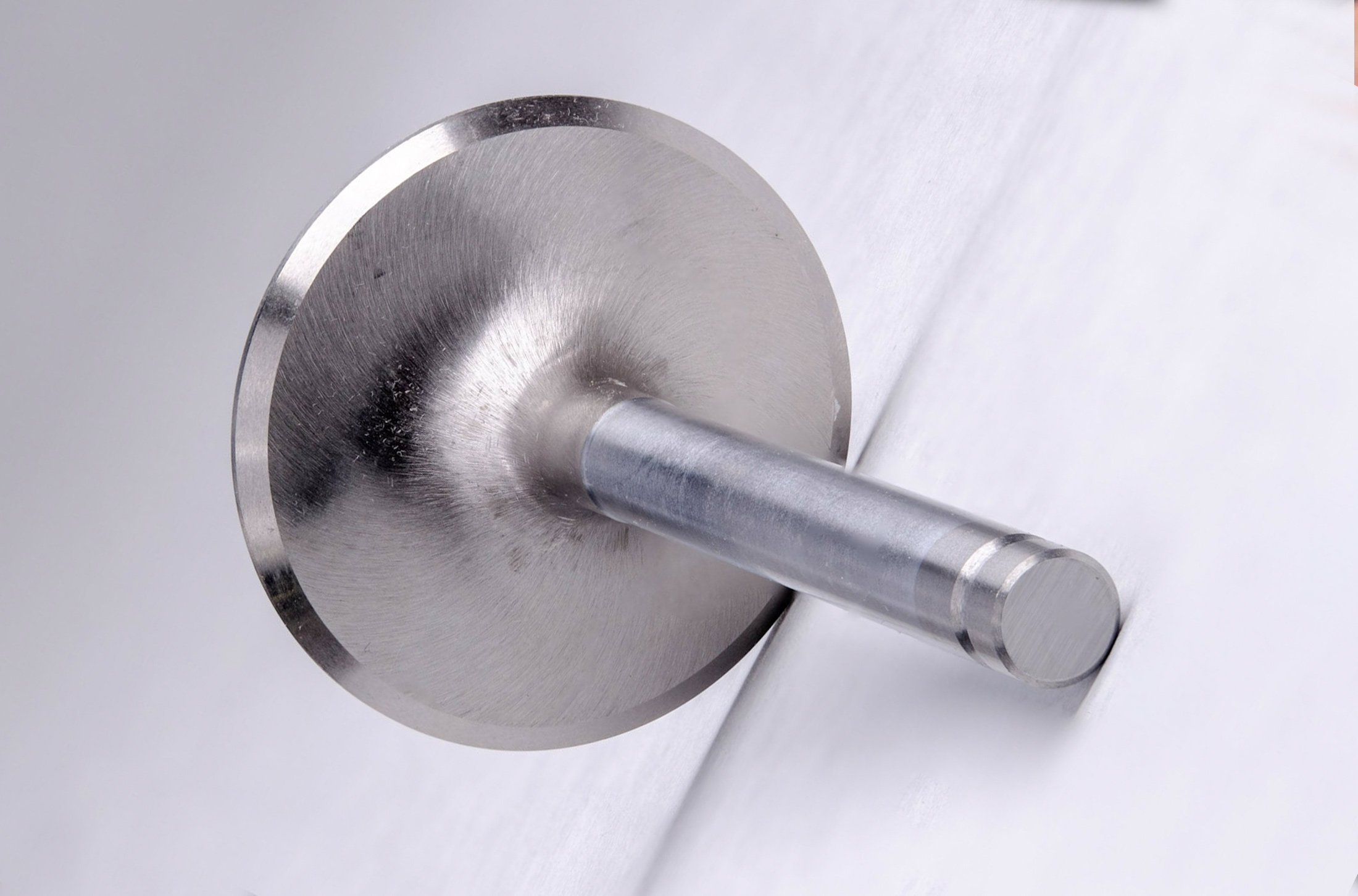
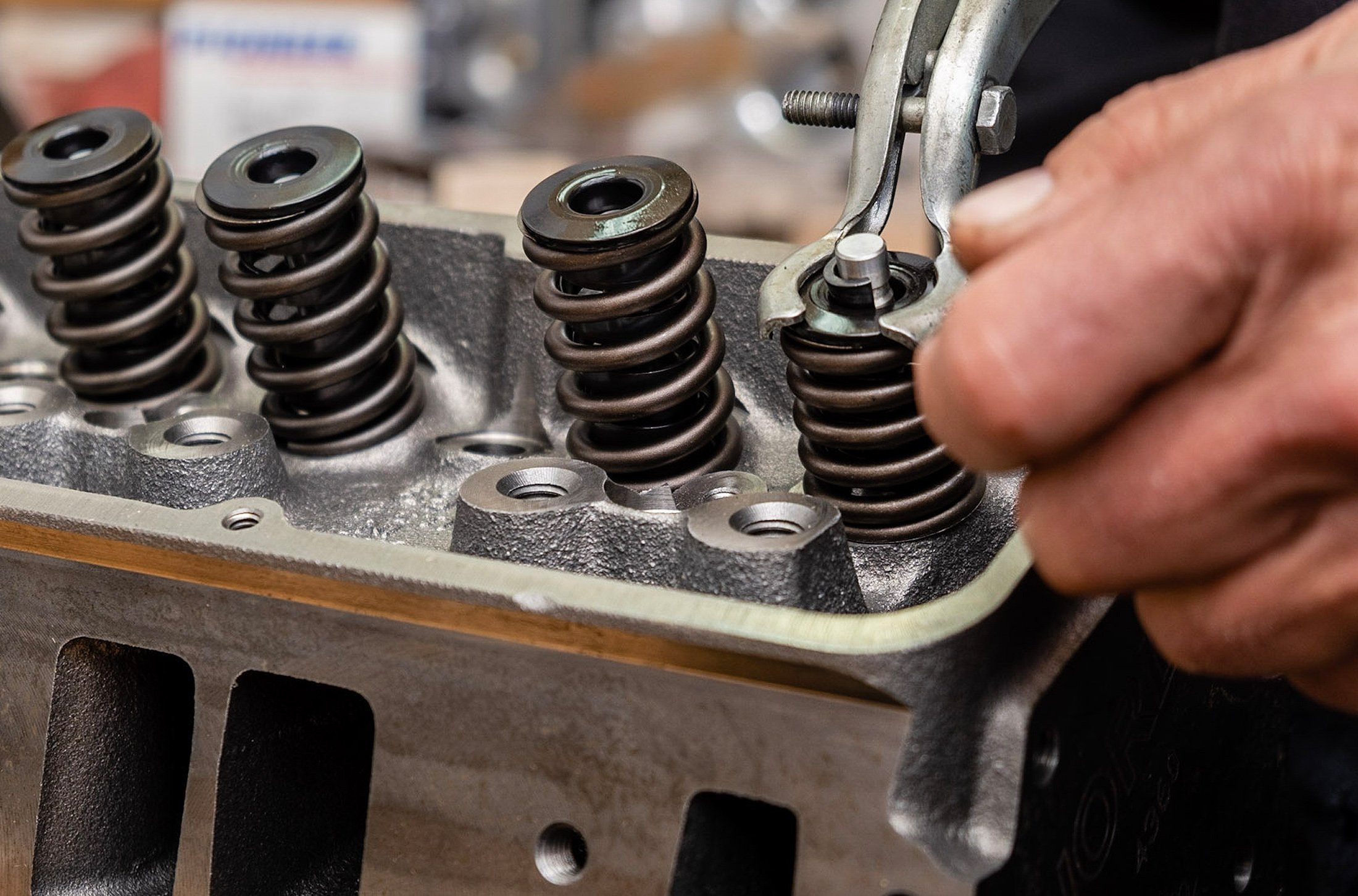
The stainless steel alloys used by Erson are designed for strength; this metallurgy making up these performance and all-out competition valves cannot be hardened. A hardened stellite material is welded at the tip or keeper area of the Erson valve. With this hard tip on each Erson valve, no lash caps are required.

McInnis noted, “There are two major factors when valve shopping for your racing engine application. At one end is the valve’s ability to take the heat from the combustion chamber. The other is the capability for the valve to handle your increased spring pressure as cam lift and RPM grow with more performance.”

Inconel Exhaust Valves

Another factor to consider with nitrous or high-boost engines comes into play when exhaust temps reach above the 1,600-degree (Fahrenheit) exhaust temperature range. There are two options for material within Erson’s top-level 1000-Series valve line: the previously described PS824 stainless and an Inconel material. This next-level Inconel material is used exclusively for the exhaust valve.
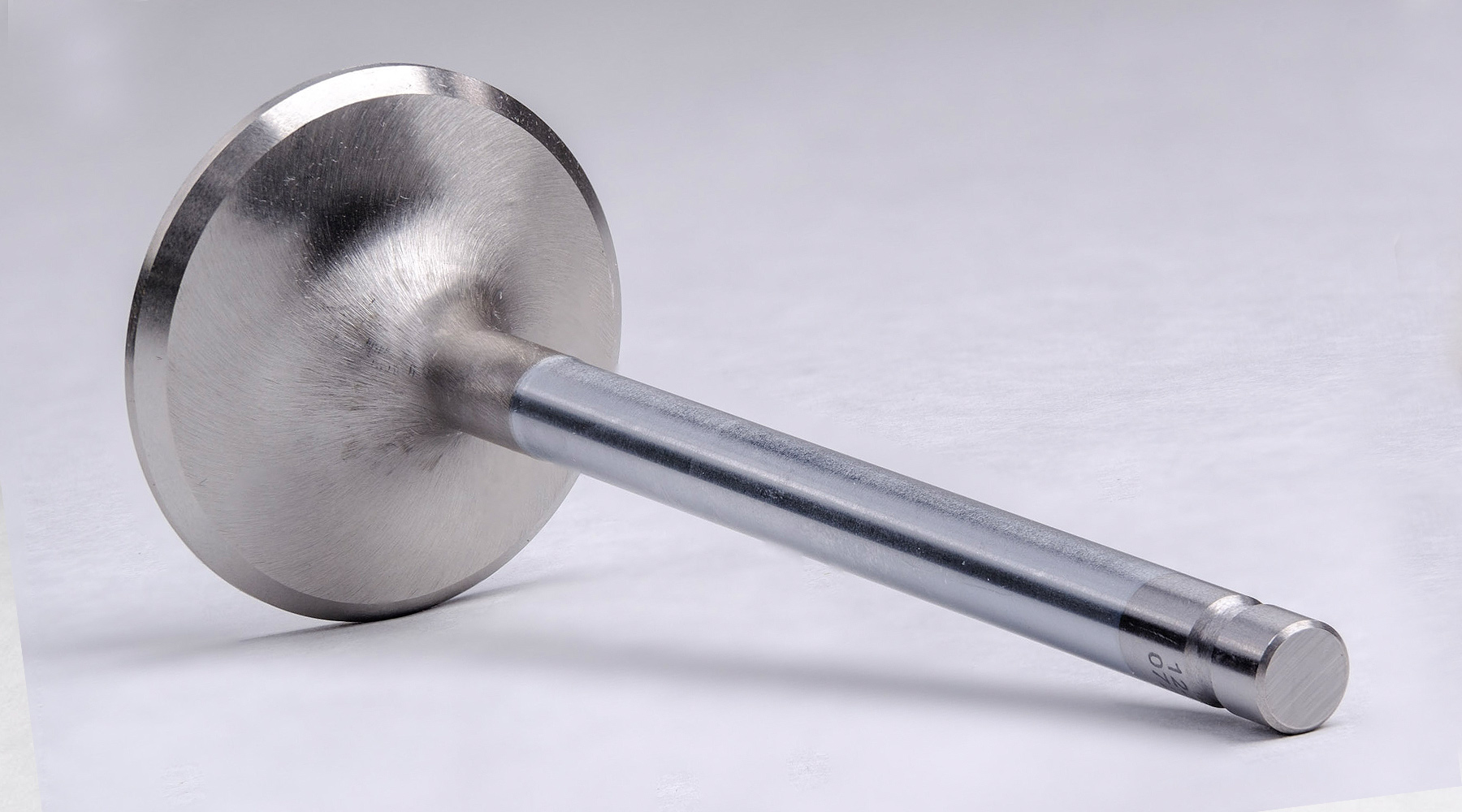
The Erson valves made from Inconel have an “intermetallic phase” that acts as a ‘glue’ within the microscopic grains of the metal. This metallurgy prevents those grains from increasing in size when subjected to high temperatures. This material integrity is what offers the valve strength at high temperatures.

“The Inconel material is termed a ‘superalloy’ because it actually gets harder and more durable as exhaust temperatures rise,” McInnis explains further. “But also take into consideration that you do not want to use Inconel valves if you are running a naturally-aspirated methanol or ethanol fuel because the cooler exhaust temperatures will result in a weaker exhaust valve.”

Unfortunately, this Inconel superalloy exponentially increases the price of the competition exhaust valve. But, if extreme exhaust temps are a factor, the Inconel material is your best friend.

Valve Stem Chrome Plating

Other specifications for the Erson lines include hard chrome-plated stems and hardened stellite material welded at the tip or keeper area of the valve. With this hard tip on each Erson valve, lash caps are not required.

The “hard” plating on Erson valve stems is a step of quality differing significantly from other racing valves using what is described simply as a standard chrome or “flash-chrome” plating process. The different plating process on the valve stem as defined by the American Society for Testing and Materials (ASTM,) is basically broken down by the thickness of the chromium material applied.

“Enthusiasts should understand the difference between flash-chrome and hard-chrome, as it is applied to the valve stem,” McInnis added. “Quality valves should have a heavy hard-level chrome surface. This greater chrome thickness provides a stem finish on a microscopic level with little pockets that trap oil and adds far greater lubricity between the valve stem and guide.”
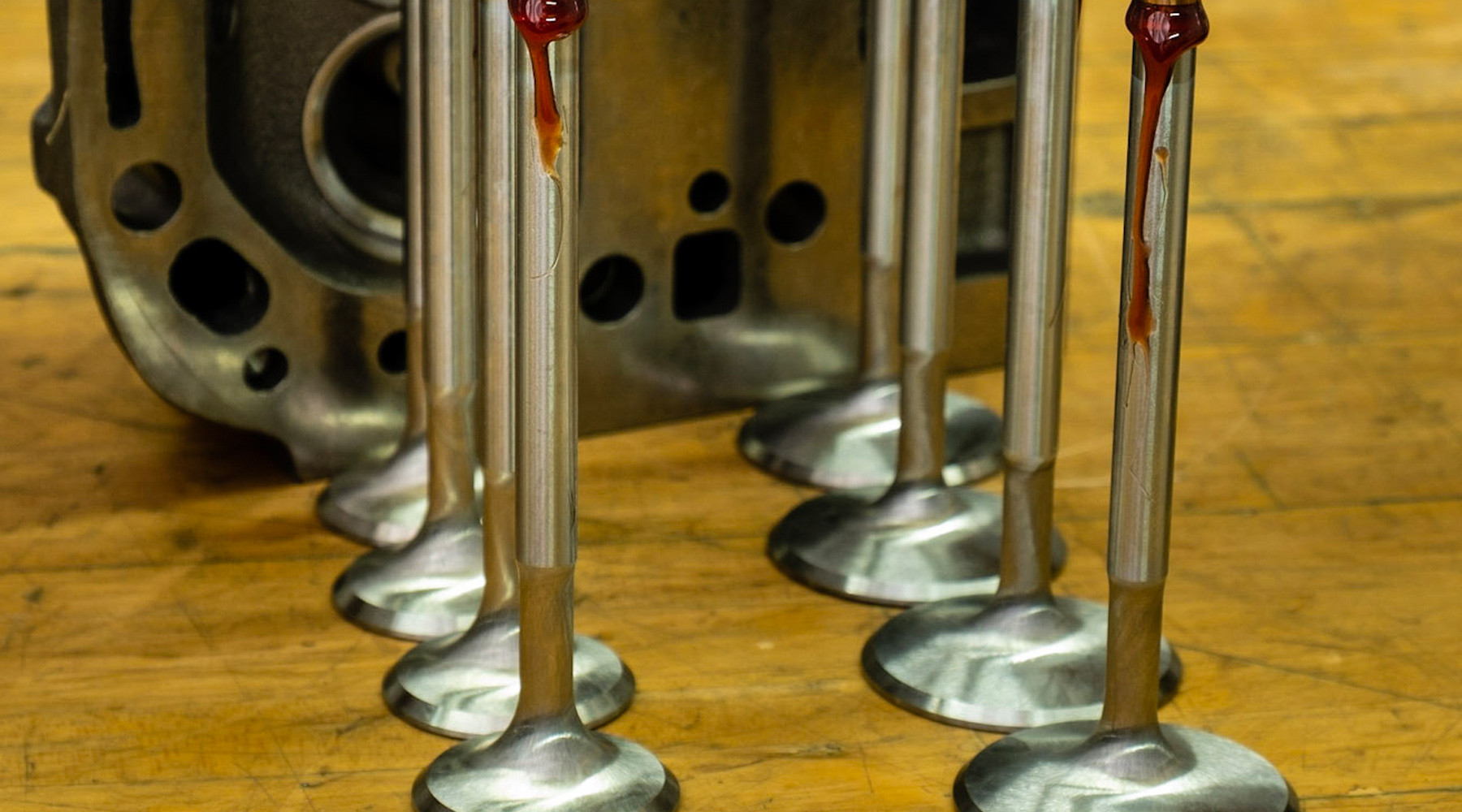
The ASTM defines “hard chrome” typically applied to the valve stem with a plating thickness range of 3- to 35-micrometers. Compare this to standard “chrome-plating” which is generally specified as a thickness in just the one-micrometer range. All Erson valves are hard-chrome plated.

Erson’s Undercut Valve Stem

The undercut valve stem implemented by Erson offers greatly improved airflow within the cylinder head port areas. All the Erson 1000- and 2000-Series valves are provided standard with this undercut design. The decreased diameter at the undercut could be an obvious failure point without the best in metals and machining processes.

The decreased diameter at the undercut stem is a big gain in flowability for all Erson valves. The trade-off could obviously be the failure point in this area. This need for strength is the reason why Erson metallurgical engineers design the valves with the best in metals and machining processes as a priority.

“The quality of the valve material used by manufacturers plays a vital role in the strength in that undercut area,” adds McInnis. “Unlike other engine components that can be hardened for strength, proper stainless alloys used in motorsports cannot be hardened; it is up to the material itself to be as strong as possible.”

Doing Your Racing Valve Homework

Learning these materials and hardening specifications may appear irksome. Still, as the comparative descriptions above cite, it can mean the difference between a reliable high horsepower engine and one that “drops a valve.”

“When it comes to valves used above the 800 to 900 horsepower range, some engine builders choose to use the higher grade Erson 1000-Series valves,” Mcinnis explains. The PS824 stainless used in these valves offers durability at higher RPM and offers higher strength at elevated combustion temperatures.

Material Knowledge Make a Difference

We have described many scenarios where one design of racing valves may be better for one application and not for another. Simply put, exotic or higher-priced valves may not necessarily be best for your individual hot rod or all-out race application.

Knowledge of materials and how different valve brands are created can spell the difference between a solid racing engine and a “dropped valve” that will wreak havoc with your pistons, rods, cylinder walls, and heads.

“We definitely credit our family of racing engine builders who send us feedback and offer ideas in proving our valve designs,” McInnis finishes. “Since we supply valves direct to racers and engine builders alike, it’s what makes our overall valve product lines our bread and butter.”

Posted on Leave a comment

What All Those Bolt Alloys And Numbers Mean

The world of high-performance engines is heating up. Average horsepower and engine RPM are on the ascent. Along with this newfound power are new demands placed on the most highly stressed engine component in any engine — the connecting rod bolts.

Think about the force exerted on a pair of rod bolts when the piston and rod assembly has to change direction at 7,000 or 8,000 rpm at the top of its stroke. When this change in direction occurs, the crankshaft yanks very hard on the connecting rod and piston. This action tries to separate the rod cap from the rod with thousands of pounds of force. The only thing preventing this is a small pair of high-strength rod bolts. This makes the material, the method in which these pieces are made, and how they are installed critical, as they are the most important fasteners in any engine.

Toward this end, Automotive Racing Products (ARP) has created a line of rod bolts made of various alloys of steel, intended to cover a wide range of high-performance applications. Making life easier is that each tier of bolts is identified by its alloy’s name. There are multiple ways to classify the strength of a fastener. Each of these terms is defined in the accompanying chart. We placed these definitions in the chart so they will be easy to find as you may likely need to refer to these several times in order to understand the complex relationships surrounding a fastener’s ability to withstand a load and its capacity to create a given clamp load.

Material Strength Definitions

Tensile Strength – (Ultimate Tensile Strength – UTS) – the maximum stress a material can support without breaking, expressed in pounds per square inch or psi. The term stress would be a load applied that applies a stretching force that is attempting to pull the bolt apart.

Yield Strength – the stress applied to the material that causes the material to begin to permanently deform – something engineers call plastic deformation. Beyond this point is where the deforming material will begin to fail.

Fatigue Strength – The ASTM defines it as a limiting value of stress after which failure will occur after a given number of cycles of load have been applied. The cycle count will depend upon the strength of the material as well as the load and the number of cycles applied.

Clamp Load – the amount of load applied to a fastener that will create tension on the fastener. Ideally, this load is a major percentage of the fastener’s yield strength. As the tightening load is increased (but still below the yield point), the clamp load will also increase.

Toughness – Toughness is the material’s ability to absorb energy before ultimate failure. Stated another way, toughness can be measured by the energy required to fracture the material.

Strength – a measure of the maximum stress a material can withstand before beginning to fracture.

A Threaded Spring

The classic way to describe a fastener is to think of it as a spring. As you tighten a bolt, it will begin to stretch. If you over-tighten it, the bolt will pull apart like a piece of taffy that’s been left in the sun, which will eventually lead to it breaking apart. The amount of force required to cause the fastener to fail depends on its material and how the fastener was constructed.

For example, ARP makes all its rod bolts by first starting with the highest quality material in rod form, and then creating the basic bolt shape. Once it is shaped, it is then subjected to a careful heat-treating process and then the threads are formed by squeezing the fastener between two dies that roll rather than cut the threads. By rolling the threads after heat treating (instead of before heat-treat) it creates a far stronger grain pattern. This makes it more difficult to form the threads and is harder on the thread rolling equipment but ultimately creates a higher quality rod bolt.

Ultimate tensile strength is often used as the measuring stick for bolt performance, but it is not the only judge of how well a rod bolt will perform. A higher tensile strength allows the bolt to be tightened more to create a stronger connection, but ultimately bolt performance in an engine is more closely tied to the fastener’s yield strength. This is really the factor that determines the amount of clamp load that can be applied to the bolt to retain the cap on the rod.

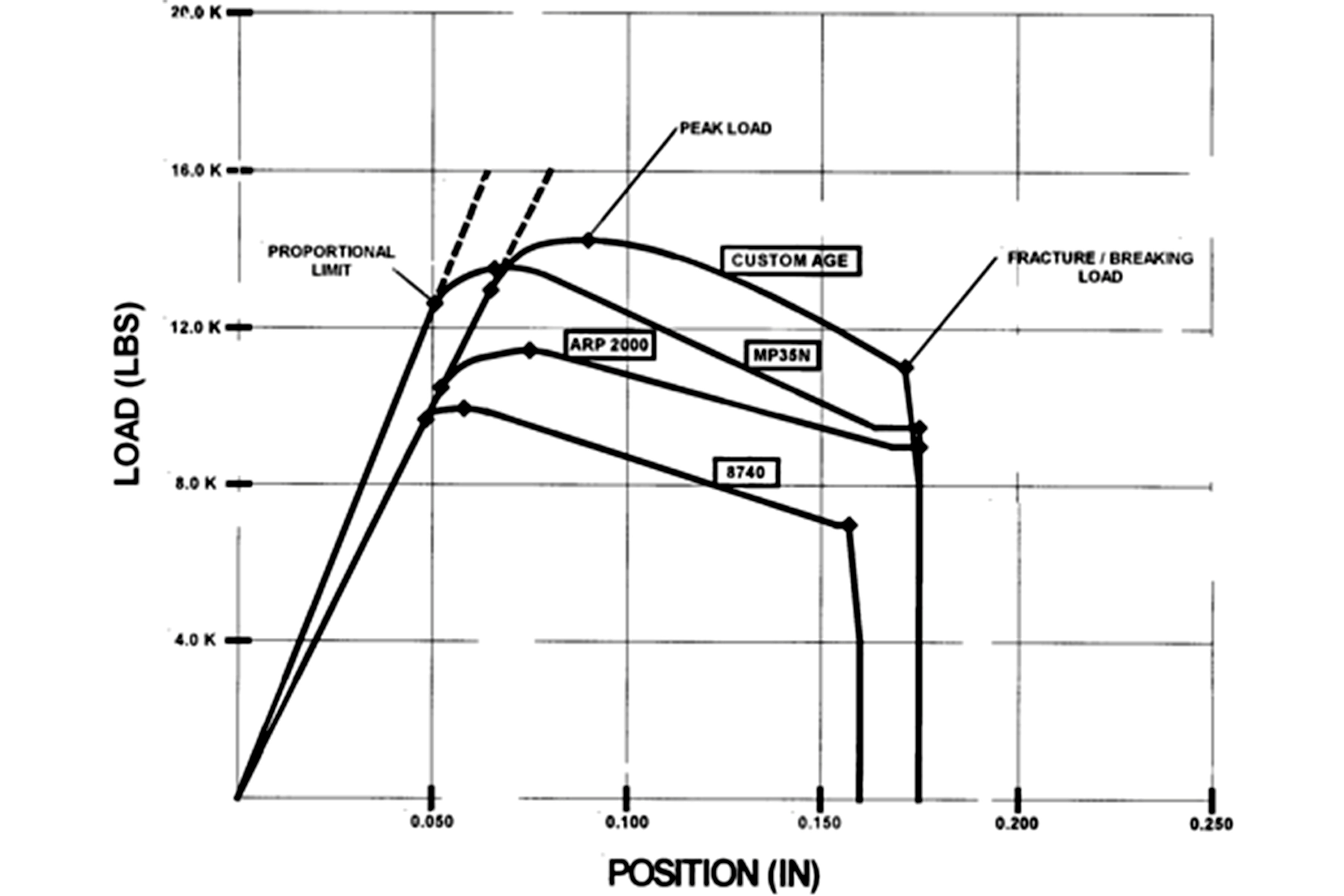
This is a graph created by ARP engineer Chris Brown that shows a strain curve for each of the ARP 8740, ARP 200, MP34N material, and the Custom Age 625. The proportional limit for each of these bolts is essentially the yield point of the fastener. ARP sets the stretch limit for its rod bolts at roughly 75-percent of the yield point. This creates an additional safety factor while still achieving the intended clamp load. Brown also points out that the “stretch” numbers across the X or bottom axis are off by a factor of 10. The number actually represents the movement of the fixture on the tensile test rig and not the actual bolt stretch numbers.

The ability of the fastener to withstand bending forces, often referred to as ductility, is another critical element. There are always bending forces present in connecting rods due to the cyclical forces created by the rotating mass. Generally speaking, as the ultimate tensile strength and yield strength increase, the higher quality material exhibits improved ductility. This can be seen in the wider spread between the tensile strength and the yield strength. This is not always the case with higher-strength materials, however.

Fatigue strength is another important component of a rod bolt and, while it is related to ultimate tensile strength, it is a separate evaluation. For example, the fastener could have very high tensile strength but it might be easily fatigued. In that situation, the bolt could fail after only a low number of load cycles. This, then, would not be a good material to use for a rod bolt.

Clamp load is defined as the amount of tension created to retain the rod cap on the rod. The clamp load must be sufficient to withstand the force generated by reciprocating weight and RPM that attempts to separate the cap from the rod. The size and tensile strength of the rod bolt needs to be sufficient to exceed the force that’s trying to separate the rod cap from the rod. This makes clamp load directly related to ultimate tensile strength.

Material Strength Ratings

Bolt Material Tensile Strength (PSI) Yeild Strength (PSI)
ARP 8740 190,000 180,000
ARP 2000 220,000 200,000
L19 260,000 200,000 – 230,000
ARP 3.5 220,000-250,000 260,000-280,000
ARP Custom Age 625 260,000-280,000 235,000-255,000

Putting All Those Figures Together

It might appear that the best move would be to use the highest quality rod bolt for even the most common engine build, but that would be like using $20 per gallon race gas to power your lawn tractor. While the high-quality components are good at what they do, it’s not the best use of limited funds while offering only limited advantages. Estimating when it would be better to use an ARP 3.5 bolt over an ARP 2000 can be a complex question with no simple answers due to the number of variables.

The standard consideration for choosing a high-performance rod bolt often looks at engine speed as a consideration when evaluating the strength of a rod bolt. The reality is that there are many more factors besides the engine speed, including the reciprocating weight of the piston and rod, as well as connecting rod design factors, and a host of other variables. The reason that RPM is so important is illustrated in the ARP catalog with an equation where the force created by the reciprocating weight is multiplied by the square of engine RPM.

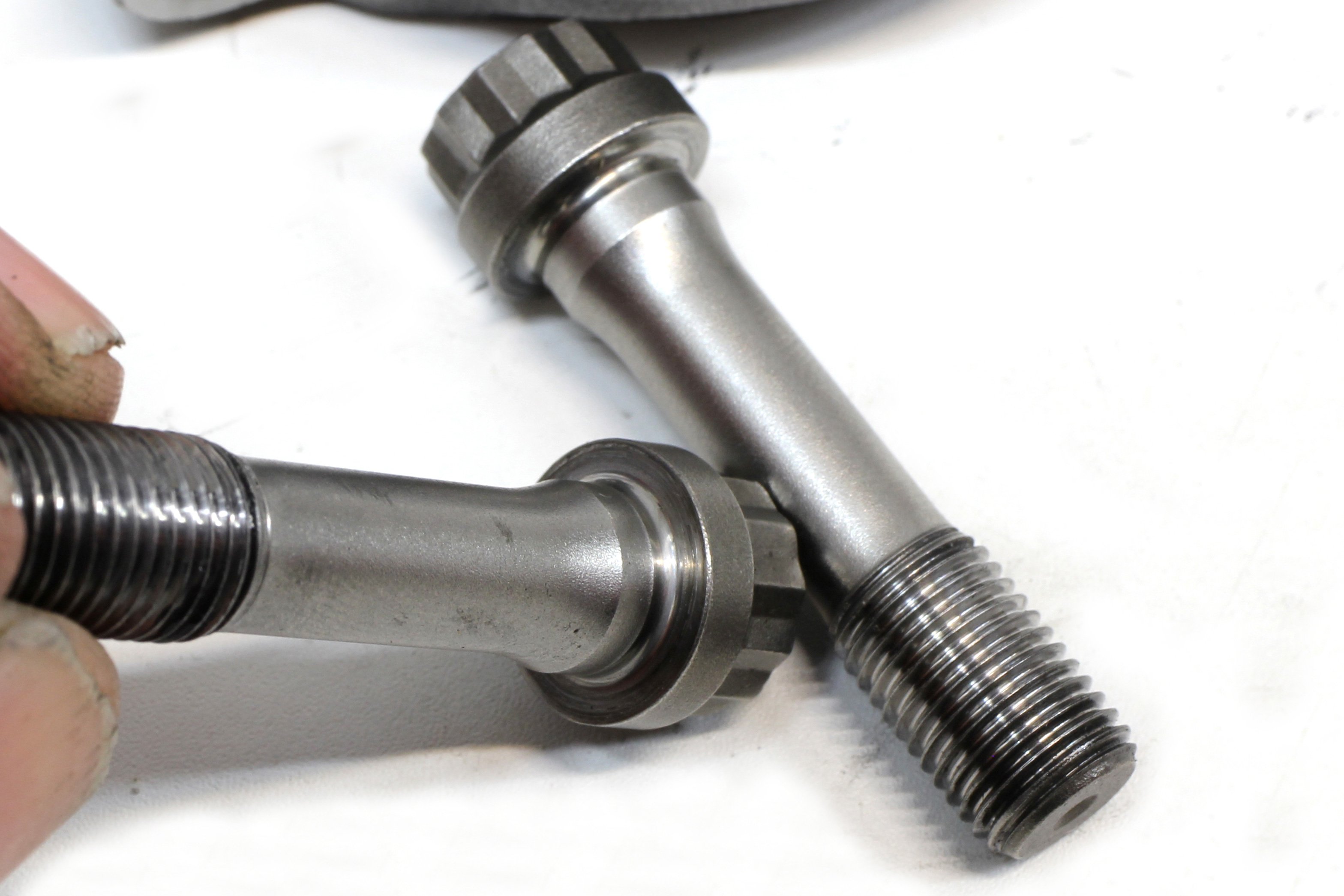
Among the critical points on any rod bolt is the radius underneath the bolt head. This is where the rod bolt’s maximum stress will be concentrated. A sharp corner will create stress risers that can quickly fail the bolt. A properly designed radius greatly increases the bolt’s overall ability to withstand a high-tensile load.

This makes it clear then that doubling the engine speed from 4,000 to 8,000 rpm would increase the force that pulls the rod cap off, generated across top dead center, by a factor of four. So doubling the speed would quadruple the force on the rod bolts. ARP’s approach is to calculate the load for a particular rotating assembly with one fastener and then use two that would safely retain the load. This offers a very secure safety margin.

This is why ARP recommends that if you have an atypical application for a rod bolt, it is best to call their technical department for guidance rather than merely choose a fastener based on a vague knowledge of metallurgy or a magazine story. It’s better to let the professionals calculate the best fastener material for that application.

The best way to ensure that the rod bolt creates the optimal clamp load is to tighten the bolt to ARP’s recommended stretch limit. This not only creates the ideal clamp load but also allows the bolt to be reused multiple times since the stretch spec is just below the bolt’s yield point. Unfortunately, many bolts require using fastener torque to estimate stretch, as opposed to actually measuring stretch itself.

The Key Parameters

Much of the discussion in this story revolves around tensile strength and the yield point. The rule of thumb for fasteners is that the yield point occurs at 90-percent of the ultimate tensile strength. According to Jay Combes at ARP, this ratio will change depending upon the alloy. You can see this effect in the ARP illustration between the yield point and the peak of the curve.

Returning to the bolt-as-a-spring analogy, the ideal situation is to tighten the fastener to a point just below the bolt’s yield point. This is just like stretching a spring to its normal extension. When the load is relaxed, the spring returns to its normal relaxed length. If we over-stretch the spring, the metal deforms (what the metallurgists call plastic deformation). Once that occurs, the spring is permanently damaged and will eventually fail where the deformation took place.

The same situation occurs with a rod bolt. The best way to create the ideal tension and clamp load on the connecting rod cap is by tightening the bolt so that it does not exceed its clamp load. ARP creates a stretch number to achieve that load while still offering a safety margin that does not exceed the yield point of the fastener.

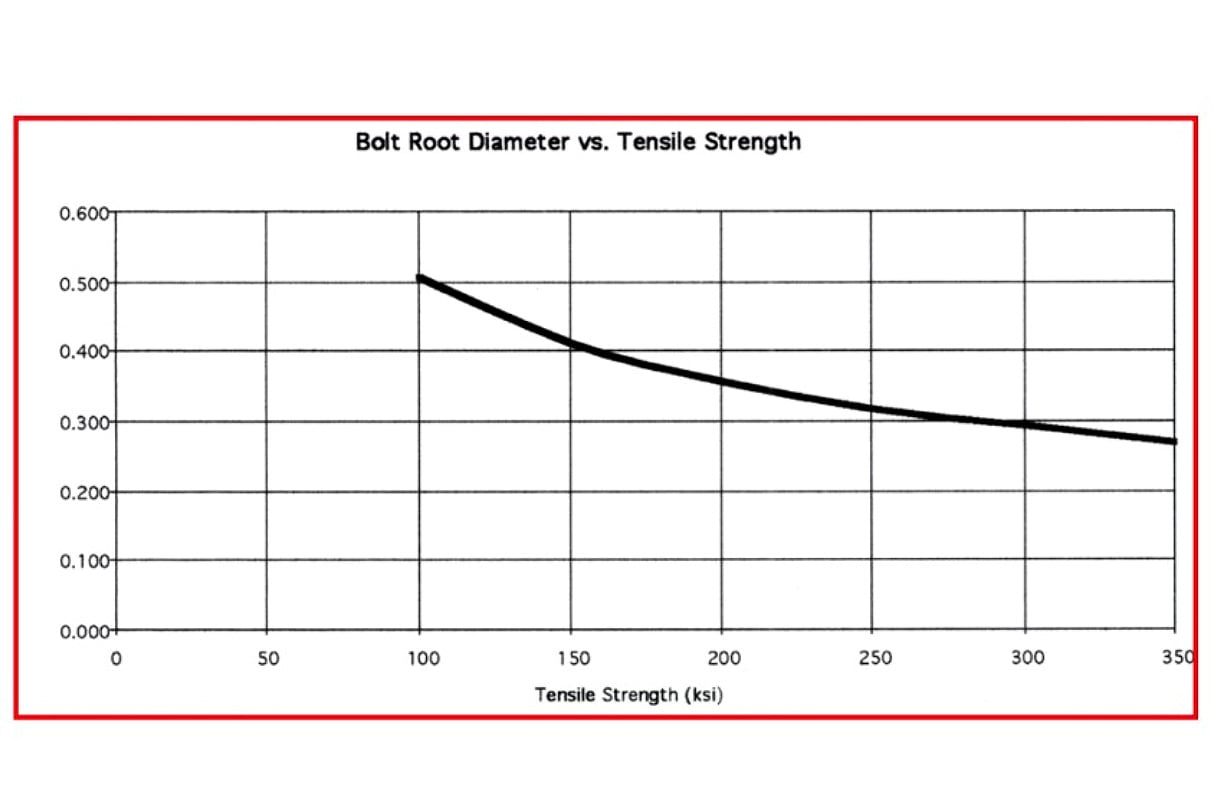
The ARP chart shows the relationship of the thread root (minimum) diameter of the bolt versus tensile strength as measured in “ksi” which is kilo-pound force per square inch. 1 ksi = 1,000 psi. In this example, a 0.400-inch root diameter requires a 150, ksi rating while a bolt with a 300 ksi rating only requires a root diameter bolt of 0.300-inch. In other words, a stronger material allows the use of a smaller bolt with no loss of strength. This is the benefit of using a stronger bolt.

By creating this maximum clamp load on the rod cap, it holds the rod cap in place under all of the loads acting on it. In the past when loads were not as severe as today, this clamp load was established by torquing the rod bolt in place. The ideal torque value is generated through an estimate of the friction necessary to tighten the fastener enough to achieve the desired amount of stretch imparted into the fastener. If the torque value is too low, the clamp load is insufficient and the rod cap itself will fail. If the torque load is excessive, this stretches the bolt past its yield point, which is almost guaranteed to cause the bolt to fail.

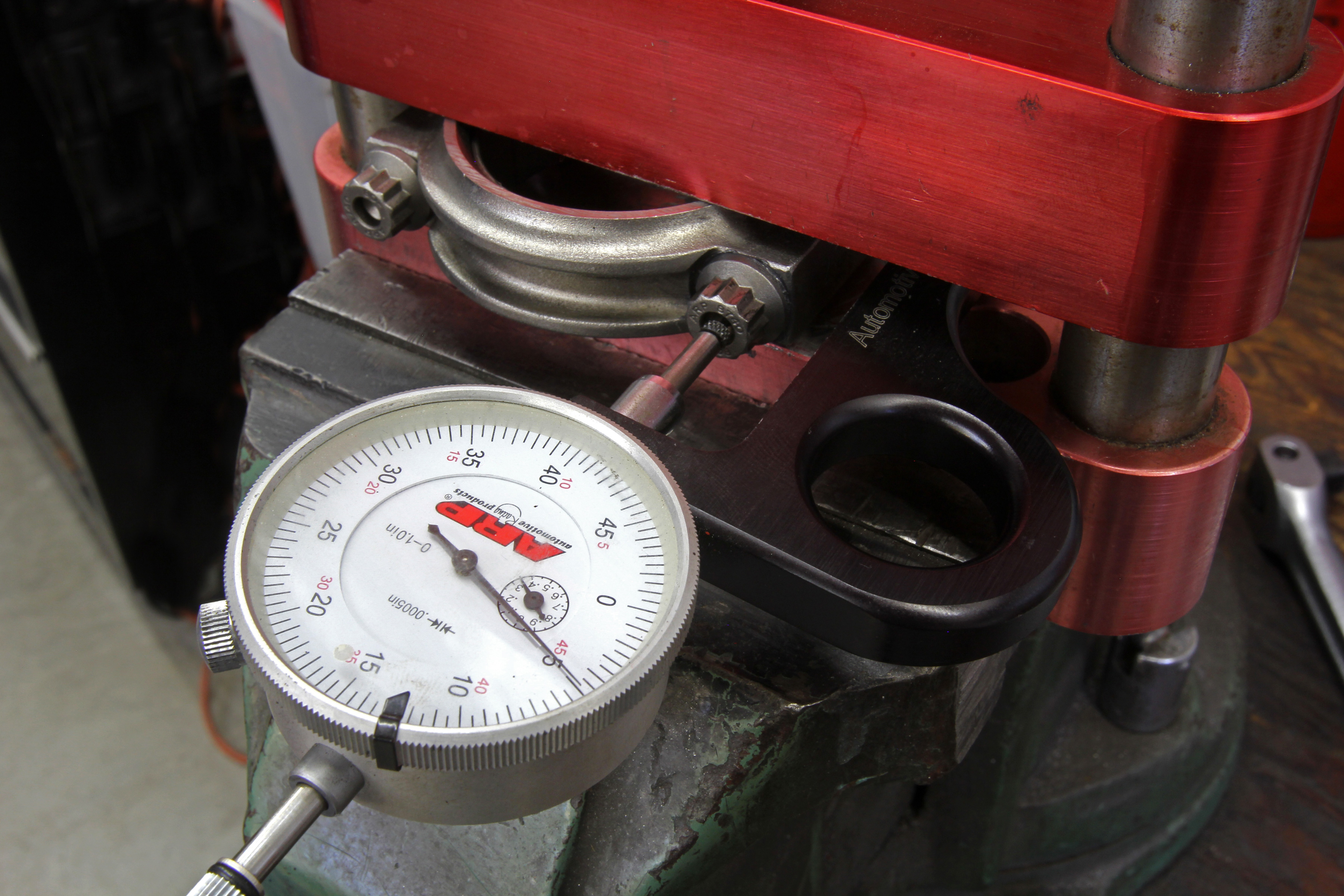
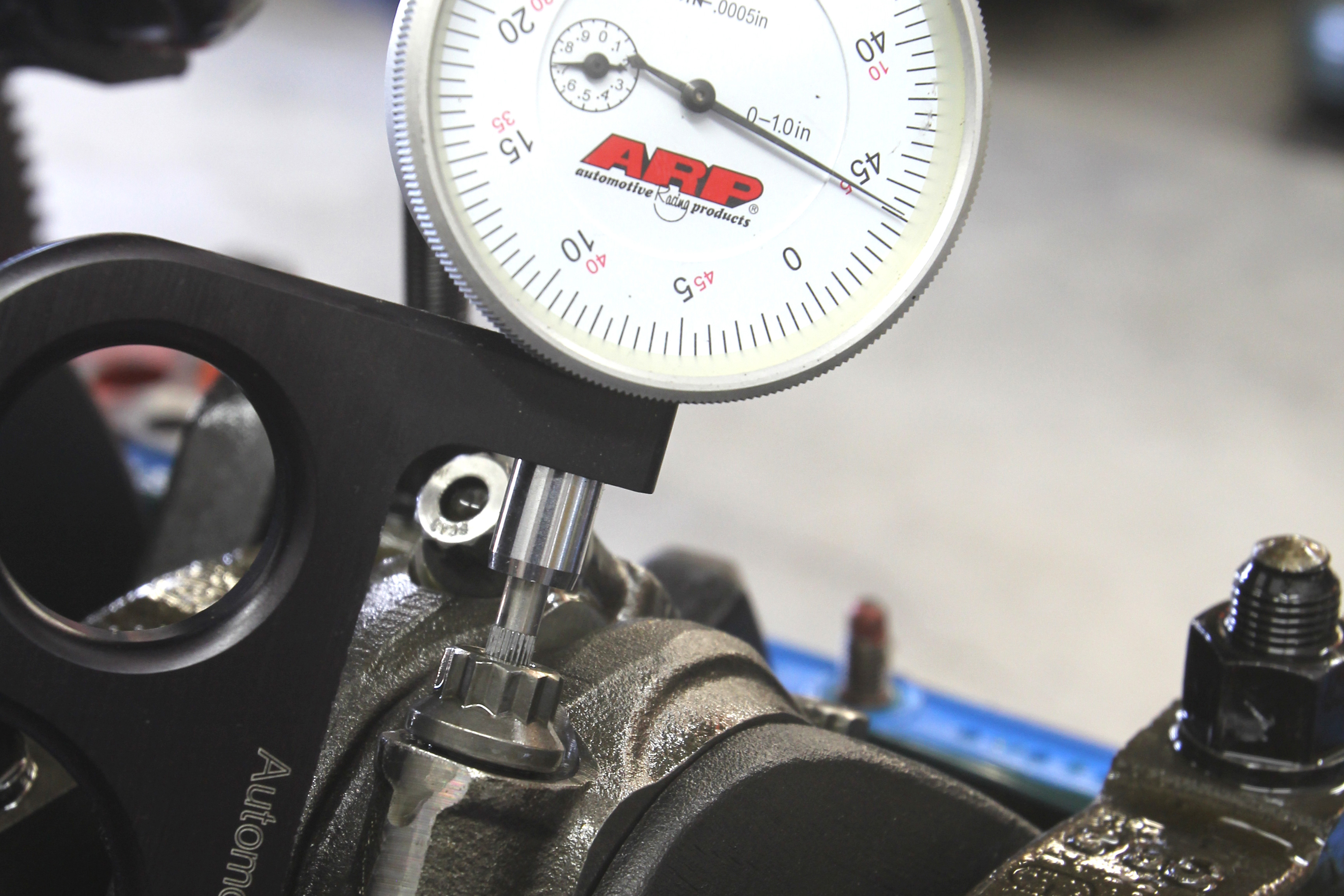
With so many variables present when applying torque to establish the proper load on the bolt, the best way to establish the proper tension on the bolt is to use a stretch gauge. Through testing for a given diameter, design, and length of the rod bolt, ARP will create a specific stretch value for that bolt. The design of the bolt plays a big part in stretch since the length of the undercut in relation to the under-head length will affect this stretch value as well as the material.

We experimented with an ARP big-block rod bolt by applying torque to the required specs of 55 ft-lbs using engine oil as a lubricant. We then zeroed our stretch gauge and loosened the rod bolt. As you can see, the bolt stretch was only slightly more than 0.004-inch. The ideal stretch for this bolt is 0.0055 to 0.006-inch. This illustrates why using a stretch gauge is far more accurate, creating an optimal clamp load.

As an example, let’s take a 3/8-inch ARP 8740 rod bolt for a big-block connecting rod. The bolt, in this case, is P/N 135-6002 where ARP specifies a rod bolt stretch figure of 0.0055 to 0.0060-inch. If we wanted to upgrade to a stronger ARP Pro Wave 2000 bolt for this application, the different material bolt requires a different stretch value. In this case, that would be 0.0065 to 0.0070-inch. This would create a much higher clamp load to withstand a greater tensile loading.

There is much more to the metallurgy and design of even the entry-level 8740 ARP rod bolt than we can cover in this short story. Perhaps the most important point worth repeating is that even the best-designed and machined fasteners can still fail if not installed correctly. So once you’ve decided on the best bolt for the engine, it’s critical that these be installed correctly. The combination of a high-quality bolt installed properly is the best insurance policy you could write up for your engine.


Posted on Leave a comment

Understanding How Brushless Fuel Pumps Work

The fuel system of a racecar is the gatekeeper to how much power it can make. Careful thought needs to go into each part of the fuel system and the fuel pump is the star of the show. Brushless fuel pumps are a great way to build a strong fuel system since they’re super-efficient and are sized to fit in the tightest of spaces around a vehicle.

Each fuel system is going to be different since every application they’re used in will have its own requirements. An EFI or carbureted engine can benefit from a brushless fuel pump providing its go-go juice, but a lot of people might not understand what these pumps bring to the table. So we sat down to chat with Rob Scharfenberg from Fuelab to learn more about brushless fuel pumps and the advantages they provide.

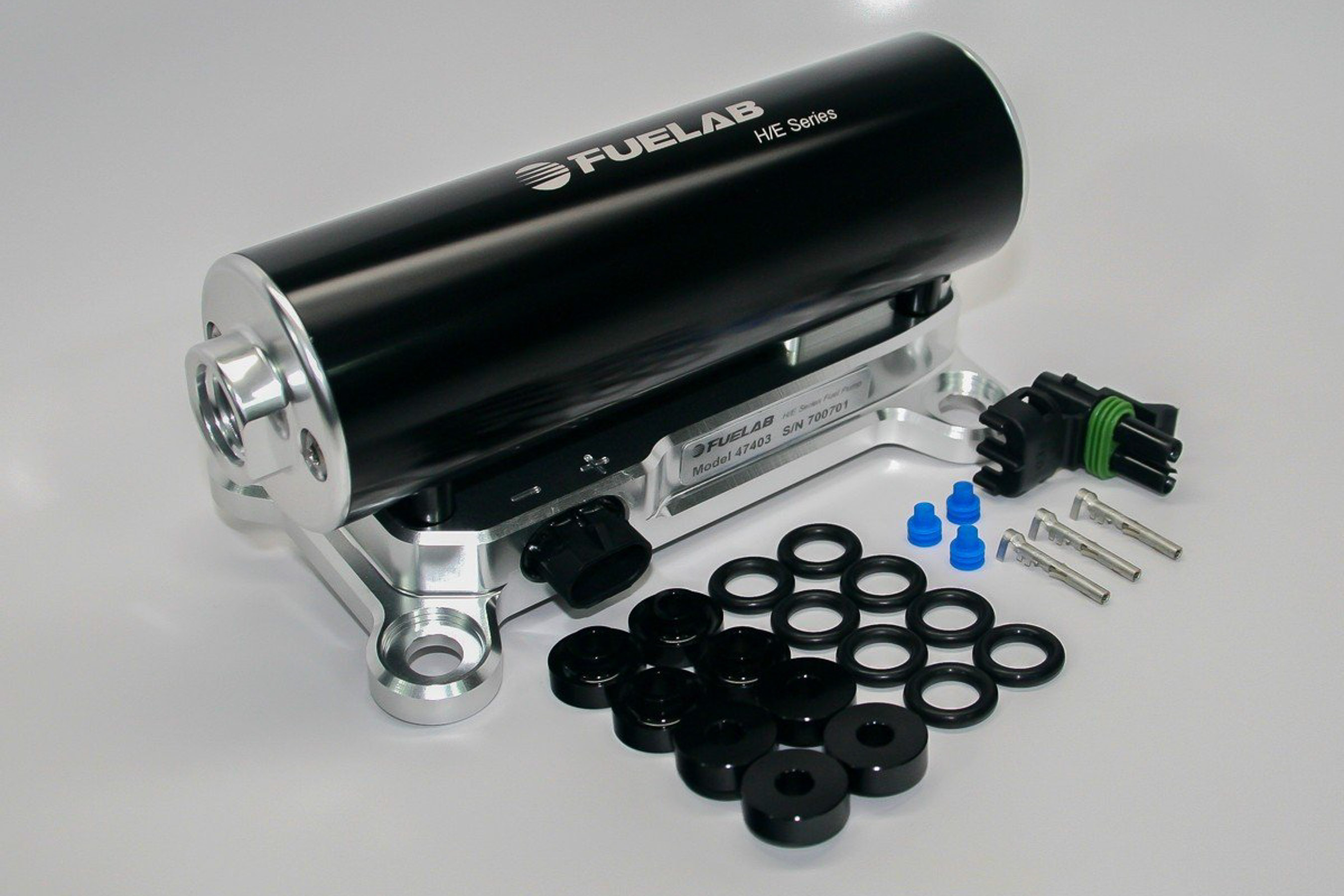
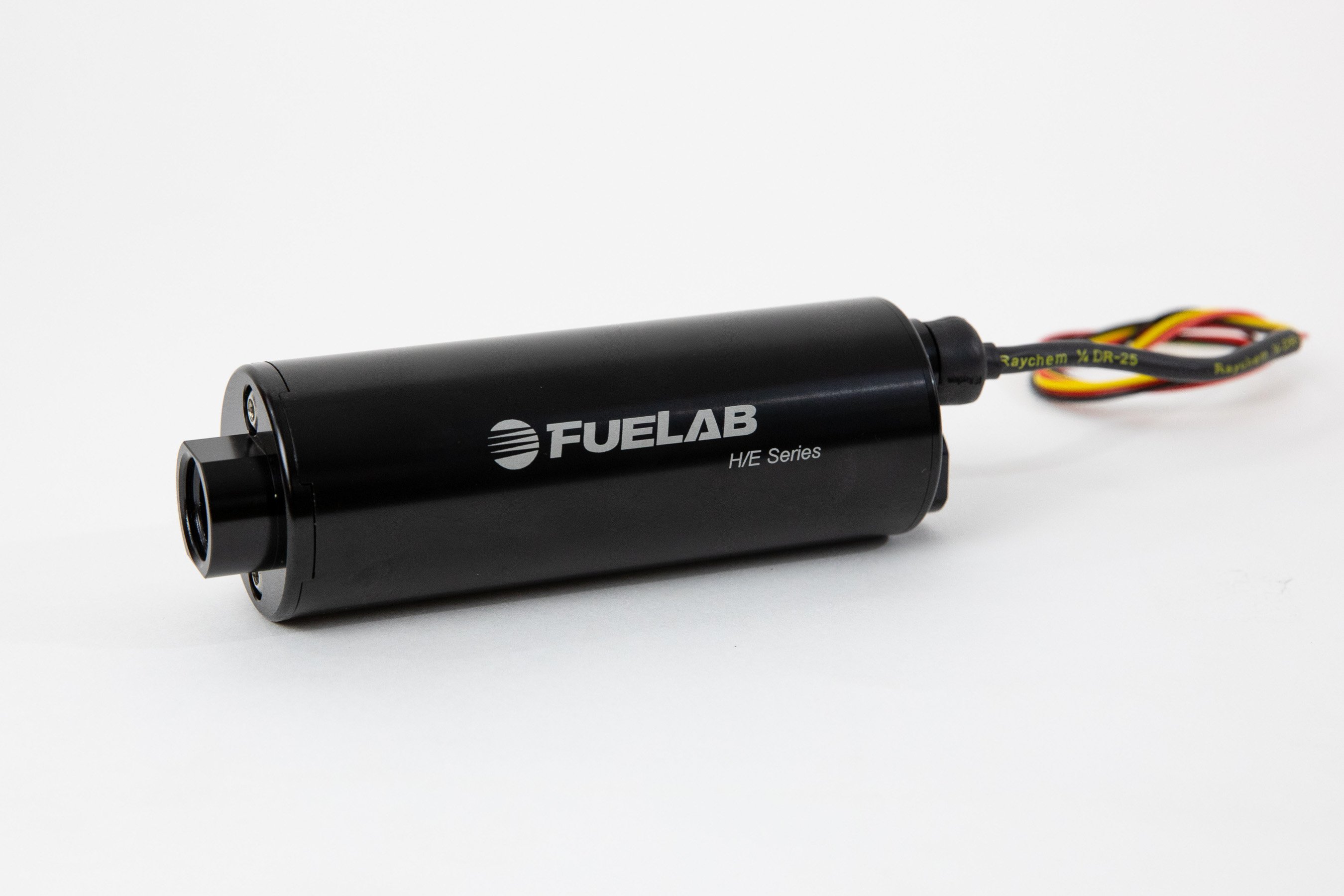
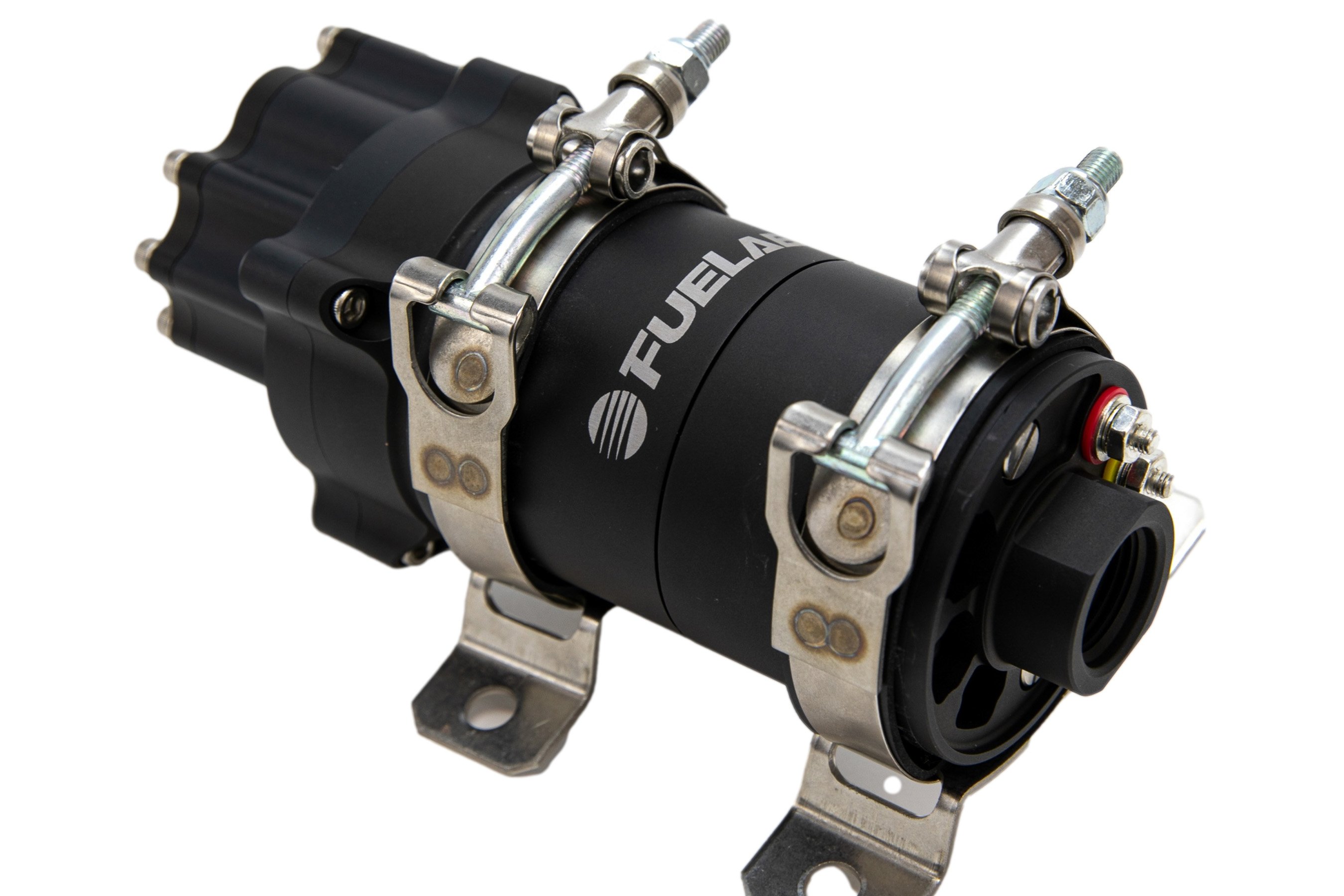
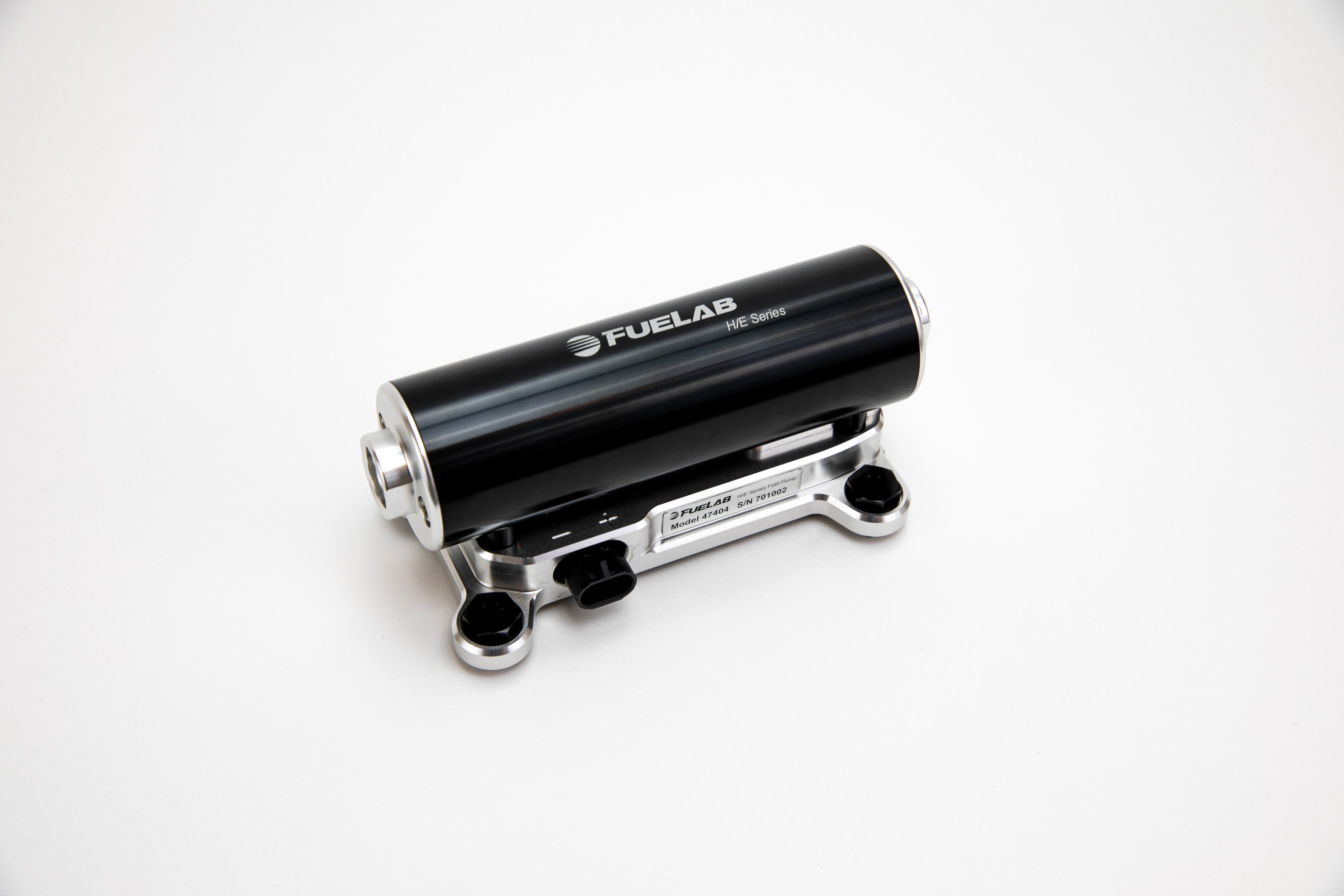
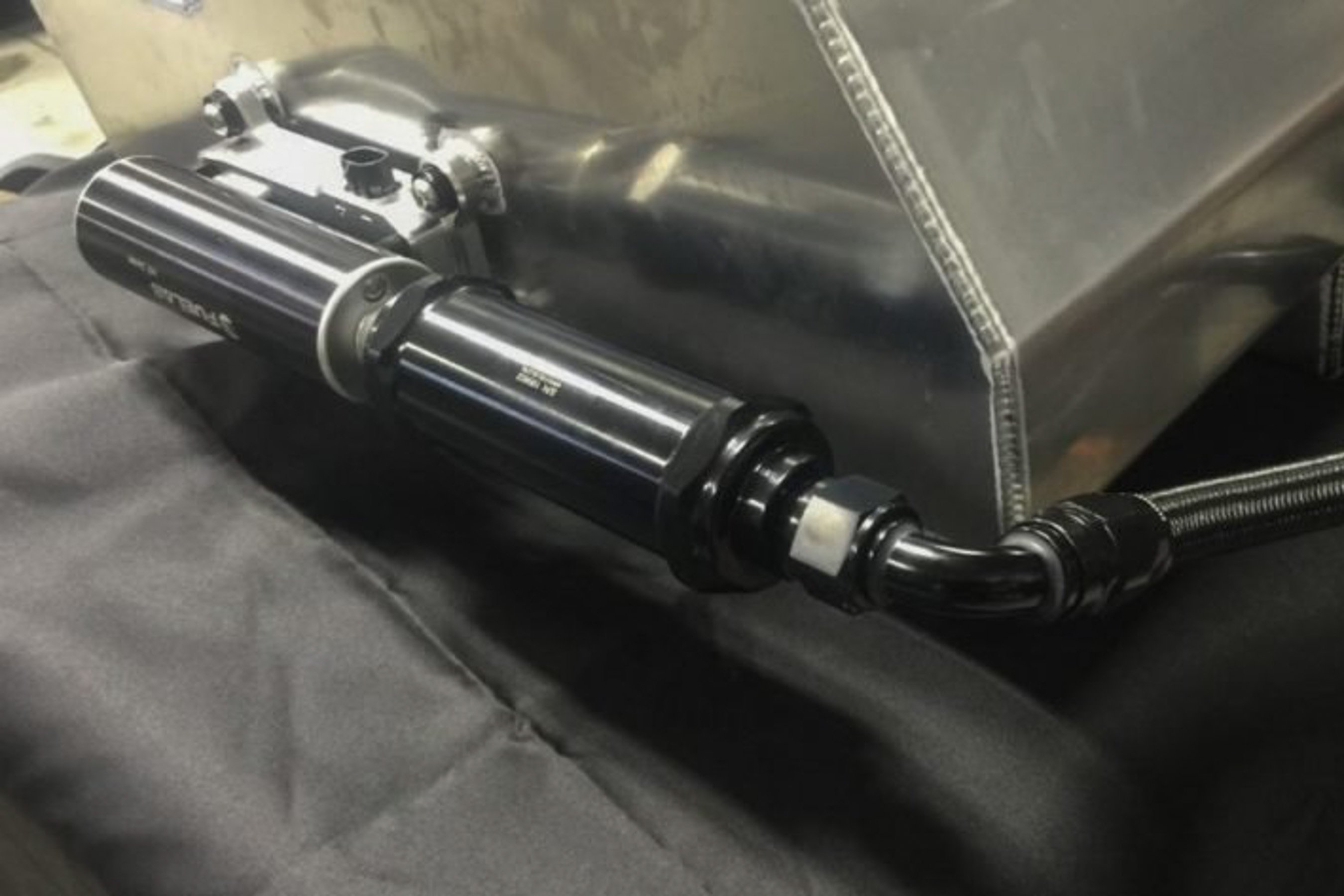
Brushless fuel pumps come in a variety of sizes and configurations — this makes them a very versatile fuel pump that can be used in different applications based on fuel demand and mounting space.


Brushless Fuel Pump Basics

Brushed motors operate in an entirely different way than a brushless motor, so it’s important to understand how a brushed motor works to see the difference.

A brushed electrical motor has brushes that keep the motor turning through the process of changing the direction electricity flows through the wire windings of the motor. The magnetic force that’s created by this process is what propels the electric motor. The brushes are interacting with the commutator on the motor and this is what allows the electricity to change directions.

Brushless motors use a totally different structure than a brushed electric motor, and Scharfenberg explains in what ways this is the case.

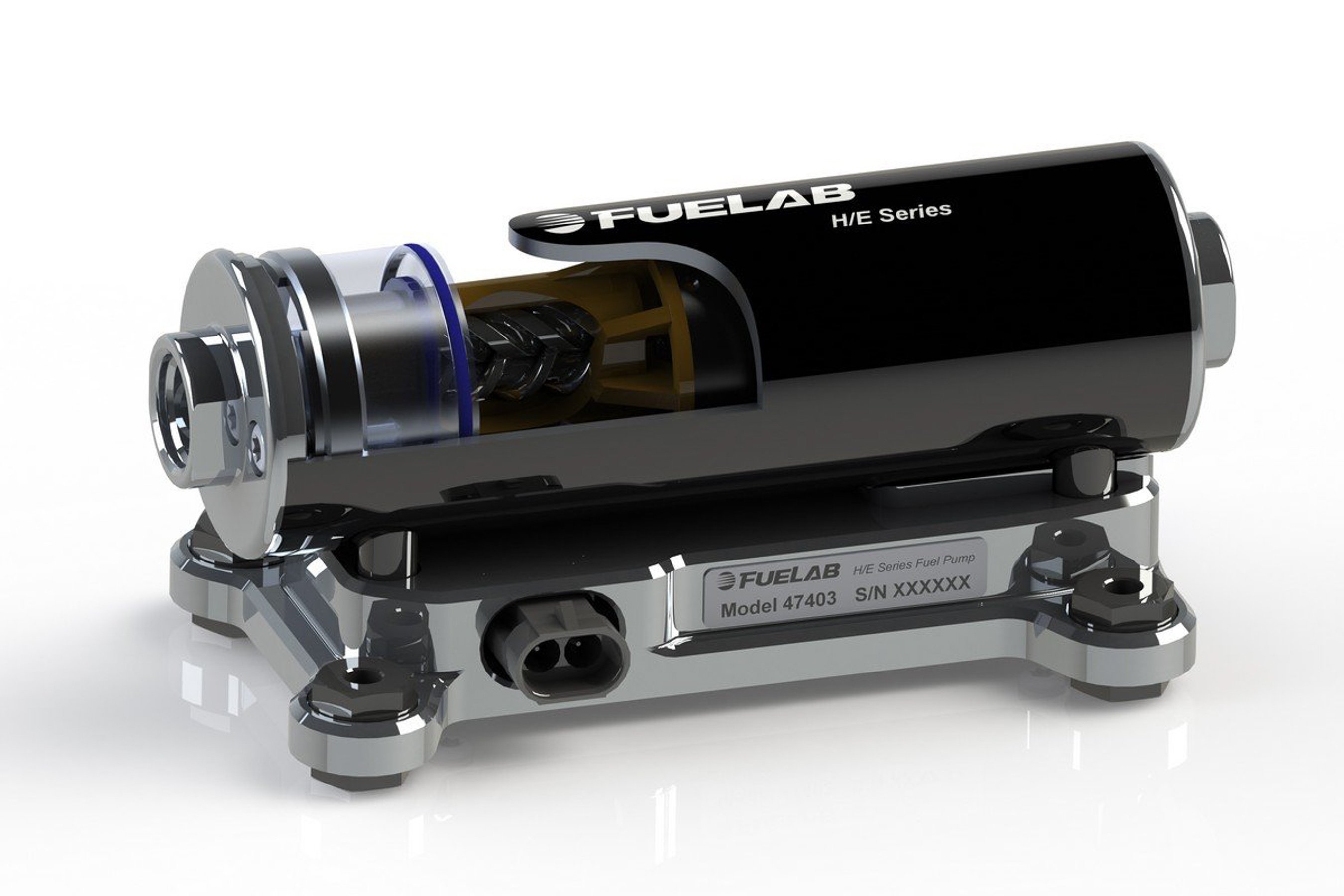
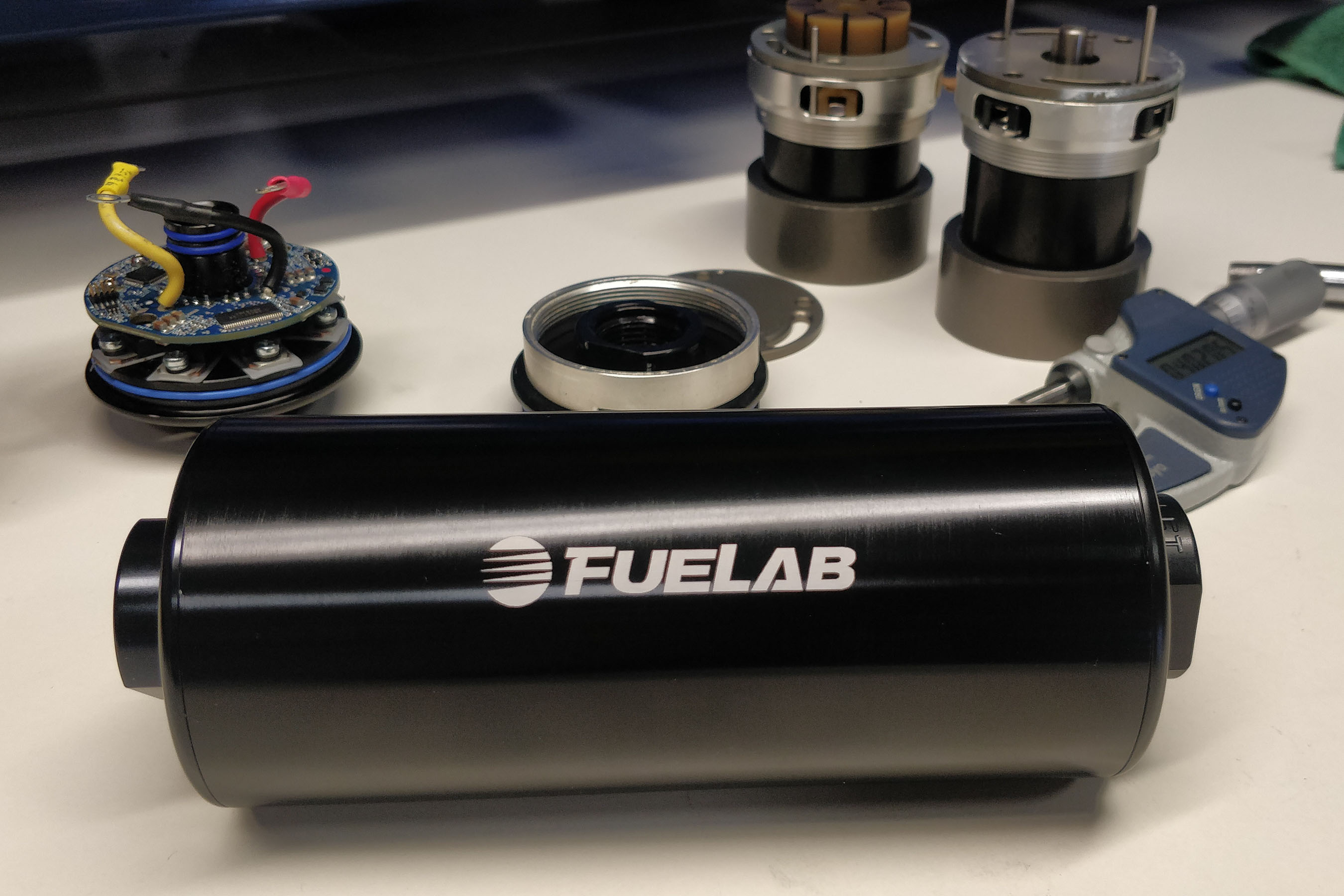
The brushless fuel pump has a totally different structure and design than a typical brushed fuel pump. These pumps are more efficient and have a smaller footprint.

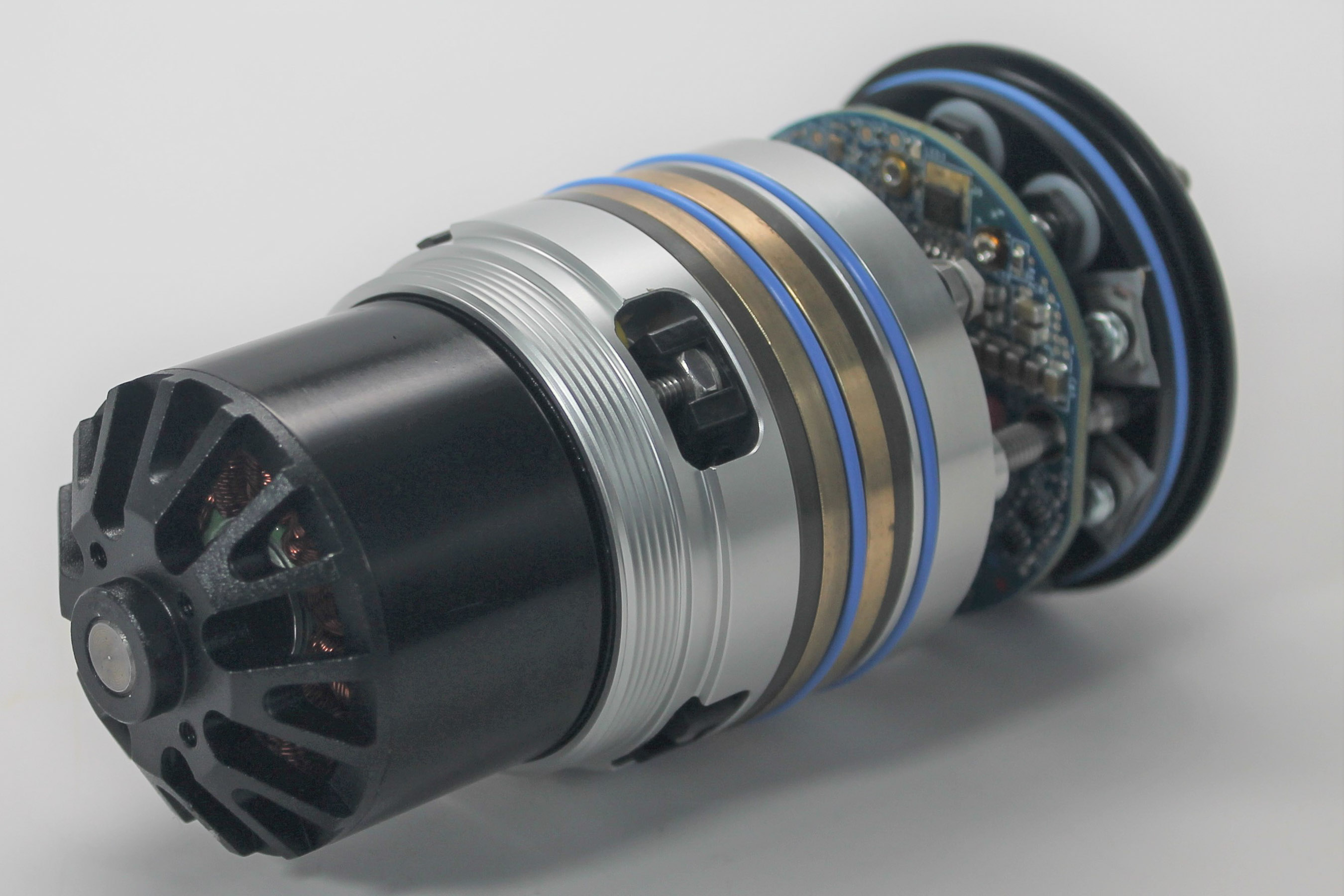
“A brushless motor has more of a ‘flipped’ structure compared to conventional DC Brushed motors, wherein the magnets rotate with the windings being stationary.  Electronics are required to commutate or change electrical flow within the windings to allow the motor to rotate.  The electronics used for such assembly can be advanced enough to allow variable speed to occur upon signal input from the outside world.”

The electronics required by a brushless fuel pump are different from what a brushed fuel pump needs, as well. The brushless fuel pump’s electronics might also require a special mounting location based on the application.

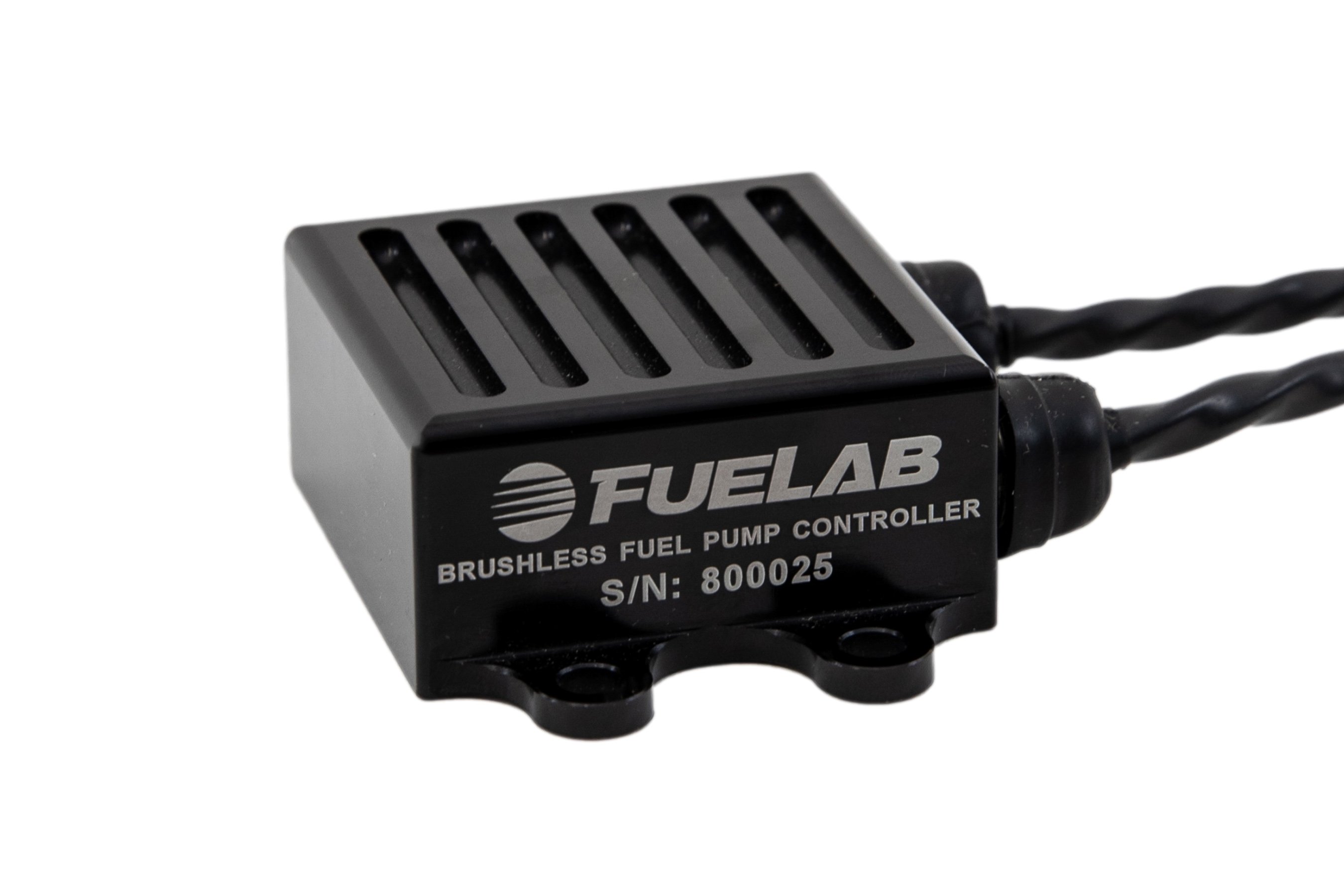
“The electronics controls what current goes into the different motor windings in the brushless motor. The electronics need to be there to control the entire system. These electronics are what go in between the power going into the motor and the motor phase wiring. Typically, you’ll see the external controller when you want to keep the electronics on the outside of the fuel tank,” Scharfenberg says.

Having a greater efficiency has the biggest benefit, it allows for a lower current draw and less heat to be added into the fuel system itself. – Rob Scharfenberg, Fuelab

The most important part of the electronics required to run a brushless fuel pump is a speed controller feature. A speed controller is the brains of the pump and it controls how fast the pump needs to spin; as the engine requires more fuel, the pump can be commanded to move faster, to flow the required amount of fuel by the ECU or other means. This technology is part of the reason a brushless fuel pump is so efficient: it makes sure the pump is running wide open constantly.

A brushless fuel pump doesn’t use any type of radical flow system to move fuel — these pumps actually take on all the same forms of a brushed fuel pump. This means you don’t have to worry about how the pump will move fuel since it’s available in a screw-style pump, a positive displacement-style pump, and even a turbine-style pump.

The electronics used to control a brushless fuel pump are more advanced than a typical brushed fuel pump. These pumps are capable of flowing more fuel while using less current thanks to their electronics.

The Advantages Of A Brushless Fuel Pump

Now that you know a little bit about brushless fuel pump basics, the question needs to be asked, why should you think about getting one? The brushed electric motor has been around for a very long time and its abilities have certain limits — that’s where the brushless fuel pump can help.

A fuel pump with a brushless motor is going to have several distinct advantages over a fuel pump with a brushed motor. The biggest of these is how efficiency. We talked about earlier how the electronics allow a brushless fuel pump to match the pace of the engine in fuel delivery, and that makes it highly efficient.

One of the advantages of a brushless pump is we can get a lot of power out of a system and reduce the size of the packaging. -Rob Scharfenberg, Fuelab

“Having a greater efficiency has the biggest benefit — it allows for a lower current draw and less heat to be added into the fuel system itself. More power being transmitted to a fuel pump will turn into heat, and since a brushless fuel pump requires less power by being more efficient, it will generate less heat. The brushless fuel pump’s efficiency also makes it less taxing on the electrical system of the car,” Scharfenberg explains.

Brushless fuel pumps can be used with nearly any type of fuel.

Fuel pumps with brushed motors draw a lot of current and that means they’re going to generate a lot of heat as they run. A brushless pump is going to reduce the load on your vehicle’s electrical system and this also means the pump won’t be getting nearly as hot. A pump that doesn’t get hot thanks to less current draw has a unique benefit — it’s not going to transfer nearly as much heat into your fuel as your vehicle runs for extended periods of time.

“The lower the amount of current draw, the less heat that goes into the system,” Scharfenberg states. “It helps with the overall reliability of your fuel system because if your fuel gets too hot, it becomes prone to cavitation…a vapor lock type of condition. If your fuel is exposed to additional heat, it can lead to a loss in fuel pressure and a host of other issues.”

Fuel compatibility is also a huge advantage for brushless over brushed fuel pumps. A brushless fuel pump will work with gasoline, E85, methanol, and even diesel. The fuel actually flows through the pump and electric motor itself in a brushless fuel pump — this is done to help cool the pump and make it easier to seal up.

“A brushless system doesn’t require you to worry about the commutator and how it reacts with the fuel as you do with a brushed motor, Scharfenberg explains. “Mechanical brushes that are exposed to fuel are going to cause compatibility issues. Fuel like E85 can be corrosive and the lubricity can be low…that’s hard on parts inside a brushed motor. With a brushless system, there is no wear since there’s nothing moving other than the shaft itself.”

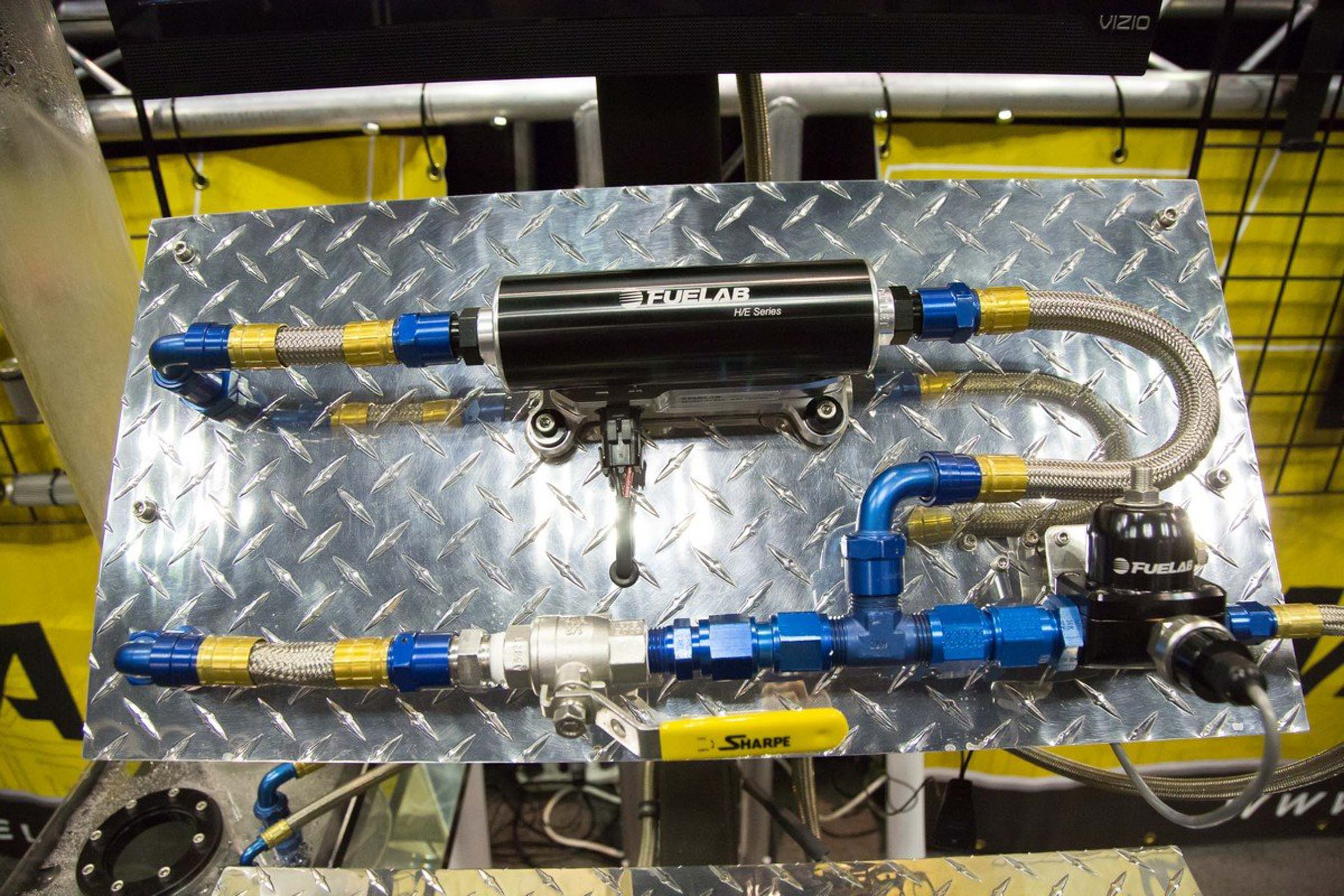
Since brushless fuel pumps are smaller, they can be mounted in tight spaces. This makes plumbing a fuel system much easier and gives the end-user more options.

Racers need fuel pumps that can move a tremendous amount of fuel quickly, but they also don’t want a giant fuel pump that adds a lot of weight or is hard to mount. The brushless fuel pump has both of these attributes thanks to their technology.

“One of the primary advantages of a brushless pump is we can get a lot of power out of a system and reduce the size of the packaging. Most brushed fuel pumps use a ceramic-based magnet that has a low flex density. A brushless system uses a neodymium magnet system that’s much stronger and has a higher performance level. For high-horsepower applications, it really becomes more significant since you need a bigger fuel pump, Scharfenberg says.

Brushless fuel pumps provide a lot from a performance standpoint that makes them a great fit for high-performance applications. These pumps are vastly more efficient than a standard pump that uses a brushed electrical motor, they won’t add additional heat to your fuel, and they don’t take up a lot of real estate thanks to their compact size. If you’re thinking about upgrading your fuel system, making the switch to a brushless fuel pump is worth examining if you want some extra performance and reliability.

Posted on Leave a comment

Coated Pistons: Measuring Advice From JE Pistons

Coated Pistons: Measuring Advice From JE Pistons

Coating technology for engine internals is becoming more commonplace today as a proof-positive way to increase wear characteristics and overall life of performance and racing engine components. JE Pistons has provided some informative advice for measuring a coated piston for overall piston diameter. These measurements contribute to the formula between the piston skirts and the cylinder bore, better described as piston-to-wall clearance.

Measuring piston-to-wall clearance is essential when building your new engine. In extremely critical motorsport engine build applications, the thermal expansion of the piston requires exact tolerances. Most commonly used in racing are forged pistons which expand more than cast pistons, necessitating this attention to detail.

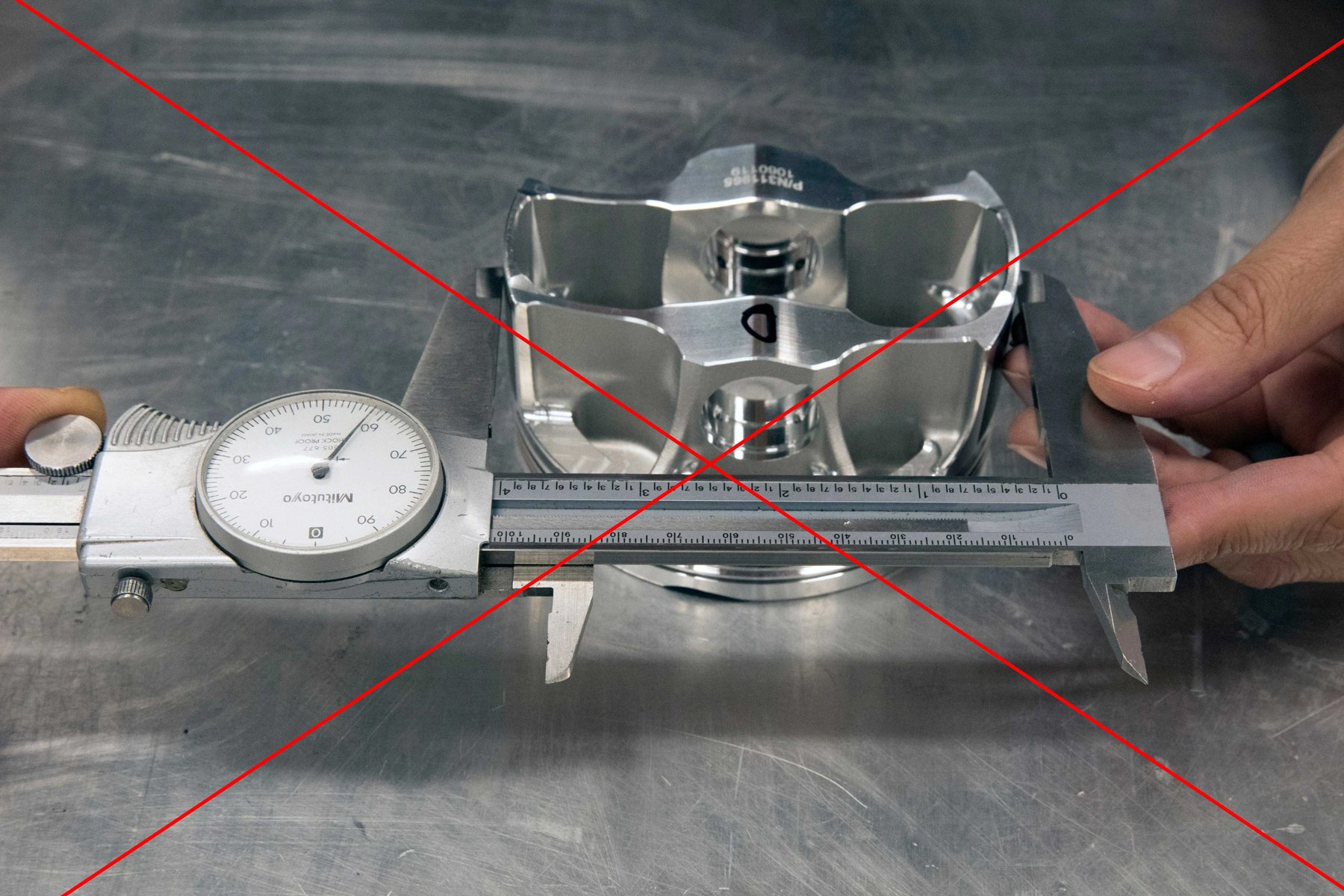
Essentially, there are correct tools and measuring procedures and, unfortunately, common incorrect ways to measure coated piston diameters. For example, the engineers at JE highly recommend never using a dial caliper when measuring piston diameter.

Using more simplistic devices such as a caliper can result in incorrect readings up to .003-inch. Different piston manufacturers may vary with piston-to-wall clearance, depending on their piston materials used. Whatever your specific tolerances may be, they are typically measured down to .0001-inch of accuracy.

Exact Cylinder Bore and Piston Diameter Measurements

Measuring your engine block cylinder bores requires a precision dial-bore gauge. Pretty much, that is the end of the discussion there. High-end dial bore gauges are the tool of choice. Similar to using incorrect dial calipers when measuring pistons, a snap gauge is another tool that will not provide the needed accuracy.

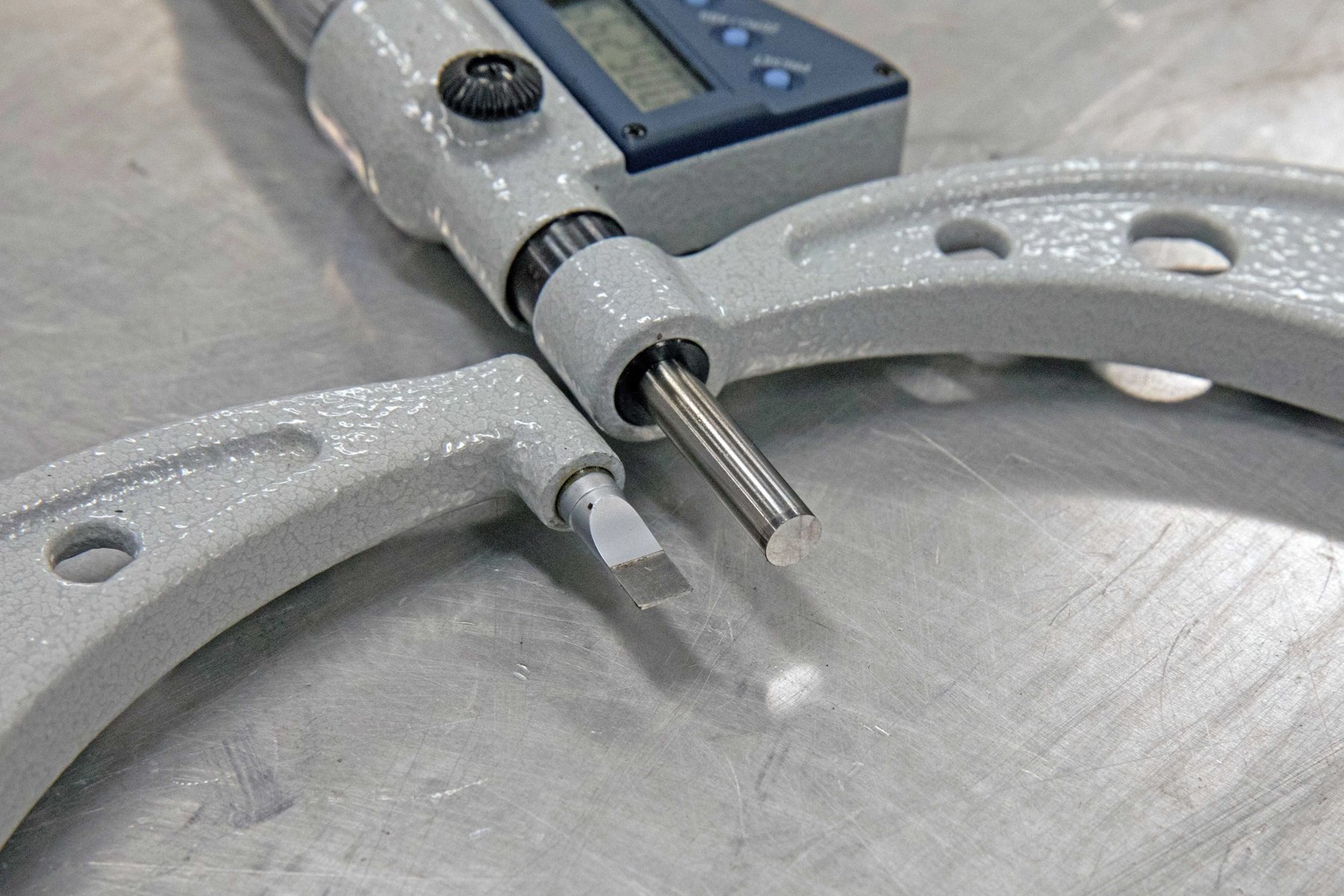
Measuring piston diameter with the popular JE Perfect Skirt–coated pistons requires measurements using a blade micrometer. Shown beside a traditional cylindrical-ended unit, the blade micrometer will accurately measure the piston’s skirt within the provided piston coating window. Measurements made when contacting the coating surface will cause inaccurate readings.

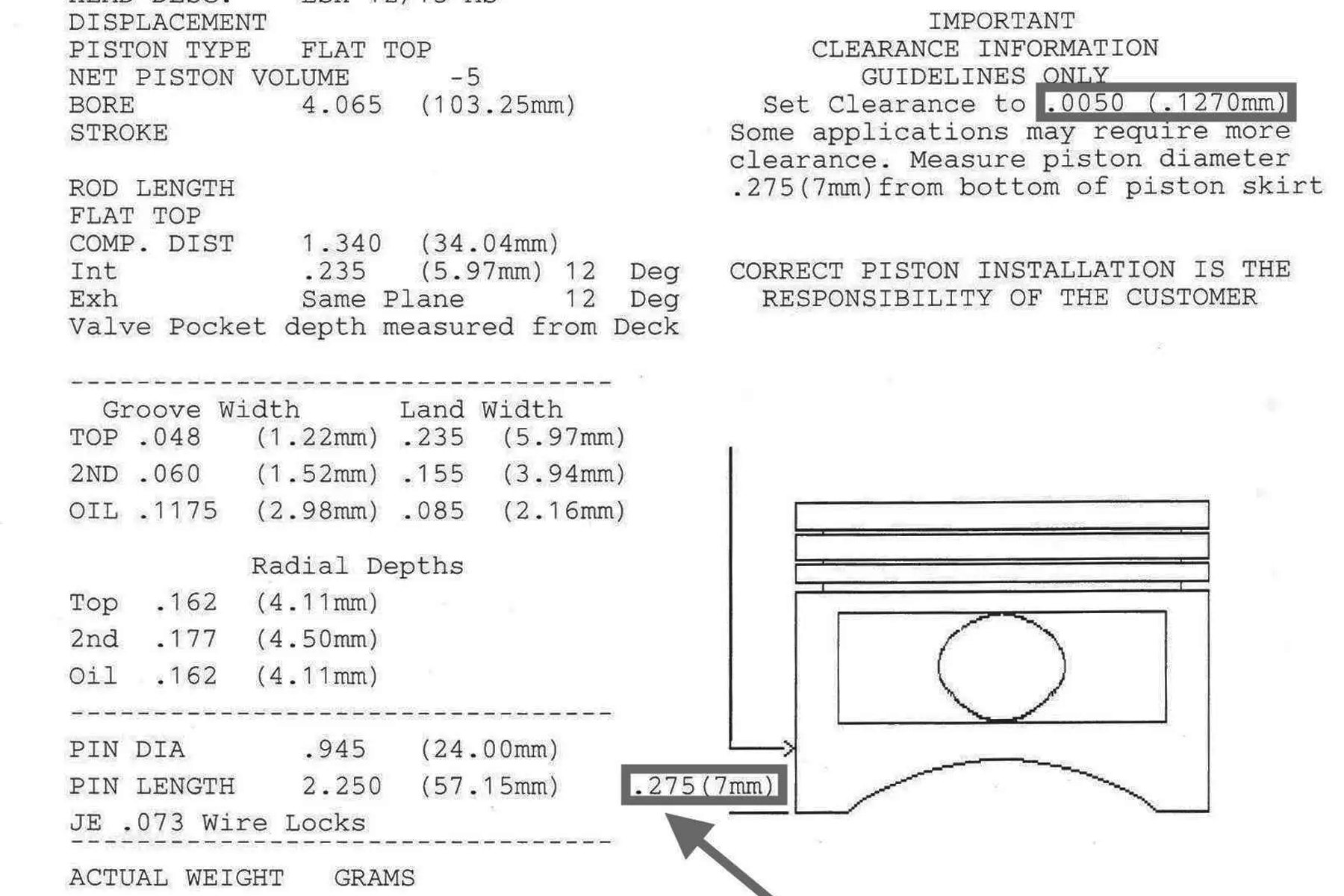
All pistons are not perfectly round; in fact, they are described as the diameter being a “cam” shape. By following the specific “gauge point” locations that JE Pistons carefully points out in its illustrated instructions, you will achieve the proper measurements to match your cylinder bore and derive appropriate piston-to-wall clearances.

A dial caliper does not have the accuracy to reliably measure a piston’s precision skirt, and should not be used for any piston measurement. The JE specification sheet included with all piston sets illustrates all proper measuring points for your coated pistons.

With careful attention to detail and proper tool usage, your Perfect Skirt–coated piston will help eliminate piston slap as well as prevent premature skirt wear. It only takes a few simple points of detail in engine assembly to incorporate coated pistons into your engine building regimen.

Posted on Leave a comment

Explaining How Piston Rings Can Affect Engine Temperature


When it comes to diving into dyno testing headfirst, one of the first people to come to mind is Total Seal’s Lake Speed, Jr. Between his days as the Director of R&D at Driven Racing Oil and now as Total Seal’s Vice President of sales and marketing, he spends a lot of time in a dyno cell, testing the company’s products. So when he finds something that he thinks is worth talking about, we tend to listen.

Recently, while doing some testing at Shaver Specialties, he noticed an apparent correlation between thickness in the piston rings, and both water and oil temps of the engine. With his curiosity piqued, Speed set up a dyno session to specifically test the theory and see if the thickness of the piston rings actually affected the engine’s temperature.


Setting Up the Test

In order to conduct any test worth its salt, you need a reliable, repeatable baseline. For the tests, Speed used a small-block Chevy dyno mule at Shavers, which has over 1,000 pulls on it with a 0.7mm/0.7mm/2.0mm ring package on it over the course of the past several years. So to say it is a known quantity would be an understatement. “We know what this engine does,” says Speed. “This engine has a very good baseline of what the engine temperatures should be with a given viscosity and type of oil, at a specific RPM, with a specific load.”


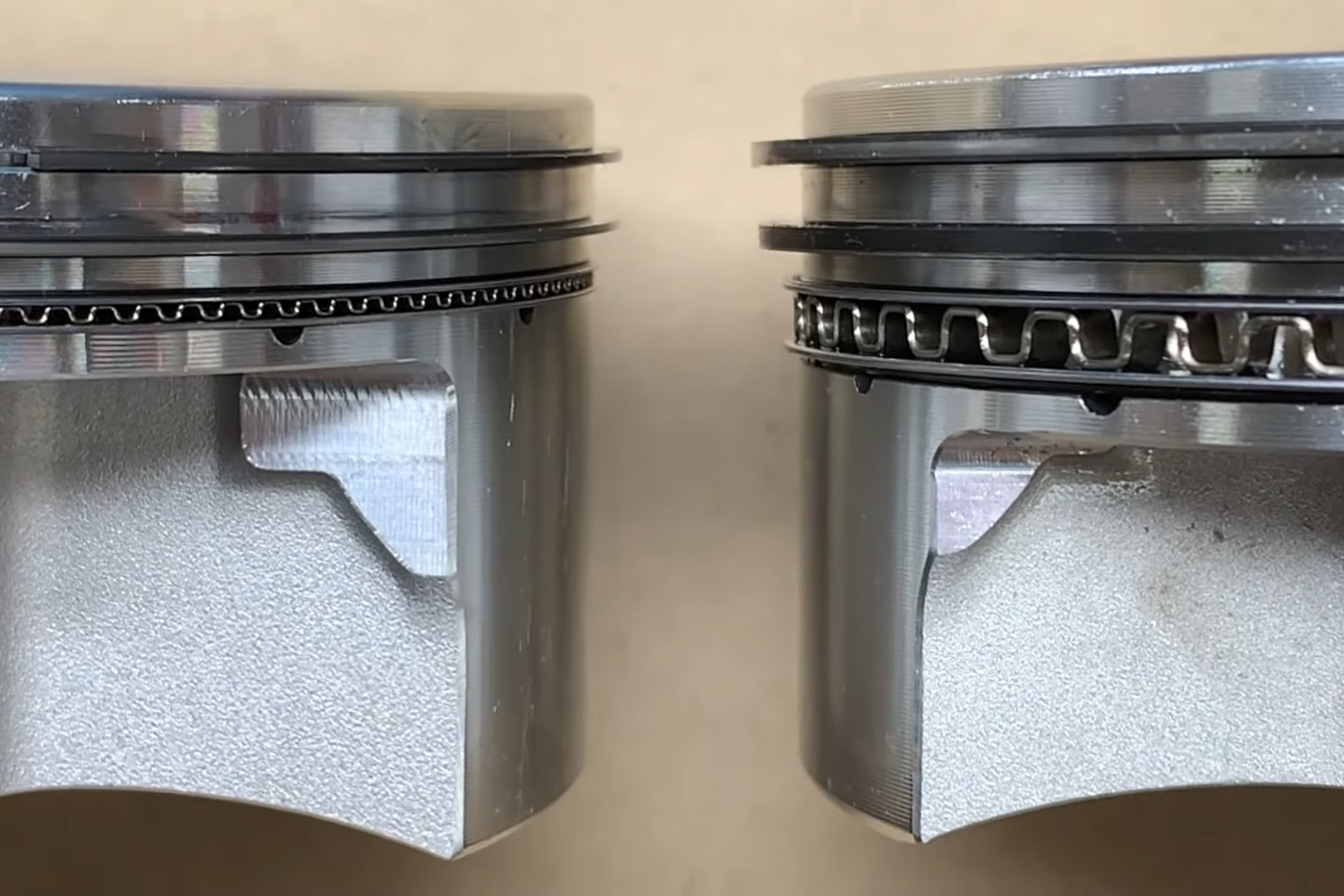
The 1/16th inch rings are over twice as thick (1.58mm) as the 0.7mm rings, which means more than double the surface area of the ring face rubbing against the cylinder wall. That alone makes it easy to understand the difference in friction between the two.


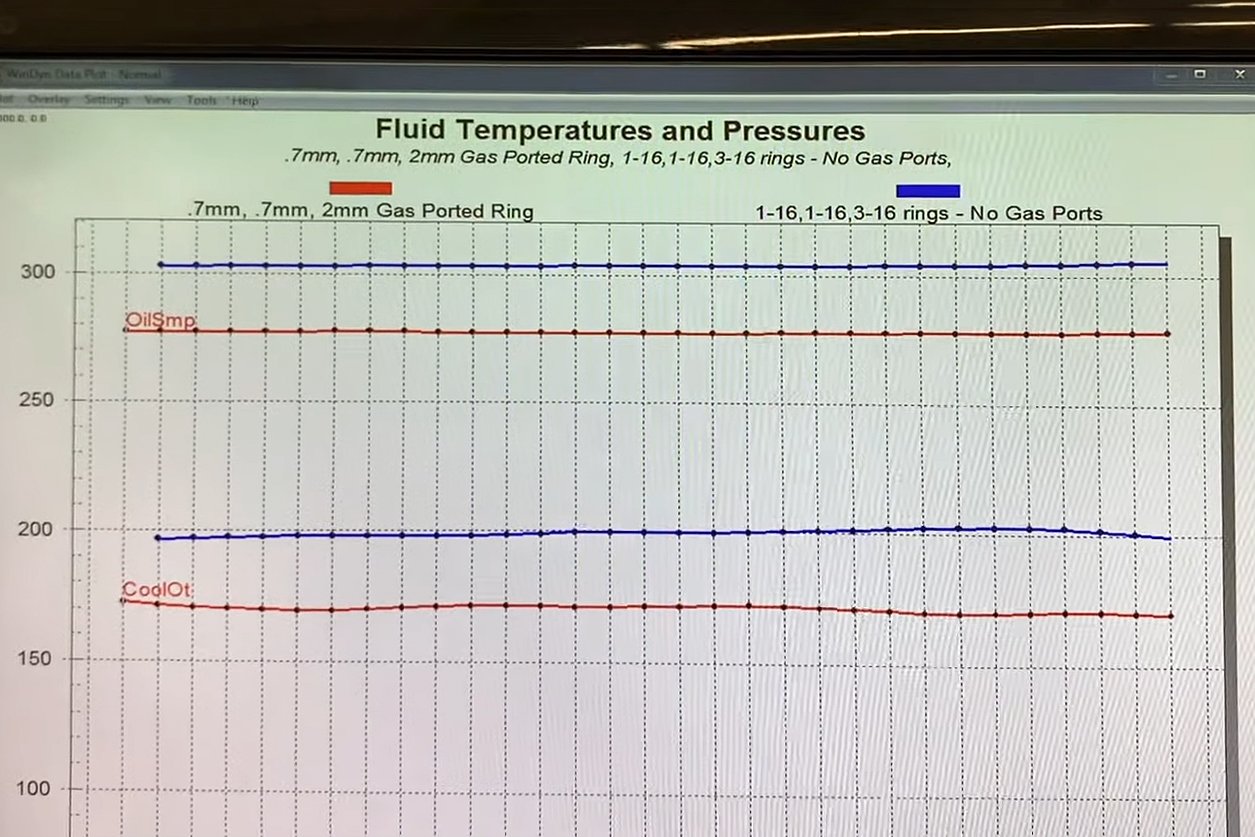
For example, Speed says that with the 0.7mm/0.7mm/2.0mm ring package at 3,000 rpm, with a 75 lb-ft load on the engine, after running for 30 minutes, the engine will have the exact same oil and water temps, time after time. “We know that [under the previously stated parameters] with a mineral-based 10W-40 oil, the water temperature will be 170 degrees and the oil temperature will be 280 degrees,” says Speed. “It does it over and over again.”

For the test, Total Seal reached out to JE Pistons and asked them to make a set of identical pistons, but with the more common 1/16-, 1/16-, 3/16-inch ring groves. The Total Seal team then put a standard tension, traditional 1/16-inch top and second ring on the pistons, along with a traditional 3/16-inch oil ring, and ran the new rings and pistons in on the dyno.


Starting The Test

“We noticed that the oil and water temperatures were coming up faster than usual,” says Speed of the initial run-in session with the thicker rings. “I thought, ‘Hmm. That’s different. It’s never done that before.’ So we actually checked to make sure everything was good with the oil and water systems. The next cycle, sure enough, it happened again. So now the question is, ‘why?’”

To Speed, the answer is simple; friction. “The rings moving against the cylinder wall is the number one source of friction in any internal combustion engine,” states Speed, matter of factly. “By going to a thicker ring package, 0.7mm vs 1/16-inch (1/16 = 1.59mm), the bigger, thicker, higher-tension rings means more friction.”

Speed then explains that the extra heat generated by the additional friction enters the cooling and oil systems, resulting in higher temperatures in those systems under otherwise identical operating parameters.


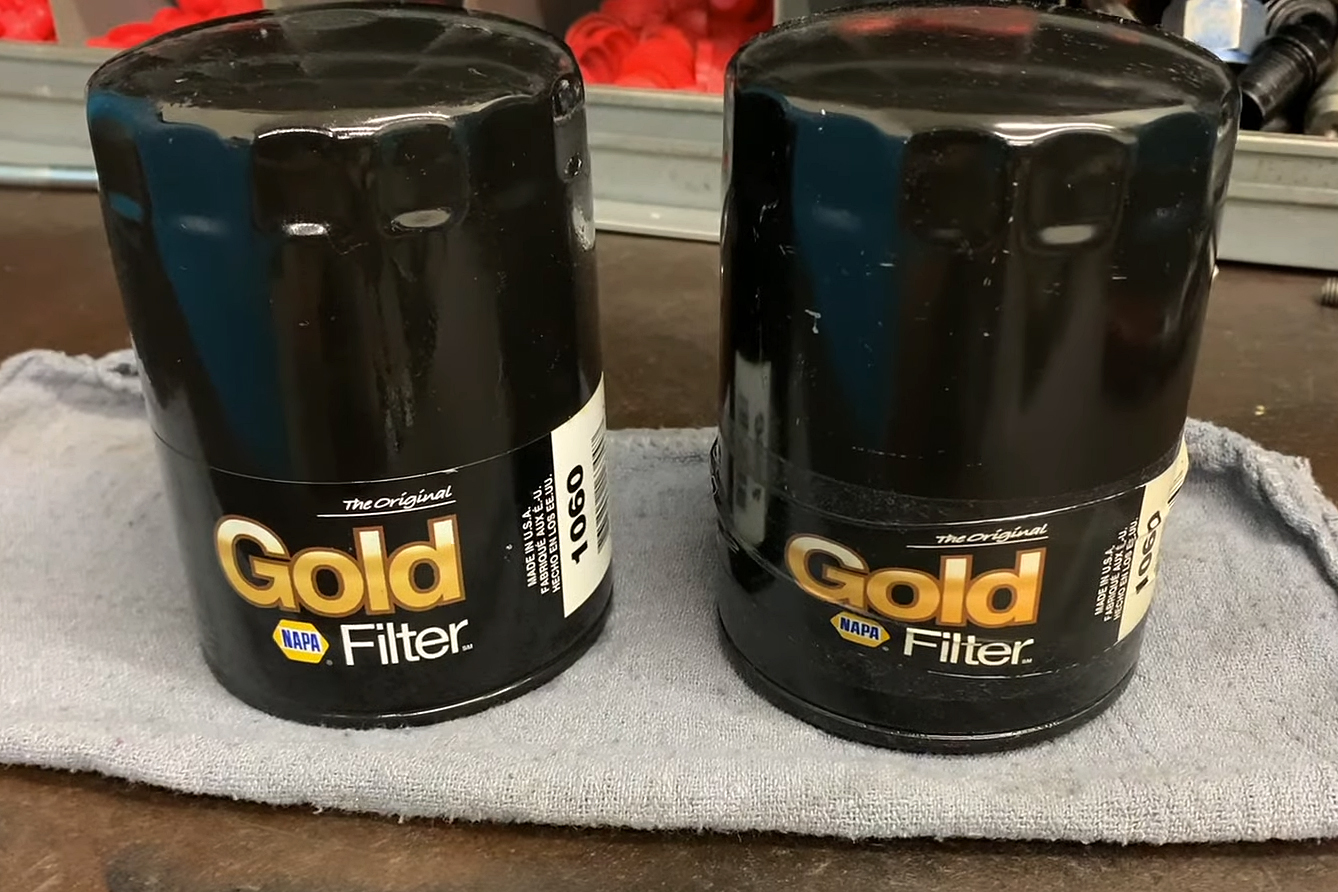
The oil temps got so hot in the 1/16th inch ring tests, that it started to cause the oil filter label to peel off. Not exactly a scientific measurement, but interesting evidence, nonetheless.


Interpreting the Data

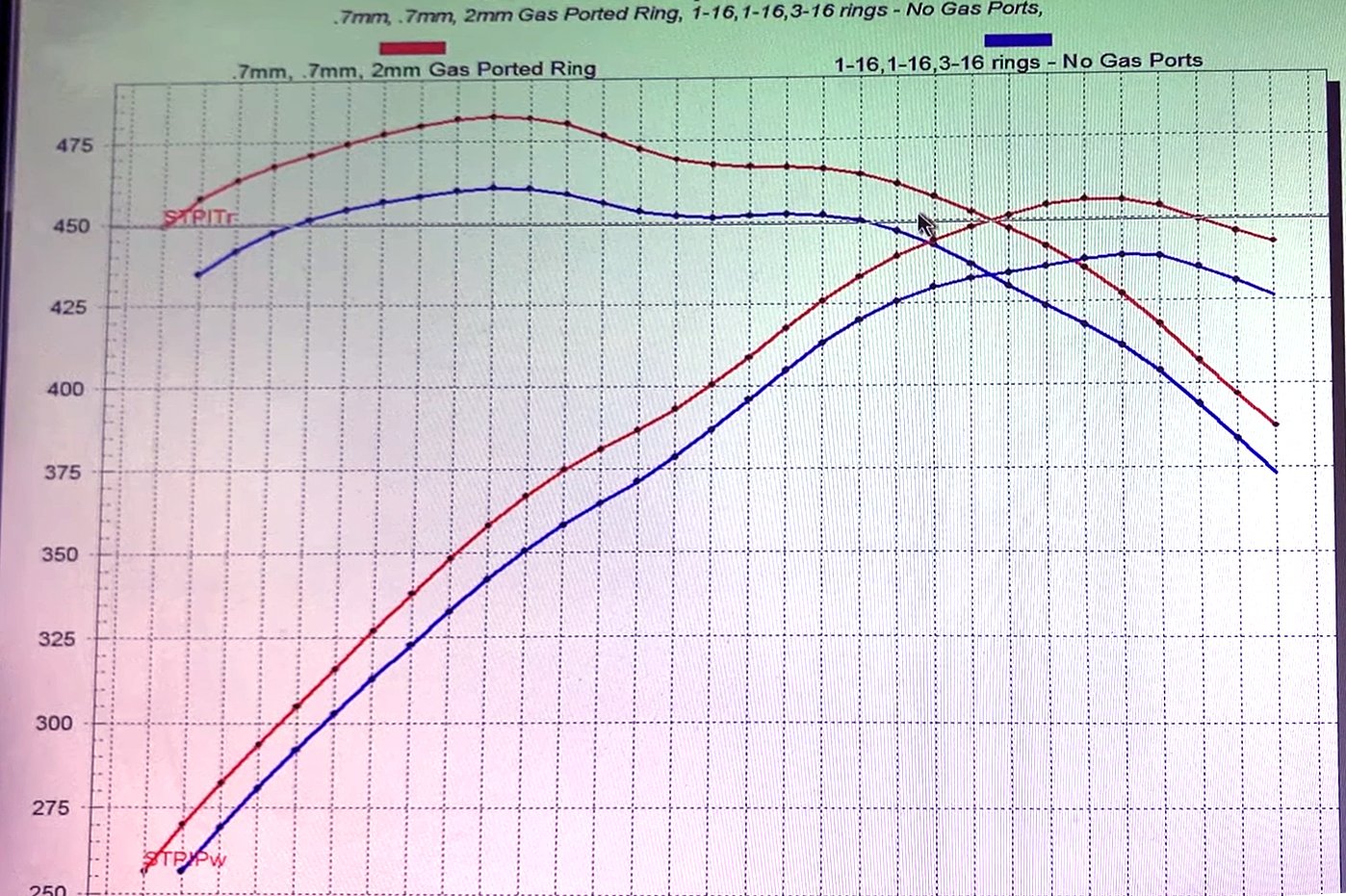
By now, I’m sure most of you are starting to correlate additional friction with less horsepower, and you’re 100-percent right. With a 3,000rpm to 6,000rpm sweep of the engine, there was an average difference of 20 horsepower between the 0.7mm rings and the 1/16th rings. With a peak power of 455 horsepower and 482 lb-ft of torque, that’s a solid 4.5-percent difference.

“You’ve got to remember that over 40-percent of the engine’s friction comes from the ring package,” says Speed. “However, the horsepower difference isn’t really the interesting thing. What’s really interesting is that with all the same variables the 1/16-inch ring package ran considerably hotter.” In fact, the engine oil got so hot, it peeled the label off of the oil filter.
As you can see, there is an extremely noticeable difference in coolant temperature, oil temperature, horsepower, and torque between the 0.7mm, 0.7mm, 2.0mm ring package (red lines) and the 1/16-, 1/16-, 3/16-inch ring package (blue lines).

To further prove that it’s not the temperature alone accounting for the horsepower difference, Speed then controlled the oil and water temps of the 1/16-inch package to bring them in line with those of the 0.7mm package’s tests and found that there was still a difference in power. It wasn’t as large of a split as it was without the temperatures matched, but as Speed points out, your vehicle is a closed system, so introducing more heat will increase the overall system temperature.

“The fact is, the 1/16-inch ring generates more friction which robs power and generates excess heat,” Speed says, definitively. He also adds that with over 1,000 pulls on the 0.7mm ring package, you aren’t giving up any durability with the thinner rings. “The 0.7mm steel ring with the PVD coating are so much more durable, it can outperform a cast-iron, ductile, moly-coated ring over time.”


Posted on Leave a comment

Hidden Horsepower: Revealing The Secrets Of The Oil Control Rings

“Run a dingle-ball hone through it, throw in a new set of rings — and you’re ready to go.”

Not long ago, this might have been considered an acceptable practice for a mild street engine. While this may still be the approach for the backyard engine builder, 21st Century internal combustion engines have progressed to the point where attention to detail can pay off with less internal friction, more horsepower and torque, less blow-by, and even superior oil control.

Among all the attention paid to piston rings, far too little has been addressed to the oil rings. But within the trio of the three-ring piston, more friction is generated by the oil ring package than the sum of the other two rings combined. So perhaps we should start with some technical details that may be surprising. One approach to improve power and efficiency on any engine would be to reduce the friction of a typical oil ring while not compromising oil control. Let’s start by addressing what is commonly referred to as standard tension oil rings.

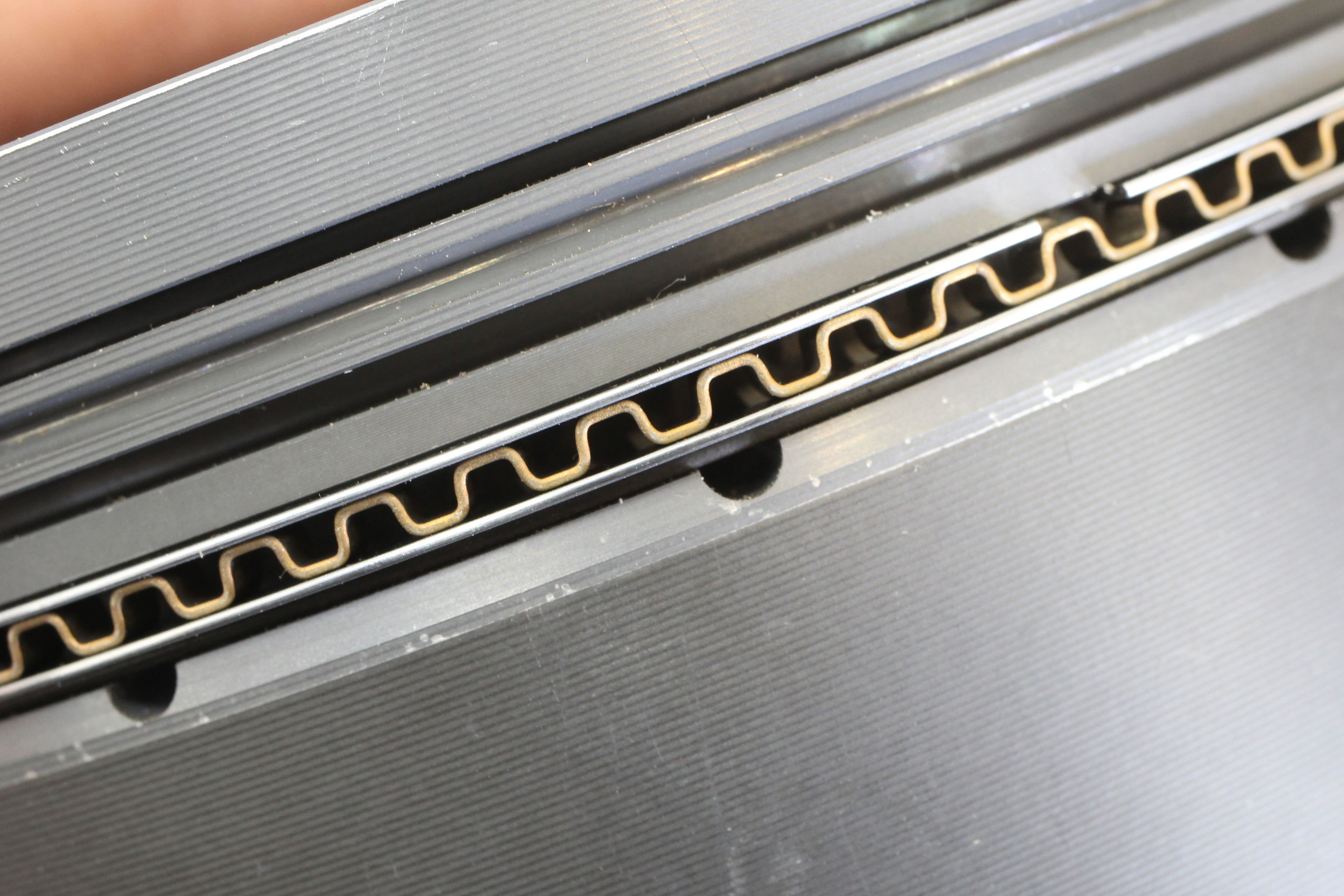
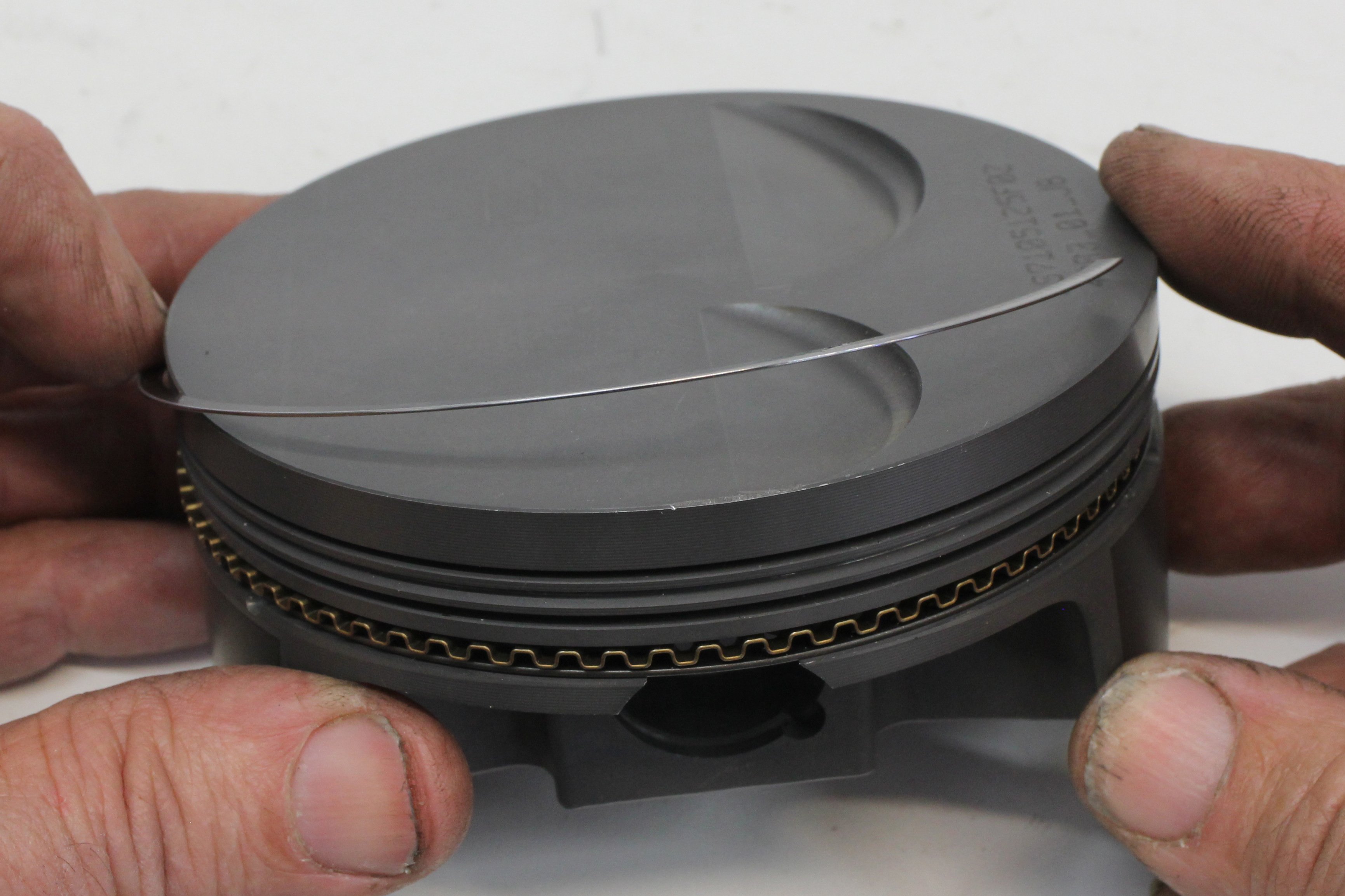
It’s not unusual for the ends of an oil ring expander to not touch when placed in the bore. However, when placed in the piston groove and the oil rings are installed, the rings press on the expander and create the necessary tension. According to Keith Jones, there is little to be gained by adjusting the ends by bending them inward.

Standard Isn’t So Standard

For street engines, nearly all recommendations call for a “standard” oil ring package and to avoid using “low drag” oil rings because of the risk of allowing too much oil into the combustion chamber.
It turns out that what is termed a “standard” tension oil ring is anything but standardized. We’ve included a chart created using data supplied by Total Seal that offers some interesting information. The force listed in the accompanying chart is expressed in pound-force (lbf).

Radial Tension Chart

Loads listed for each ring in this chart are the actual radial (outward) force exerted by the ring. This is not the amount of friction generated by the movement of the piston in the bore. This is an important distinction that should not be overlooked.

Ring Pack Oil Ring Radial Tension

(lb-force)

Improvement
Standard 3/16 (0.187”) 20           —
Standard 3.0mm (0.118”) 11   -9 lbf = 45%
Ultra-Thin 2.0mm (0.078”) 8.0 -12 lbf = 60%

This is not lb-ft or torque, which is a twisting motion. Pound-force is the radial or outward tension against the cylinder wall created by the oil ring when compressed in the cylinder. These lbf measurements were obtained with a very sophisticated (and expensive — like, $60,000 expensive) tool used by Total Seal to measure this force. These lbf readings do not represent sliding friction, although common sense dictates that higher radial tension will certainly contribute to increased sliding friction.

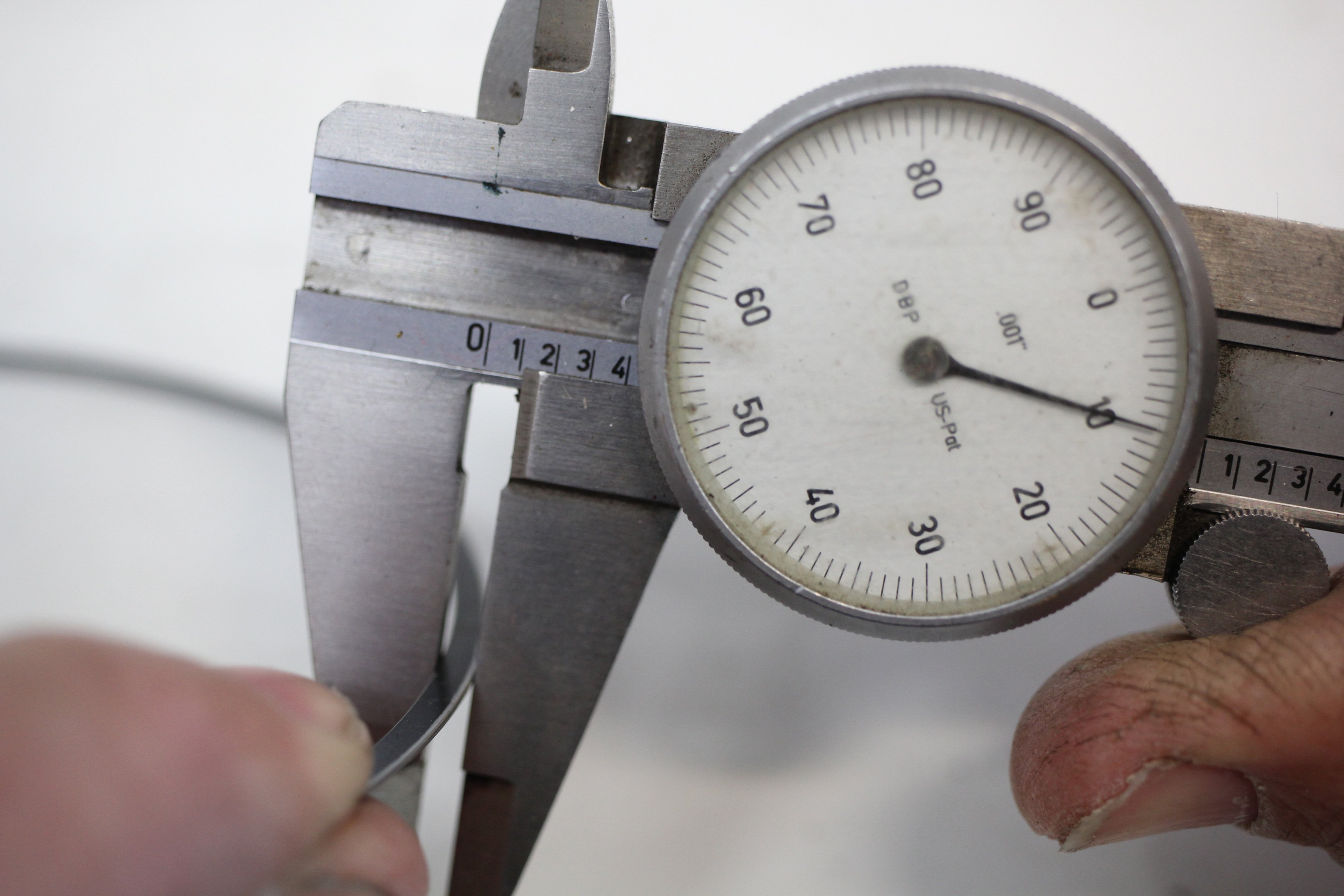
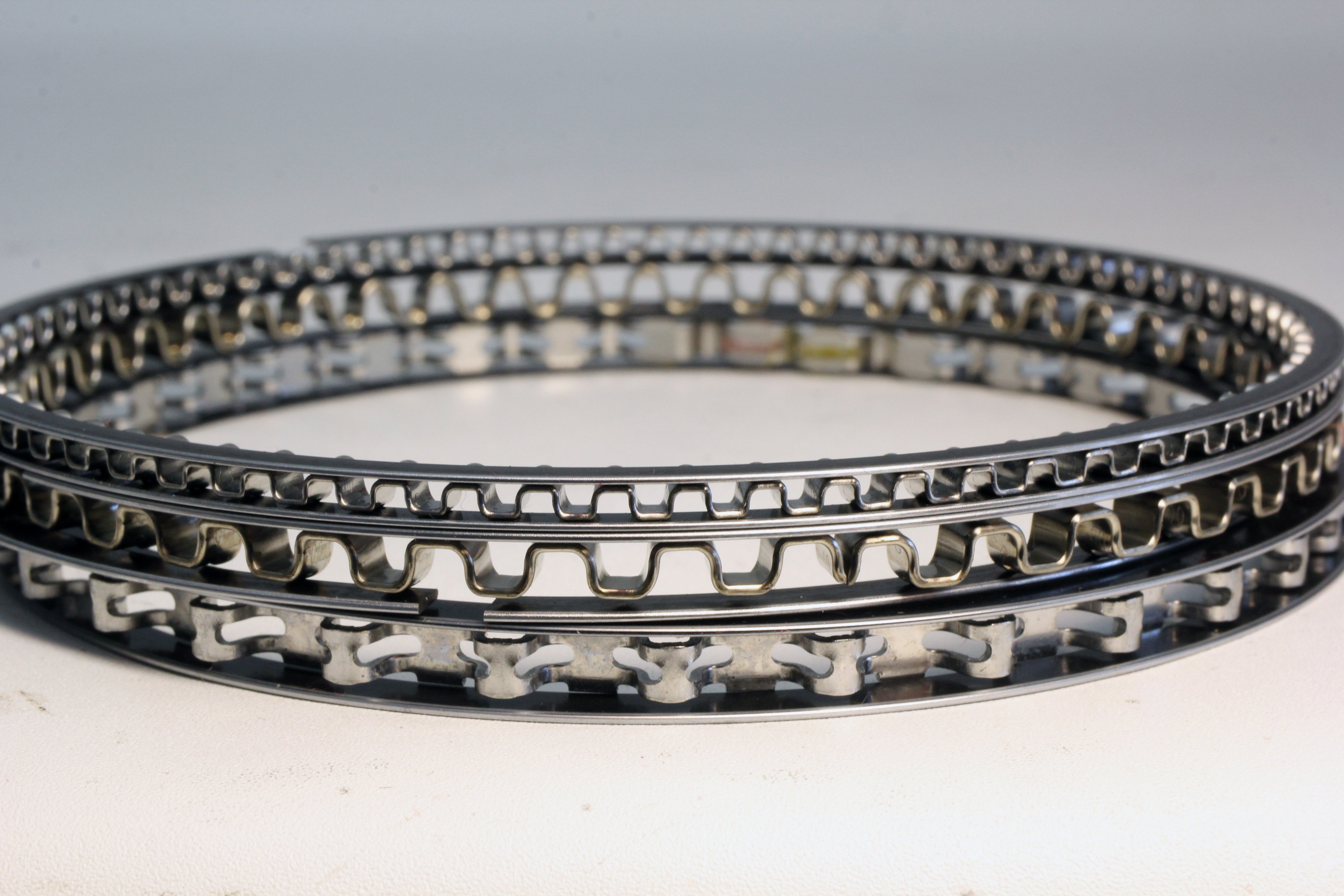
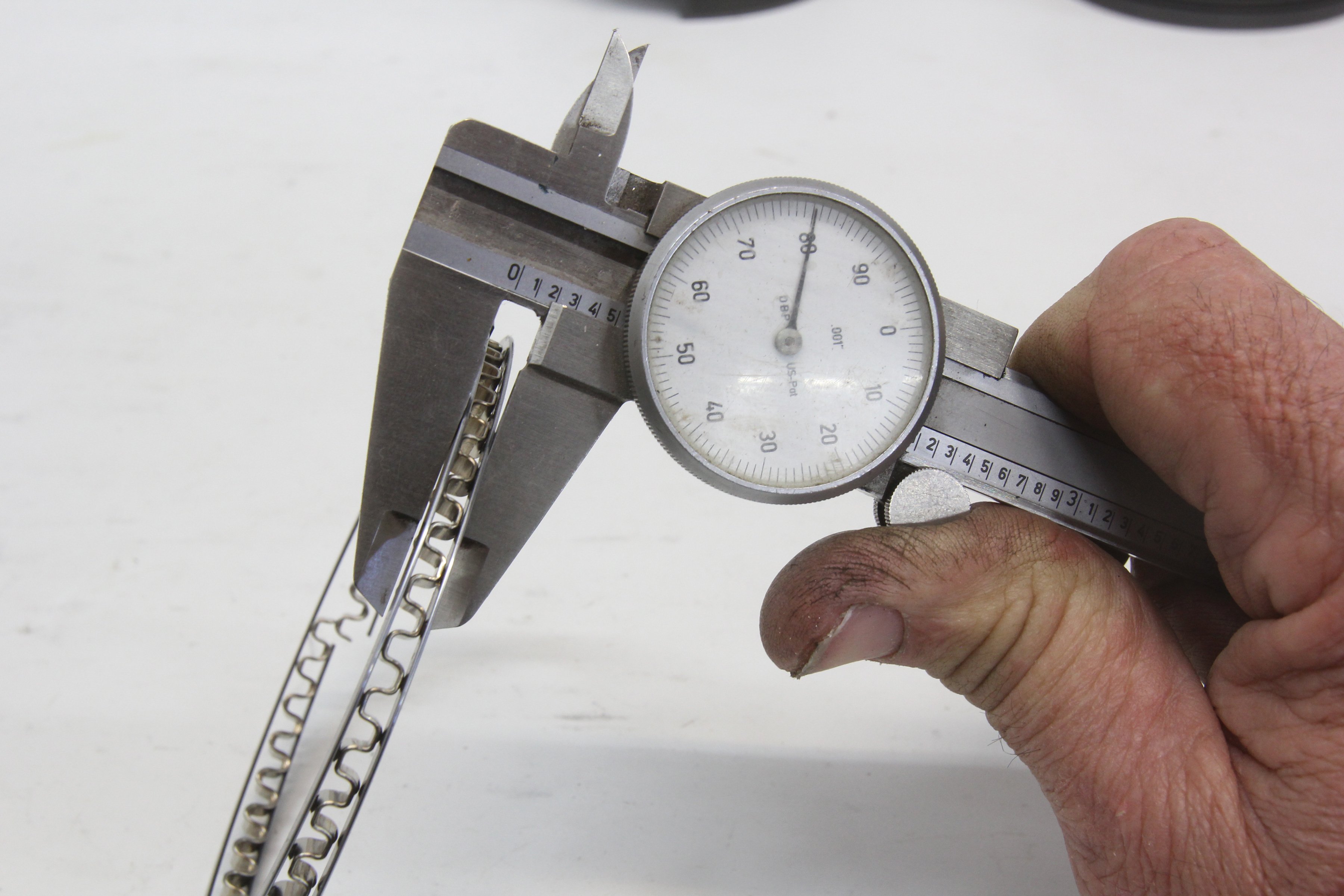
(Left) The radial width of an oil ring helps determine its radial tension. Here, we’re measuring a 3.0mm oil ring which comes in a 0.110. (Right) This stack o’ oil rings compares a stock replacement 3/16-inch (bottom), to a 3/16-inch oil ring from a 1/16-inch performance ring package with a different expander (middle), to a 3.0mm oil ring (top) as used in a typical LS 6.0L engine. The top two expanders are the more common flex vent design while the bottom is called an SSU, which is an older configuration similar to the flex vent but turned on its side. Speed says the flex vent is a more efficient design.

A typical performance piston ring combination is a 1/16-inch top, 1/16-inch second, and a 3/16-inch oil ring. A “standard” 3/16-inch (0.187-inch) oil ring package, as listed in the chart, creates a significant 20 lbf radial tension. What’s interesting is the spec for a “standard” late model 3mm (0.117-inch) oil ring package, Total Seal’s radial tension measurement plummets from 20 lbf to 11 lbf – an amazing 45-percent reduction in radial tension.

What’s worth emphasizing is that both of these oil rings are considered “standard” tension. As one example, the lowest radial tension ring — the 3mm ring — is the standard factory oil ring in late-model LS engines. What we’ve learned is that there are many ways to achieve good oil control and still reduce friction when the proper oil ring components are selected.

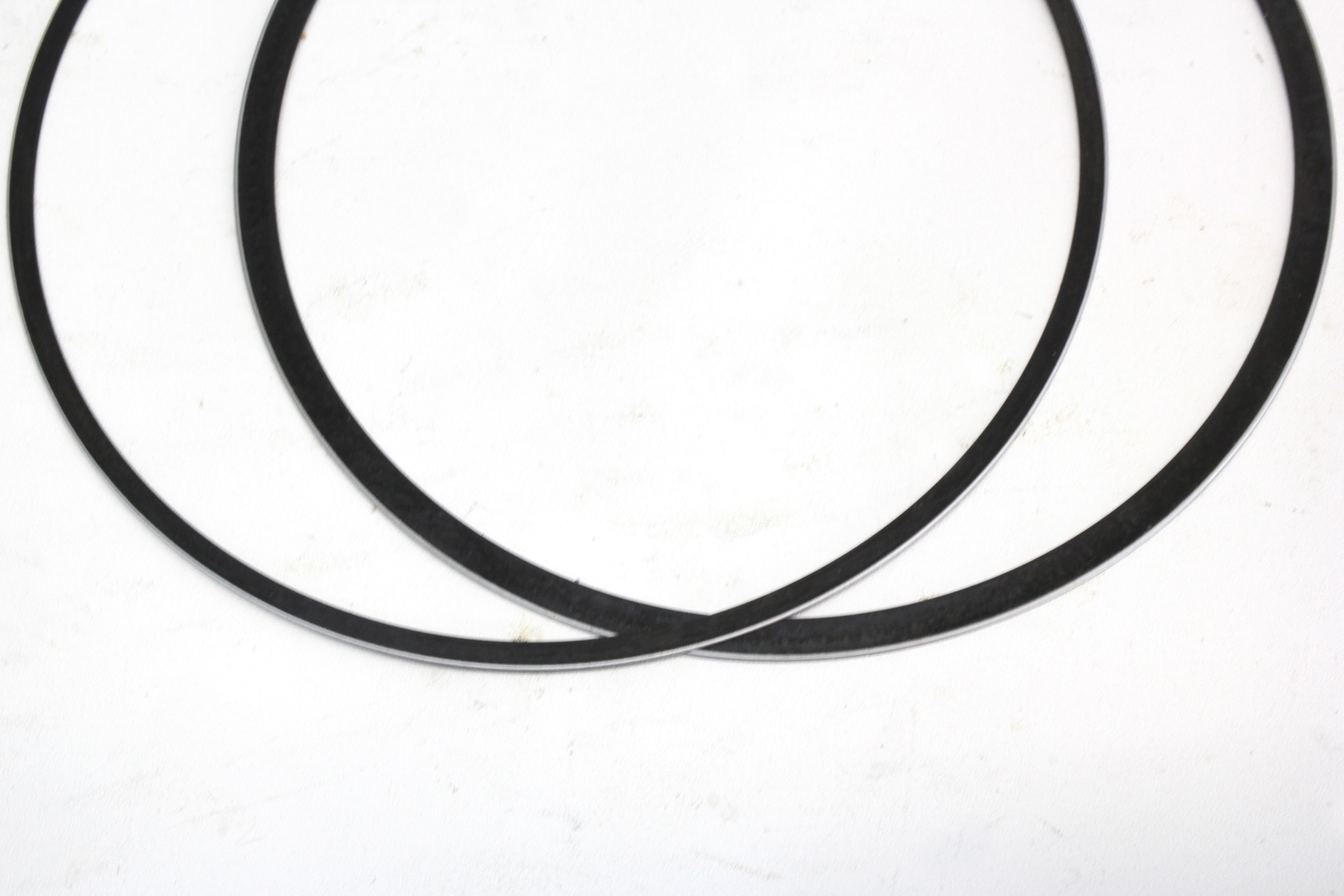
To reduce oil ring drag, most “low tension” techniques use a combination of a given expander with a thinner radial wall width oil ring. The wider oil ring in this photo is from a 3/16-inch oil ring while the narrower ring is from a 3.0mm oil ring package for a 6.0L LS engine. Both are intended for use in a 4.00-inch bore.

Less Tension, More Control

Interviews with Total Seal’s Keith Jones and Lake Speed, Jr. offer some tech-savvy insights into how these numbers directly relate to street-driven engines and how a sophisticated and knowledgeable engine builder can create his own custom oil ring package. But before we get into that, let’s look at some details about oil ring construction that will lead us to intelligently create this oil ring package.

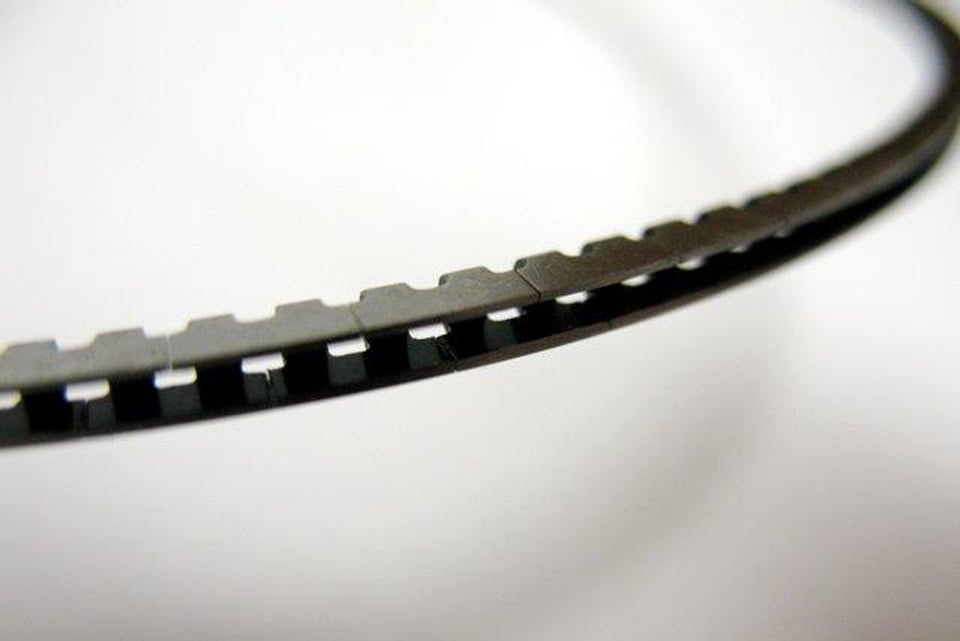
Nearly all current oil rings are created using a three-piece construction technique. The expander is the large center piece that is restrained with a pair of oil rings. The expander can be thought of as a spring that is loaded when installed in combination with the upper and lower oil rings. The oil rings’ function is to scrape oil off the cylinder wall and push it inward to oil return holes or slots cut on the inside of the piston’s oil ring groove.

Sliding Friction Test

These are some numbers we created using a simple digital fish scale on a 4.155-inch small-block Chevy bore testing a 1/16-, 1/16-, 3/16-inch ring package. Each ring was tested individually and Total Seal’s Keith Jones suggests the top and second ring numbers appear a bit high for the application while the oil ring numbers are closer to what they’ve experienced. Relative to each other, the numbers are consistent which means the oil ring offers the most potential for improvement in terms of reducing overall friction.

Ring Sliding

Friction

Top 6 – 7 lbs
2nd 4 – 4.5 lbs
Oil 18 – 19 lbs

Think of the three-piece oil ring’s job as gross oil control. This is followed by fine control exhibited by the second oil ring. Generally speaking, 80-percent of the second ring’s job is to clean the rest of the oil not removed by the oil ring. The remaining 20-percent of its job is to help seal combustion pressure that has leaked past the top ring.

The first big revelation that Speed offered is that the oil ring’s vertical thickness has nothing to do with overall tension and ring drag. Oil control is created by a combination of the length of the expander and the radial width (as viewed from the top) of the oil rails. Speed says to think of the expander as a spring. If you place an expander inside its intended cylinder, the ends of the expander may not touch. But when the expander is squeezed between the two oil rails, the rails create the load much like adding a spacer under a valve spring to increase its tension on the valve.

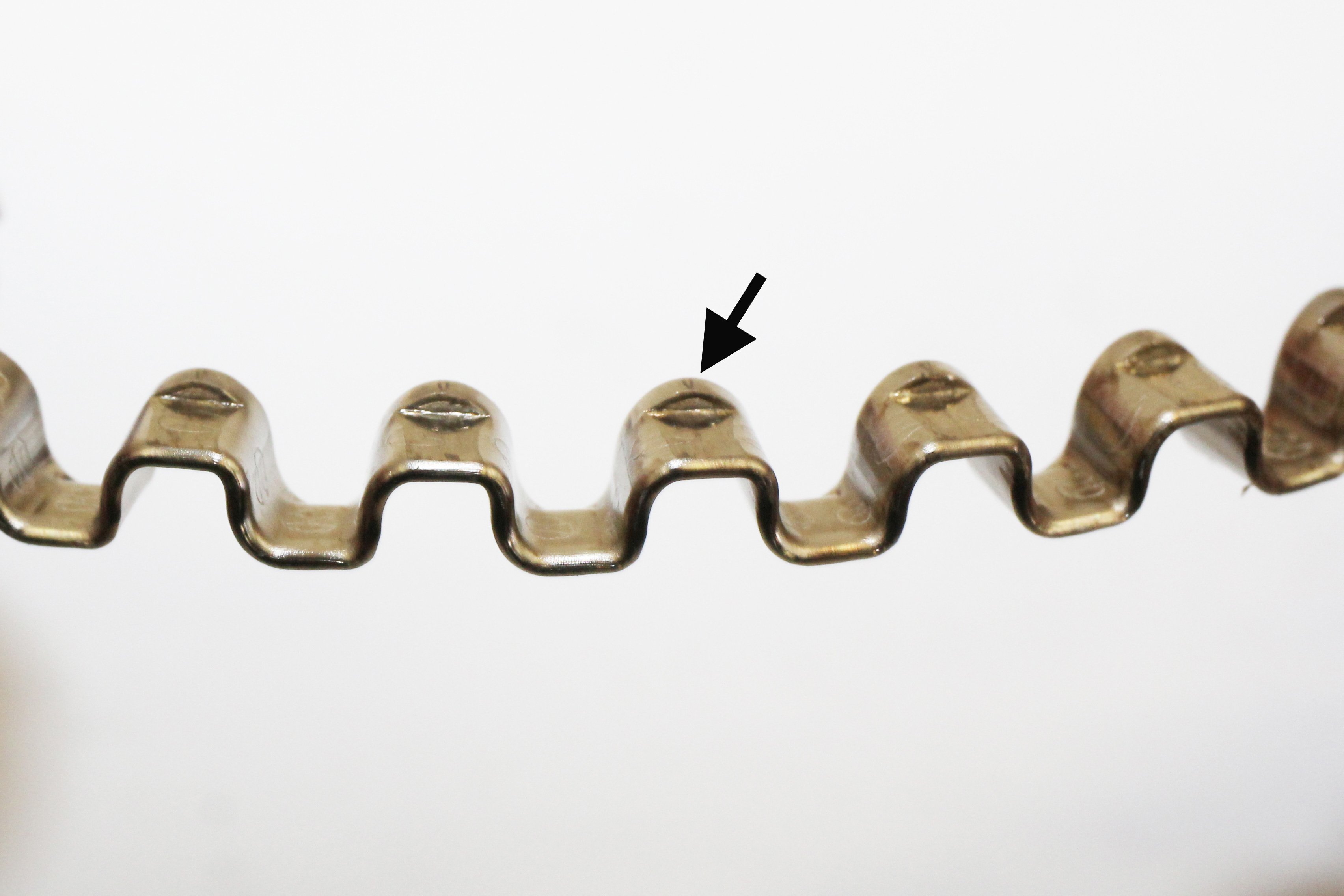
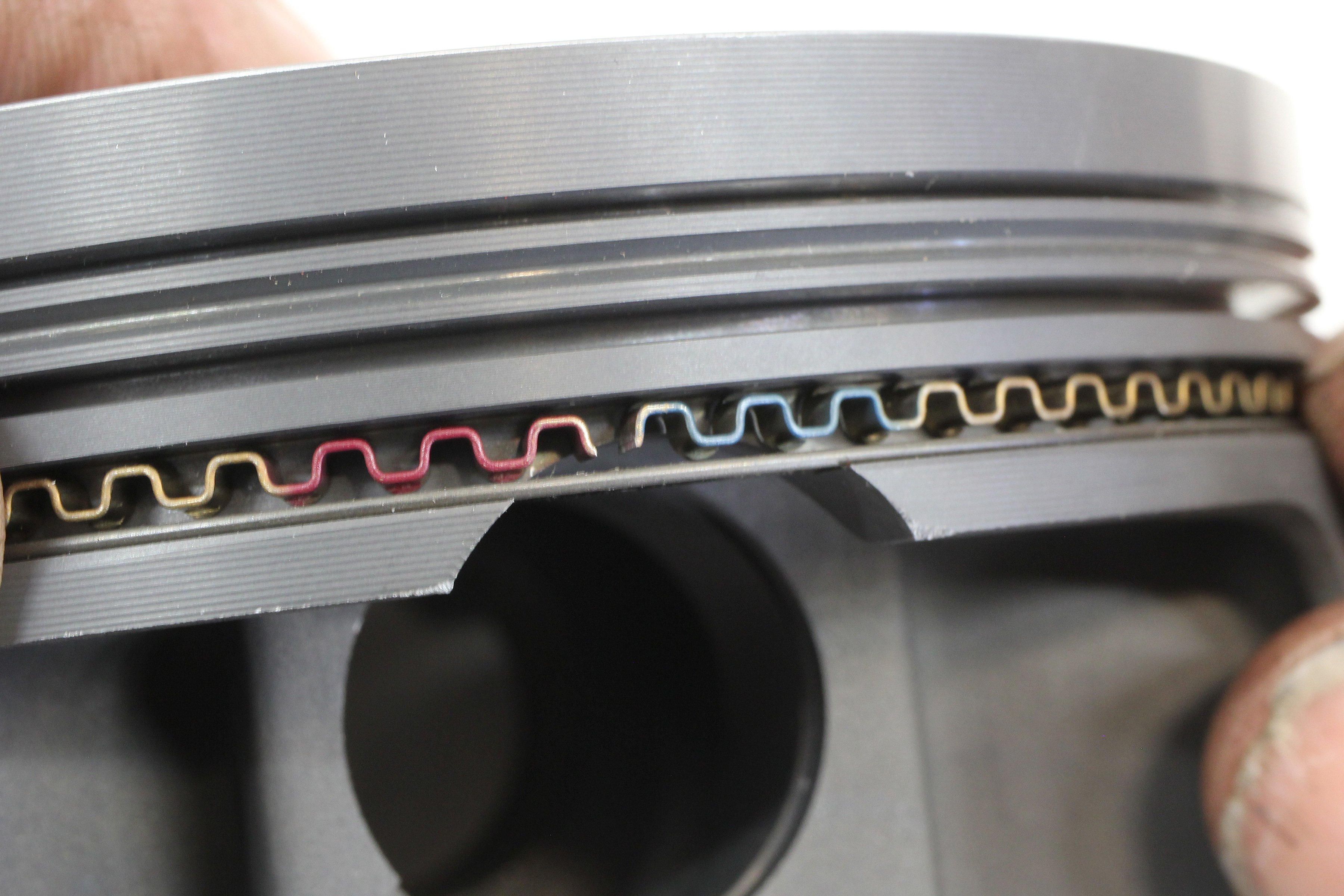
On the left, the arrow points to what Total Seal calls the tab area of the expander. The combination of tab area contact area with oil ring radial depth is what creates the oil ring’s tension. So by using different expanders and oil rings with narrower or wider radial width, Total Seal can create the near exact oil ring tension for a given application. The vertical thickness of the oil control ring is not a variable that controls overall tension. A low tension oil ring can be created with a larger 3/16-inch oil ring just as easily as with a much thinner 2.0mm oil ring (right).

The rails are also an important part of the equation. Changing the radial width of the oil ring will alter the load created by the expander. A thinner radial width oil ring will reduce the load created by the expander. We’ve created a chart where we measured the radial width of three different oil rings. Notice the major change in oil ring radial width between the 3/16-inch oil ring rails and the 3mm rails. There’s nearly a 50-percent change. Compare these numbers to the radial tension chart and there is a direct correlation between the radial width of the oil rails and reduced tension.

Oil Ring Dimensions

We measured two small-block Chevy and one LS ring package from rings we had at our shop. Note there are two different radial widths listed. The first was for a 5/64-inch ring package and the second was for a 1/16-inch ring package. The major size revision occurs between the 1/16 and 3.0mm ring sets.

Oil ring Oil Ring Axial

Thickness

Oil Ring

Radial Width

3/16 0.023 0.150
3/16 0.027 0.144
3.0mm 0.019 0.103
2.0mm 0.018 0.085

Beyond Standard: Even Less Ring Tension

Using this information, Speed offered that Total Seal can create nearly any desired tension for any oil ring package. Working with the example that a 3mm oil ring offers a radial tension of 10 pounds of force, a similar radial tension could be created using a larger 3/16-inch ring by combining a custom expander and oil rings. Speed said that perhaps half of Total Seal’s business is building custom ring packages that are not necessarily listed in the Total Seal catalog.

Speed offered that just within the 4.030-inch bore diameter for a 3/16-inch oil ring that Total Seal offers several different radial widths for the oil rings that can be combined with a given length of expander to create the intended overall oil ring tension spec. As an example, Speed says Total Seal could create a 10 lbf (or just as easily a 16 lbf) oil ring package for a 3/16-inch oil ring piston that would reduce friction and still control oil on a street engine.

The oil ring expander acts like a spring. When installed in the oil ring groove, the rails press down on the expander and this action exerts pressure against the cylinder wall to produce a given tension which is used to scrape oil off the cylinder wall. The important part is to ensure that the ends of the expander do not overlap when installing the rings.

But there’s more to the story. In order to be successful, a “low tension” oil ring should be combined with a Napier-style second ring. The Napier ring is a tapered scraper style ring that includes a hook or recessed area behind the tapered lower face of the ring that enhances the ring’s ability to remove oil from the cylinder wall. Speed emphasized that the combination of the Napier second ring with the custom 3/16-inch oil ring would improve oil control while also offering the opportunity to reduce friction which would result in more horsepower over a “standard” tension oil ring of the same size.

Speed further mentioned that the engine’s intended usage is an important factor in creating an oil ring package. A drag race engine that does not create high oil temperature could benefit from a different oil ring package compared to an engine that is raced in autocross where oil temperature could escalate beyond 250 degrees-Fahrenheit. So oil ring combinations should include the oil viscosity as part of the oil ring equation.

Shavers’ 383ci small-block Chevy mule engine uses a very thin but gas ported 0.7mm / 0.7mm Napier / low tension 2mm ring package that is very small yet durable. It offers excellent oil control and minimal blow-by. Speed also mentioned that during oil testing that the lower tension ring package reduced friction that not only increased power but also lowered oil temperature.

A purely drag race engine could get by with a much thinner oil viscosity such as a 0w20 while the autocross or road race engine might need a slightly higher viscosity oil like 10w30 or 10w40. If the engine in question will use a high viscosity 20w50 oil, then a higher tension oil ring will be required to more efficiently scrape the thicker oil off the cylinder wall.

A typical retort to all this is that the reduced load exerted by the oil ring will only result in poor oil control and increased oil usage. But, that does not account for the fact that GM research has chosen to employ a 3.0mm oil ring package in a 6.2L LS engine that does not have an oil control problem. One reason for this performance is that this smaller ring package and lower tension allows the oil ring to more accurately follow the distortions in the bore which means more oil is removed from the cylinder wall by both the oil and second rings.

Thin ring packages aren’t some exotic option on pistons anymore. Mahle offers many of its pistons with much thinner ring packages such as a 1mm / 1mm / 2 mm package for small-block Chevy engines as an example. This is a 4.125-inch bore Mahle LS piston.

Talk Is Cheap, Proof Is Priceless

A further example of how a custom oil ring package can perform is the 383ci small-block Chevy used as Shaver Specialties Racing Engines’ mule engine that has survived thousands of dyno pulls. It is currently equipped with a set of Total Seal 0.7mm top, 0.7mm Napier second, and an 8 lbf, 2mm oil ring package. We personally witnessed one of these pistons slide down the bore by itself (merely from the force of gravity) because of the reduced radial tension exerted by the ring package.

While this sounds like the engine should be challenged when it comes to oil control, Shavers’ dyno operator “Dyno Don” MacAskill reports that the engine has no oil control problems, the chambers stay very dry, and the blow-by is quite low. Further, this engine does not employ any special windage control measures. In other words, the oil pan is devoid of screens, trays, or other control devices.

(Left) If an oil support rail is required because the oil ring groove intrudes into the wrist pin hole, always place the support rail with the small dimple facing down. The dimple contacts the piston and prevents the support rail from moving. (Right) When installing the oil ring, make sure to Install the expander first and make sure the ends of the expander do not overlap. Then gently install the top oil rail followed by the lower rail.

As for a practical street engine application for all this acquired knowledge, let’s stick with a typical 1/16-, 1/16-, 3/16-inch ring package engine. The consideration would be to use a lower tension oil ring package with a custom expander nested with thinner radial width oil rings combined with a Napier second ring. This would measurably reduce friction while still minimizing oil consumption.

For high-end competition engines like NHRA Pro Stock or NASCAR, Total Seal also has a one-piece oil ring that is also extremely flexible.

Armed with this new information, you might want to consider the advantages of building your next engine with more attention paid to the lowly oil ring. It might just pay off with a little less friction and a touch more horsepower.


Posted on Leave a comment

Checking Engine Bearing Clearances Without Breaking The Bank

When building or performing maintenance on the engine in your hot rod, checking your engine’s bearing clearances is a great practice while you are “knuckles deep.” Not only is it advisable to check the visible condition of your main and rod bearings, but it is also a good practice to see how the tolerances are holding up.

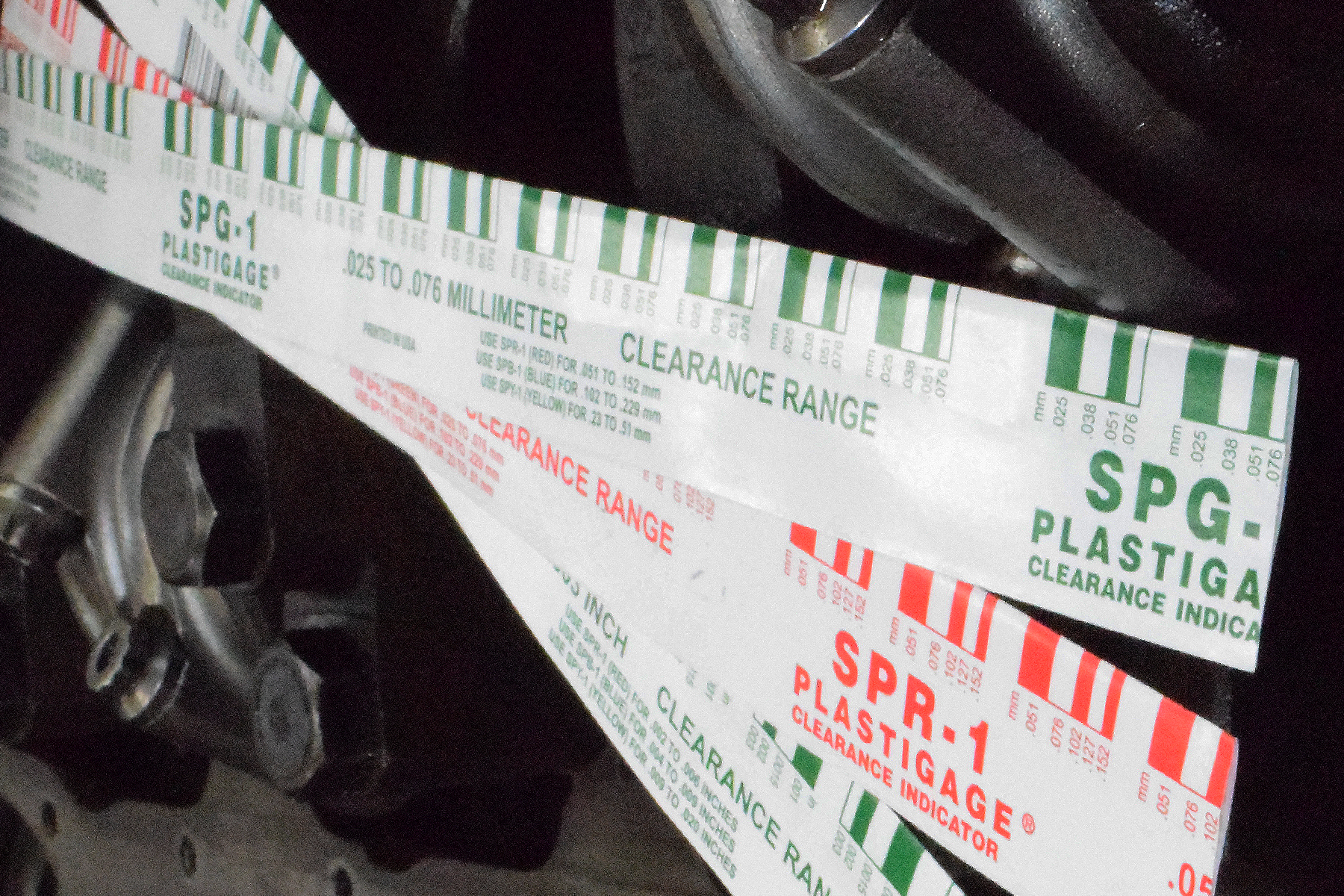
The cost-effective option, primarily known by its product name, Plastigage, is constructed from a special extruded wax plastic with accurately controlled crush properties. This fine plastic thread precisely crushes to repeatable dimensions depending on the tolerances between the bearing and crankshaft.


Reasonably Priced Tool

For big horsepower applications, generally defined at 800-horsepower and above, working with your bottom-end bearing clearances suggests using highly accurate micrometers and dial bore gauges to ensure proper clearances. While these tools can be great for an engine builder, they are not typically considered “average” tools every enthusiast has in the arsenal.

MAHLE Aftermarket Incorporated recently took over the United States production of Plastigage, and Dan Begle from MAHLE provided his take on its practical applications with performance engines.

“In reference to your 800-horsepower fundamentals for Plastigage, that’s probably a good number,” says Begle. “I’m not sure if horsepower levels are a huge issue; it depends on the engine builder or machine shop you trust. If you talk to someone who builds a considerable number of performance engines, they’re probably using precision gauges.”

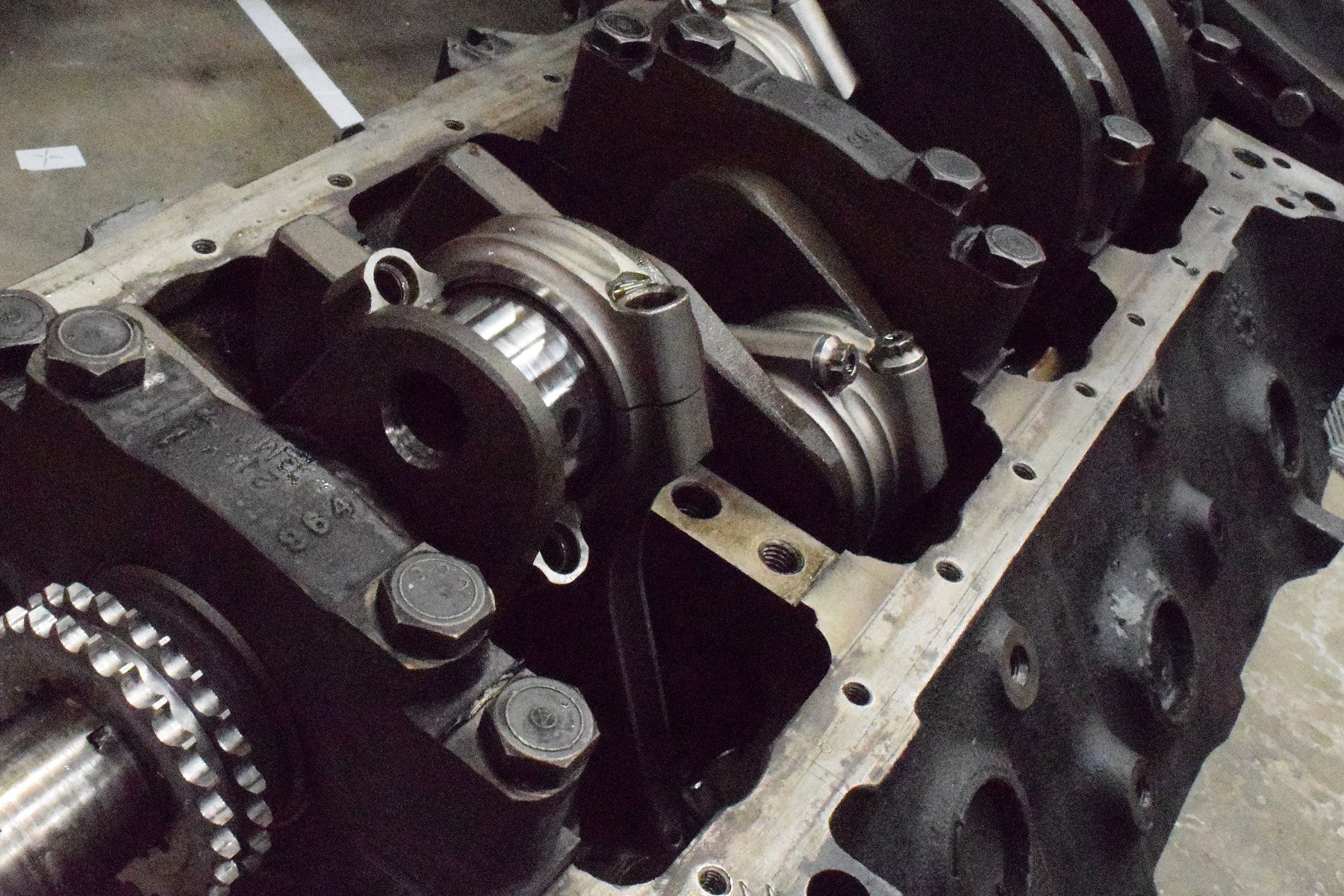
With our engine dismantled down to the short block, we are visually checking the condition of all rod bearings and main bearings for wear or damage. With no visible problems, we can comfortably use Plastigage to confirm our bearing clearances without the use of micrometers and dial bore gauges.

Begle continues, “If you’re looking at performing checks and balances on your engine, this is the ticket. It is not quite as accurate as a dial bore gauge, but if you’re conservative and not building something totally crazy, you’re probably good.”

For approximately ten-bucks, the home engine builder can utilize Plastigage to get the job done, especially when combined with a proper visual inspection of your bearing surfaces. Currently, I have the 489 big-block Chevy out of our bracket racing Camaro, and this is a prime opportunity to carefully check out the engine that came with our unfamiliar turn-key purchase a while back.


The Mahle/Clevite Performance Engine bearing catalog (Number EB4016) is easily viewable online. It contains a wealth of information concerning bearing clearances along with visual bearing inspection practices.

The typical rule of thumb for an OE or mild-performance application is .001-inch bearing clearance for every 1-inch of crankshaft or rod journal diameter. With a big block Chevy using a 2.75-inch main journal diameter, our tolerance is calculated to .0027-inch. A similar calculation for the rod journal indicates a necessary .002-inch clearance.

These tolerances can vary depending on engine design, horsepower levels, intended oil viscosity to be used, and many more variables. In fact, I called the original engine builder, who cited that a bracket racing engine like this is constructed at his shop with clearances slightly tighter than the previously mentioned standard. Make sure to do your research before scrutinizing your dimensions.

“I am also kind of old school on the .00075- to.001-inch of clearance per inch of journal rule, but you also need to consider the oil viscosity you are using,” comments Begle. “With a light viscosity and/or synthetic oil, I would certainly lean to the lower side of that clearance spectrum. In equal consideration, if you’re running a higher viscosity oil, definitely lean to the higher side of your clearances.”

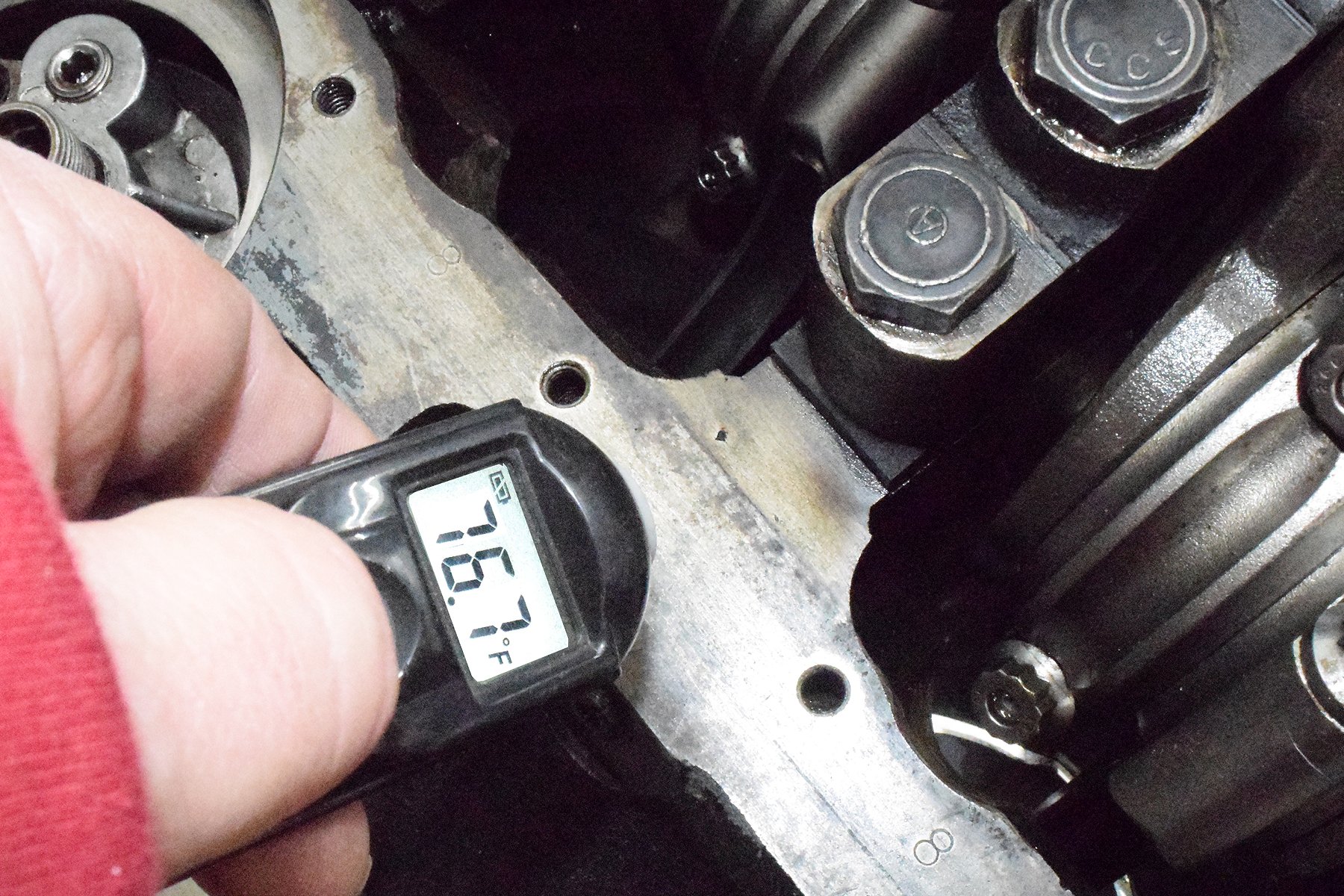
The first step in checking your engine’s bottom end is to carefully inspect all bearings for damage or uneven wear. Only then can you measure bearing tolerances. It is also critical to test with the Plastigage when the engine steel is at a minimum of 65 to 70 degrees for proper metal expansion. While extreme cold will make the Plastigage somewhat brittle and heat will soften the material, Plastigage remains usable and accurate through all normal variations of air temperature and humidity.

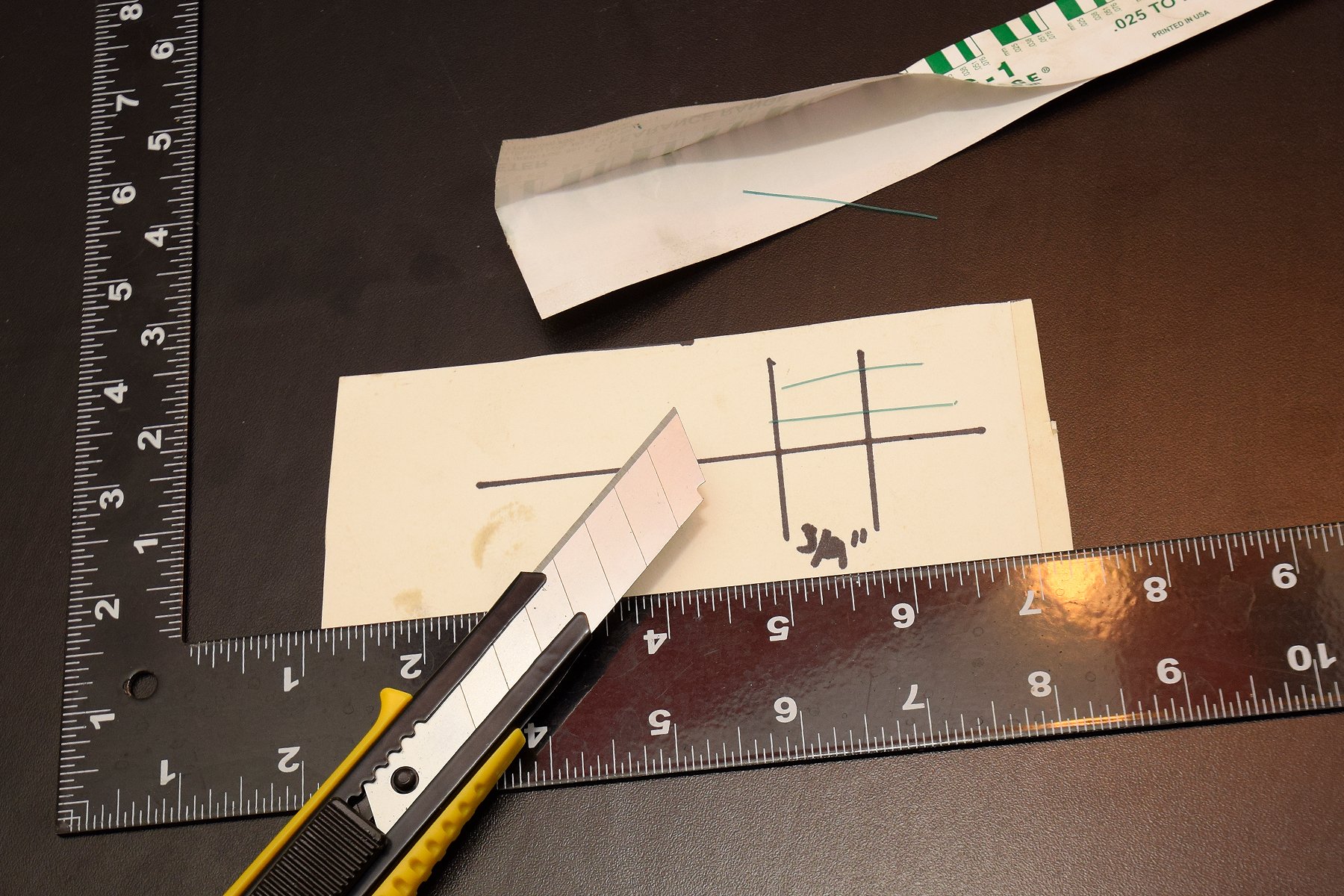
Each package of Plastigage comes with one 12-inch piece of color-matched, formulated plastic. These pieces are usually referred to as “threads” since they are equivalent in size to a piece of sewing thread in an uncompressed state. With a standard V8 engine, this will test all rod and main bearings with a little to spare. The extra is handy because, if you ever drop a small section of this thread, it is my experience that you will never find it again.

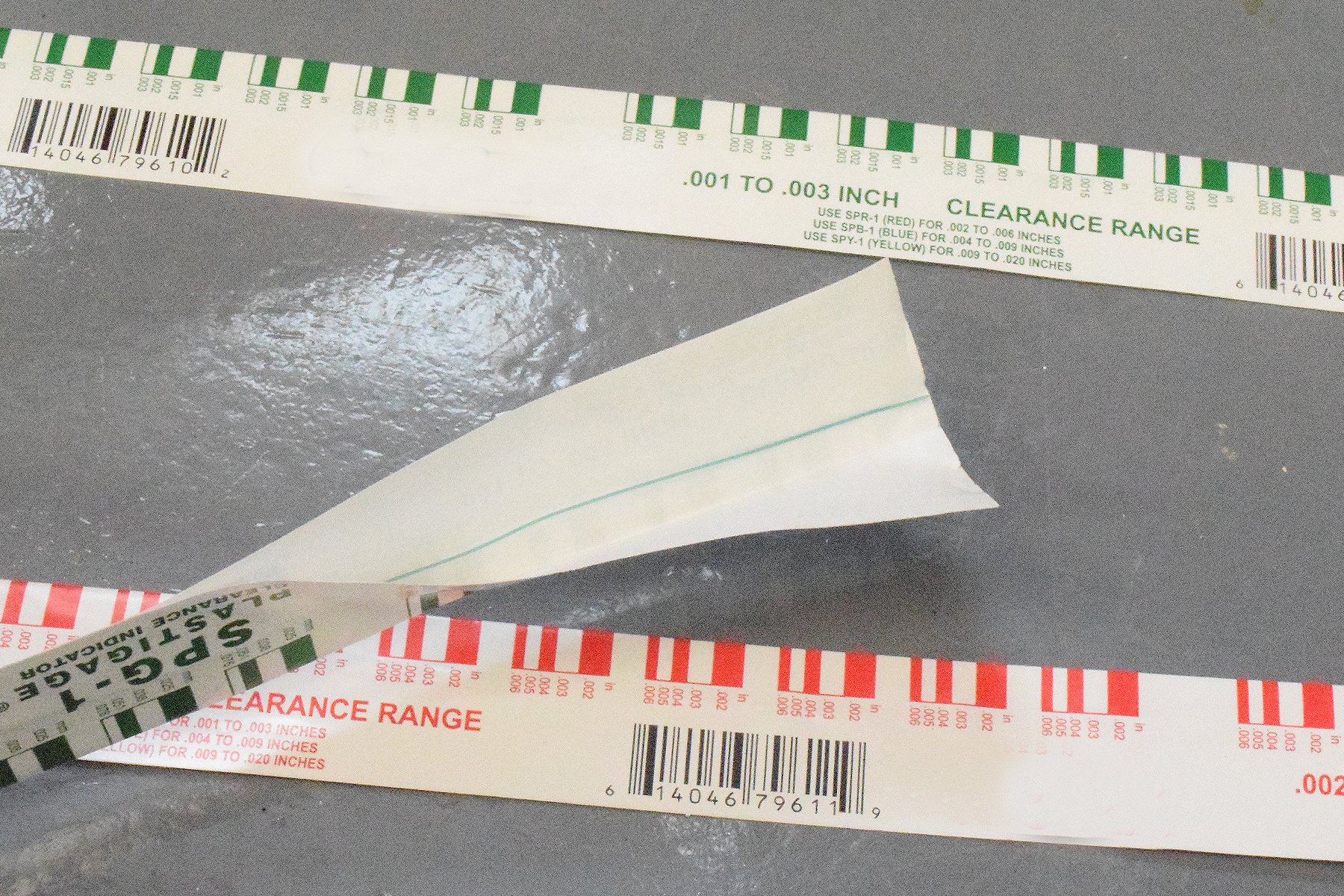
Plastigage is offered in three tolerance ranges for typical automotive use. The sizes range from green: .001- to .003-inch (.025- to .076-mm), red: .002- to .006-inch (.051- to .152-mm), and blue: .004- to .009-inch (.102- to .229-mm).

I first inspected each bearing for any signs of damage. If damage is evident, measuring tolerance is a moot point until you have the crankshaft checked and possibly polished or machined for future use. If you install new bearings, the use of Plastigage at this point would be a good step during reassembly.

When I purchased the Camaro, the seller told me the engine had no more than 25-passes on it since built new. This bearing inspection indicated that to be true with no damage or heavy wear indicators.

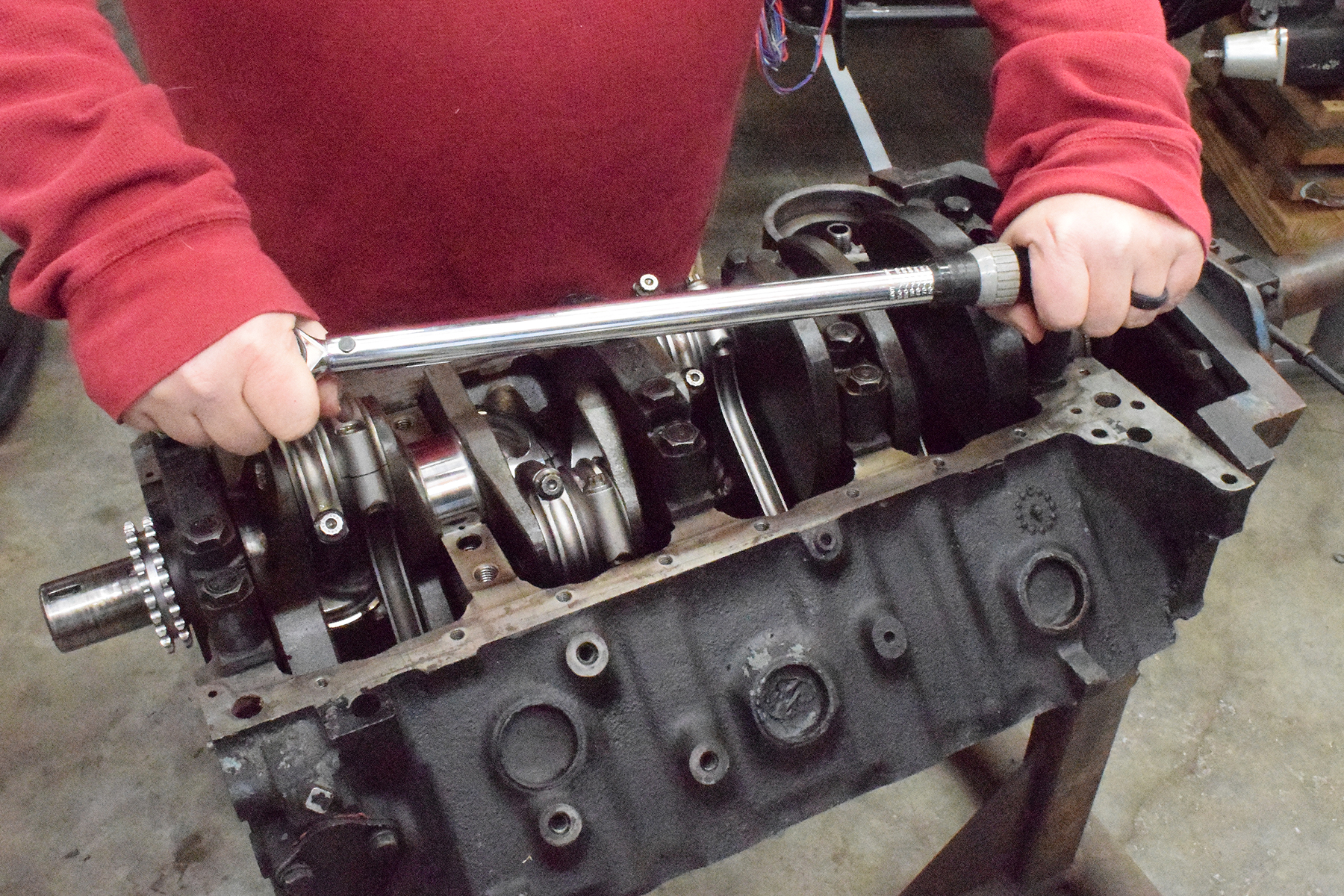
Cautiously torquing each cap to specification with the Plastigage in place is necessary to get an accurate thread crush.

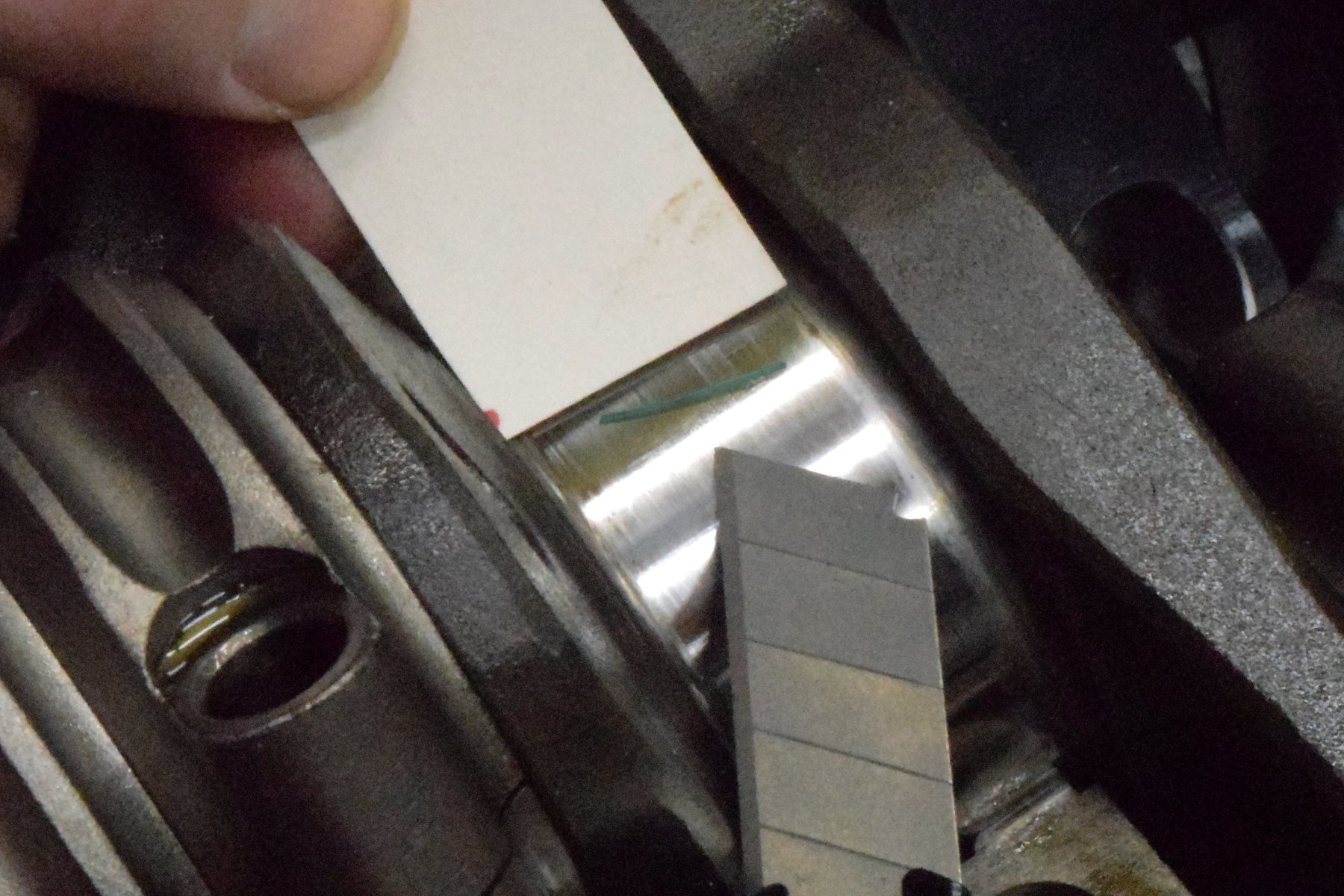
I began testing the bearing tolerances one bearing cap at a time. Removing one rod cap at a time to install the Plastigage test seems like a reasonable precaution to avoid any switch-ups. Make sure not to place the test thread near any oiling holes as tolerances may differ around that area of the crank journal.

Remove, Retorque, and Repeat

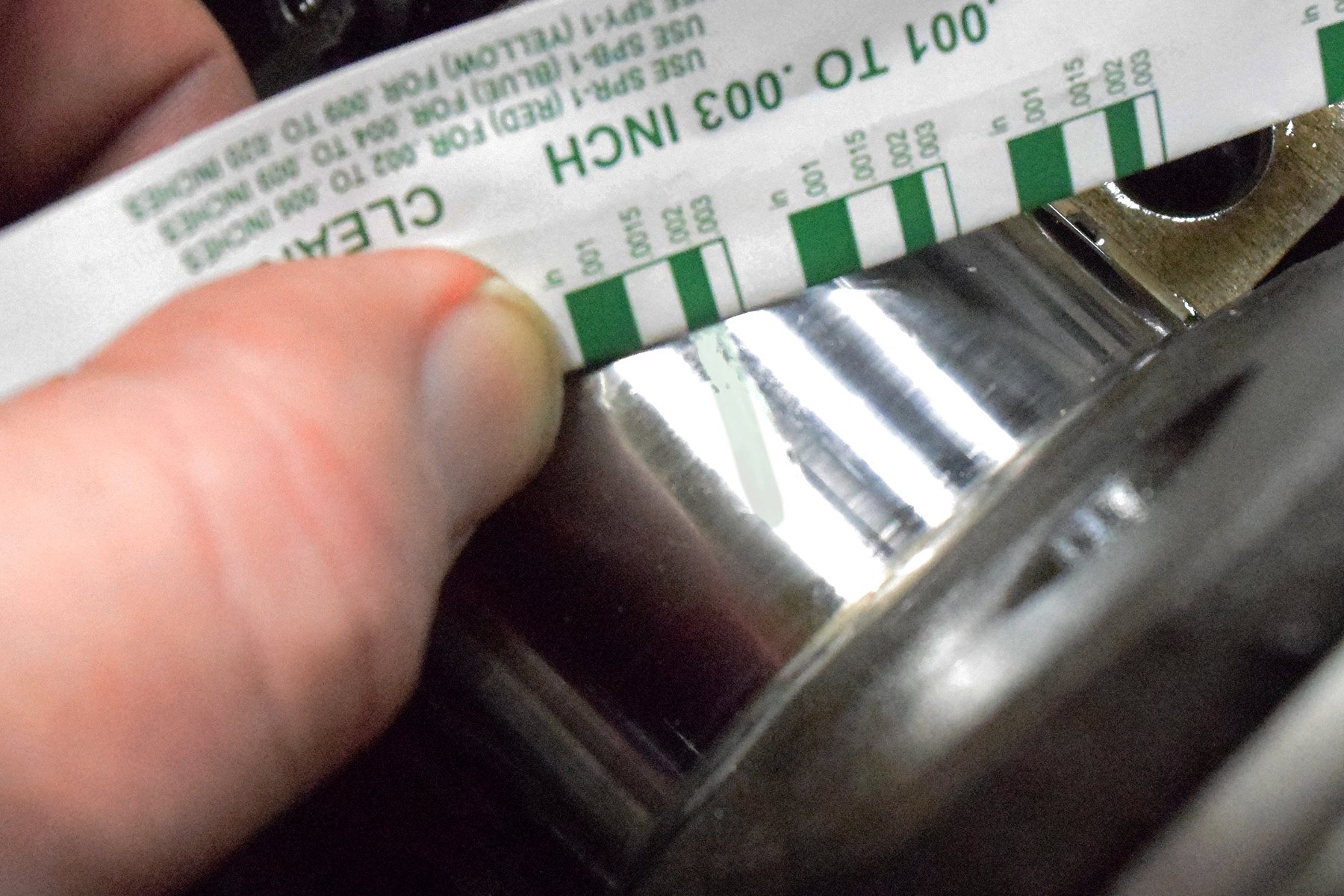
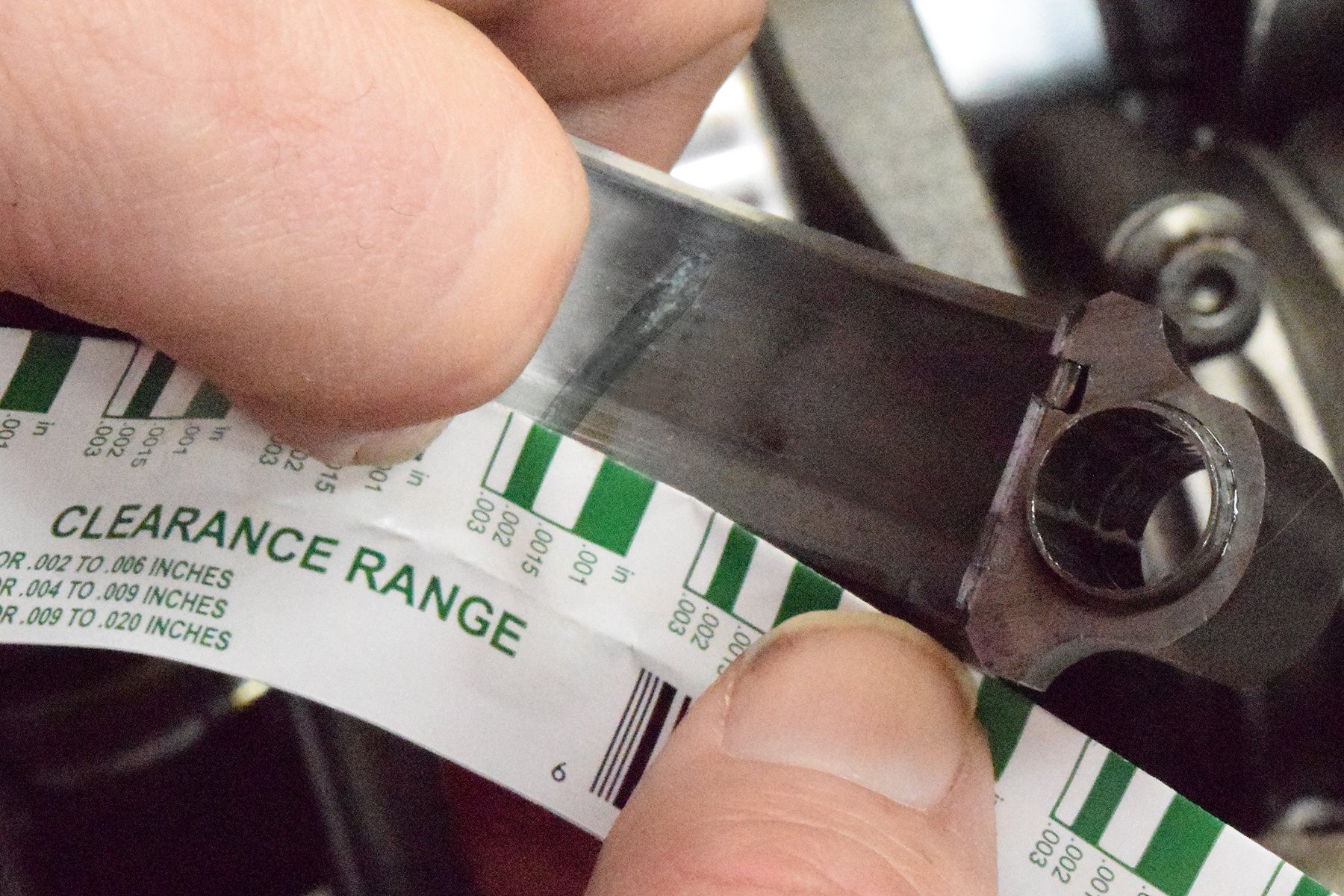
With the recommended bearing clearance from the engine builder noted, I used the green Plastigage. To gauge the results, use the printed ruler-type measurements marked on the thread wrapper. The wider the thread is when compressed, the tighter the bearing clearance.

I use some heavy white cardstock paper to cut each piece of thread carefully. With Plastigage sections cut narrower than the journal width, we also use a narrower piece of cardstock to place the tread onto the journal face. This avoids accidentally crushing the thread if you try to pick it up and place it.

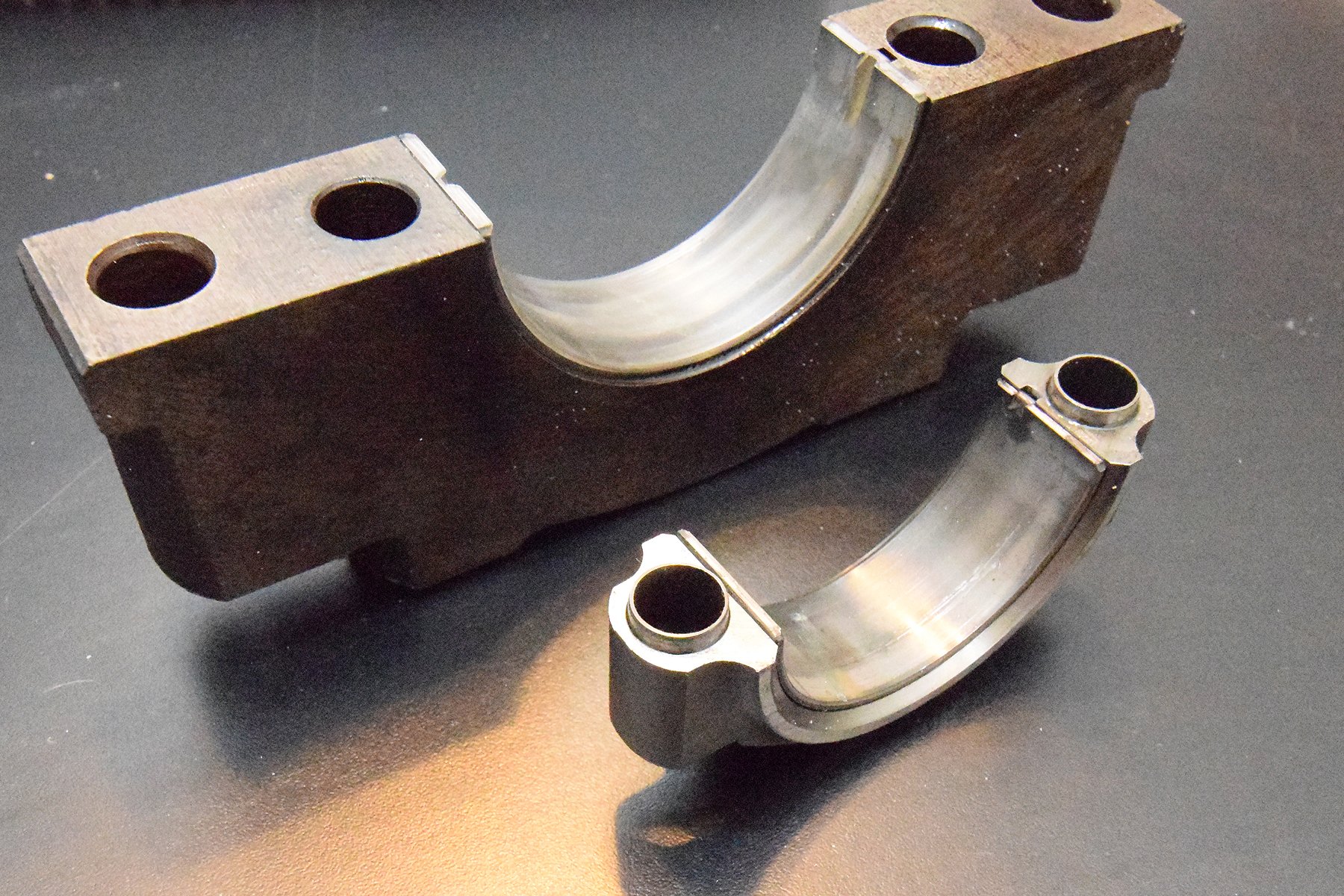
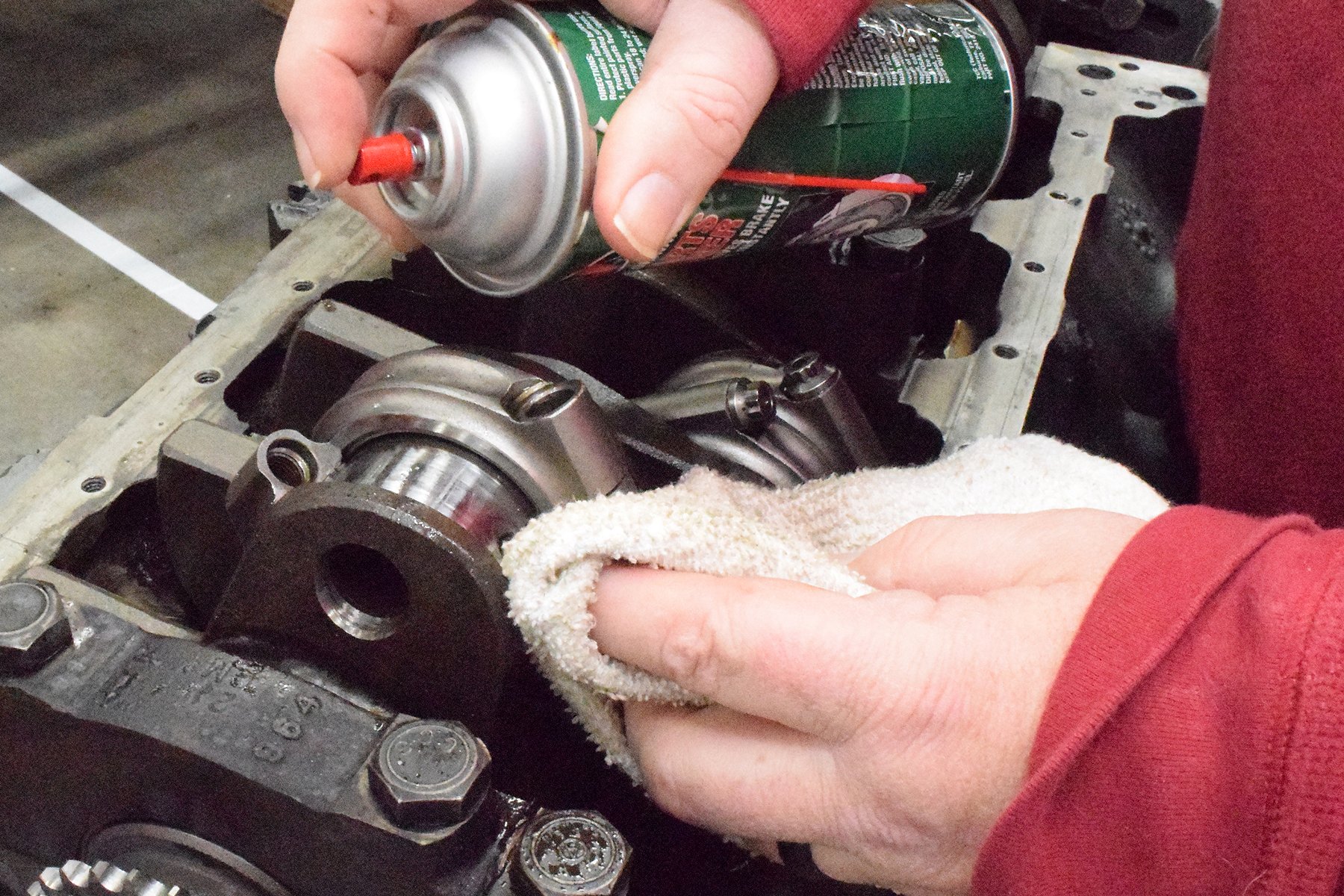
Thoroughly cleaning the bearing surface and the journal face before testing is absolutely necessary. Plastigage is intended to be used in a dry condition. Any oil or residue on the surfaces can throw off the compression results. Once installed, torqued to specifications, and then loosened, carefully remove the caps directly outward from the crankshaft face, as not to damage the compressed thread. Sometimes the compressed Plastigage will affix to the crankshaft journal or the bearing face.

If your engine uses a main girdle or internal oil pump, make sure to perform the proper install, torque, and removal process to ensure any changes to bearing clearance measurements. We carefully clean all bearings and journals with brake cleaner as Plastigage is intended for use on oil free surfaces.

Trust, But Verify If Necessary

Once the bearing cap was removed, I matched our compressed thread with the width ruler on the thread wrapper. The thread compressed to just slightly wider than the .002-inch indicator. This measurement indicates the bearing clearance at just slightly more than .002 clearance or near our goal of .0020- to .0025-inch.

To gauge the Plastigage results, compare the crushed Plasigage to the thread wrapper markings. The wider the thread is compressed, the tighter the bearing clearance. When you carefully remove the bearing caps following the crush process, it may adhere to the bearing or the journal.

The bottom line is, Plastigage is a “trust, but verify” device for me. Many engine builders highly downplay the accuracy of the plastic thread. In contrast, many home builders swear by its use for the task, such as those I performed on our bracket engine.

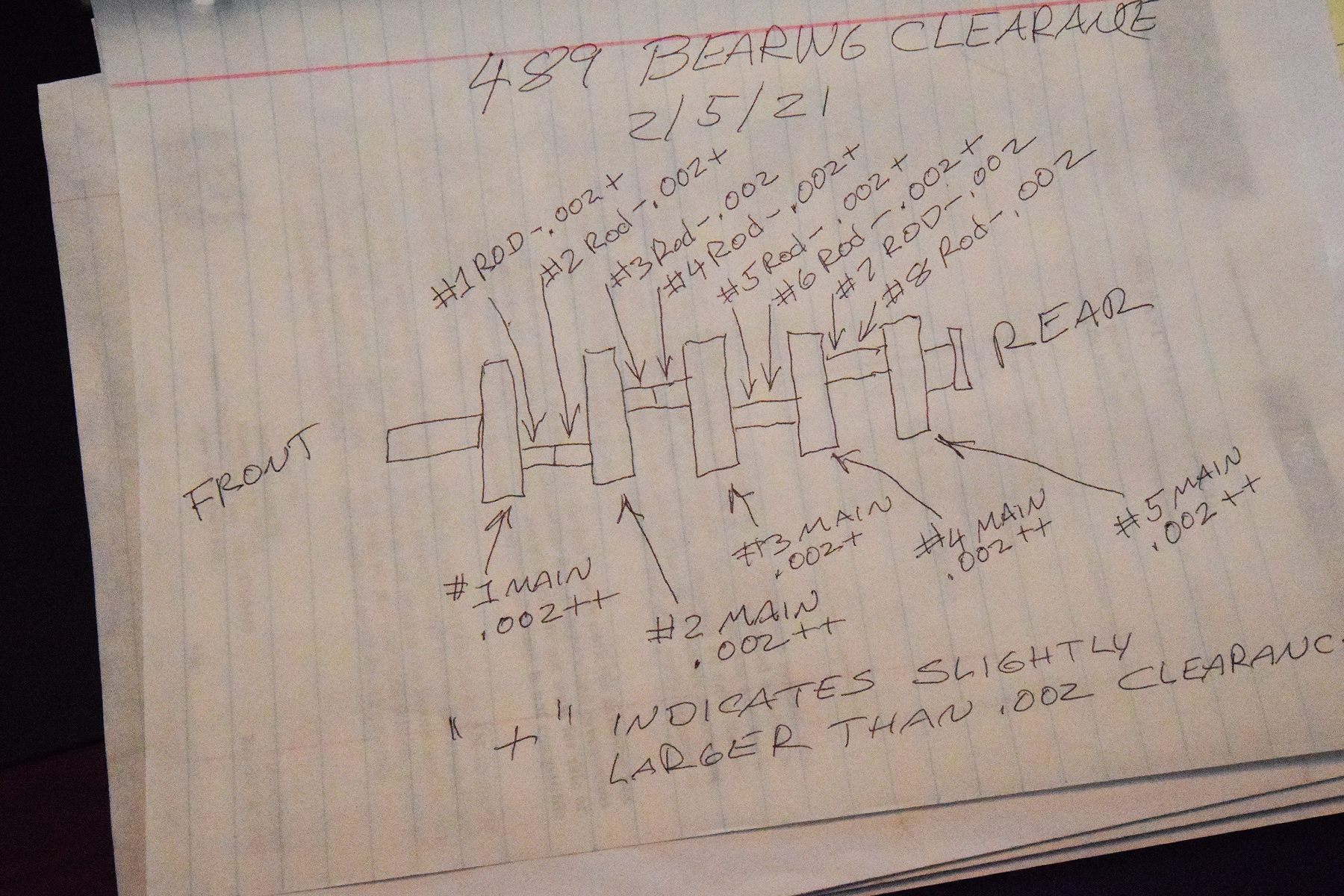
I logged each of our individual bearing clearances for our Camaro logbook. This is handy for future reference, and you can also spot trends such as a bent crankshaft. If the clearances incrementally change towards the center or at each end, it is wise to have a trusted crankshaft shop check for problems.

With some friends watching my Plastigage work within my own shop, one buddy asked me if coated bearings play any role with clearances. I passed the question along to Begle. He responded, “Clearance is clearance, no matter what the bearing type. Though coated bearings in a performance application is an entirely different subject, I would still set up my clearances the same, coated or uncoated.”

If you have the talent to tear down, build, and rebuild an engine in your shop, Plastigage is an excellent tool to help you verify “red flags” along the way. If bearings do not pass a visual inspection or you find they have fallen out of tolerance, it is time to visit your favorite engine machine shop.

Posted on Leave a comment

What CFM Ratings Mean To You With SPAL Cooling Fans


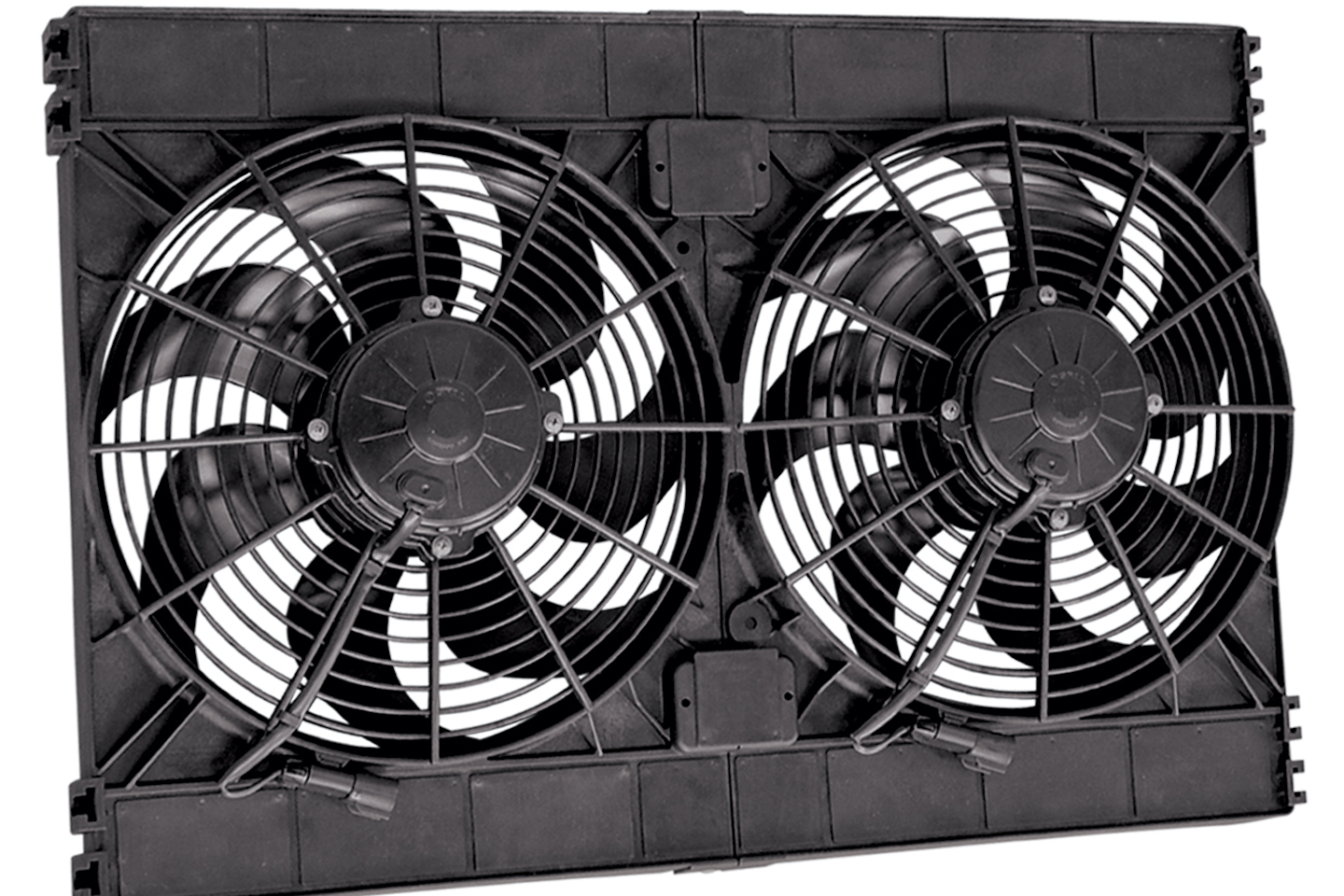
When shopping for new automotive components, it never fails that we are bombarded with tricky sounding terms and acronyms. Many times, we are casually familiar with these acronyms and we may know what they stand for, but don’t actually know what it does. Take CFM for example. Most people can correctly state that CFM stands for Cubic Feet per Minute and it is a measurement of airflow. But, what does it really mean to car enthusiasts?

It is not uncommon to hear salesmen quote CFM numbers when explaining cooling fans. From time to time, you may also hear one representative explain how company X’s CFM numbers are not as accurate as company Y’s. So we approached the specialists at SPAL USA to explain CFM to us.

One of the most common questions we hear from customers is ‘What is the CFM rating?’ of a particular fan,” said Thom Balistrieri, director of aftermarket sales for SPAL USA. “This is a tricky question, as it’s very important to understand how CFM ratings are determined as well as how much CFM an application actually requires.”

According to Balistrieri, CFM ratings should be looked at subjectively because there is not an accepted standalone method of measure when it comes to determining CFM ratings.

“Think of it like wheel horsepower. Different dynamometers [dynos] will give different wheel horsepower ratings,” Balistrieri explained. “Sometimes, there is a ‘correction factor’ from one dyno manufacturer to another. This is the same situation, where measuring on a machine with different certifications could give different data.”

Tabular Data

SPAL uses a broader spectrum of CFM data for consumers to understand a fan’s ratings. “We provide tabular airflow data to our customers,” Balistrieri added. “This tabular data allows our customers to see how the fans perform across the entire static-pressure range.  This is critical information when selecting the correct fan for the job, and often, the most misunderstood aspect of fan selection,” he said.  “When customers don’t consider the static pressure drop of the radiator, it’s easy to get a fan that is underpowered for the task.” 


Balistrieri’s advice is to not get misled by trying to standardize and compare all the different methods of CFM measurement in the industry. He says there is an easier approach. “One way to determine if CFM ratings make sense is to look at the current draw of the fan.”

This approach states the current draw (in amps) is proportional to overall fan performance. “Motor-current draw is directly related to motor torque and the amount of pressure the fan can generate to overcome the restriction of the radiator,” he said. To put it even more simply: Increased amperage typically equates to increased airflow.

“We have a fan to solve nearly any circumstance you can imagine,” added Balistrieri. We actually put together an article about fan selection, and you can find that information by clicking here. According to Balistrieri,  “just call (800) 345-0327 to talk to an experienced technician and determine which SPAL fan is best for you.” Or visit them online at www.spalusa.com.

Posted on Leave a comment

Boost-N-Juice: Why You Should Run Nitrous On A Boosted Engine


For years nitrous, supercharger, and turbo companies have pushed enthusiasts to use one or the other. You were either going to be a fan of boost or nitrous oxide, but not both. They were like oil and water as you would hardly ever find someone using these power adders in conjunction at the track or on the street. Today, it’s not uncommon to find boosted cars with nitrous, as well. Street Car Takeover and other events even allow for multiple power adders permitting the enthusiast to get the most out of their vehicles. One company that has pushed these boundaries in the last five years is Nitrous Outlet. But, it hasn’t always been that way. We reached out to Dave Vasser, owner of Nitrous Outlet, to see what’s changed and to get the inside scoop on injecting nitrous into a supercharged or turbocharged application.

LSX Mag: Why do you support nitrous and boosted combinations?

Dave Vasser: I owned a speed shop for many years back in the early 2000s. I wasn’t much of a boosted fan at that time, however, superchargers and turbochargers have come a long way in technology and dependability. Now, performance vehicles are coming from the factory with blowers or turbos on them. There is only one way to top the increased performance and drivability of a boosted street application, and that is adding nitrous. Now you can have the drivability with all-out performance when you’re ready to get after it. 

LSX Mag: How do nitrous and boost work in unison?

Dave Vasser: The best way to explain the benefits of using nitrous on boosted applications is to address how each power-adder increases the engine’s performance.  

Nitrous and boost both provide the ability to increase the air pressure within the combustion chamber. The higher the air pressure, the higher the air molecules are. The higher the air molecules are, the higher the oxygen content is. When the oxygen content is high, more fuel can be burned. This increases combustion and cylinder pressure, enhancing the speed at which the piston is pushed back down into the cylinder. This process creates additional “horsepower.” In simple car guy terms, Oxygen + Fuel + Cylinder Pressure = Horsepower. 
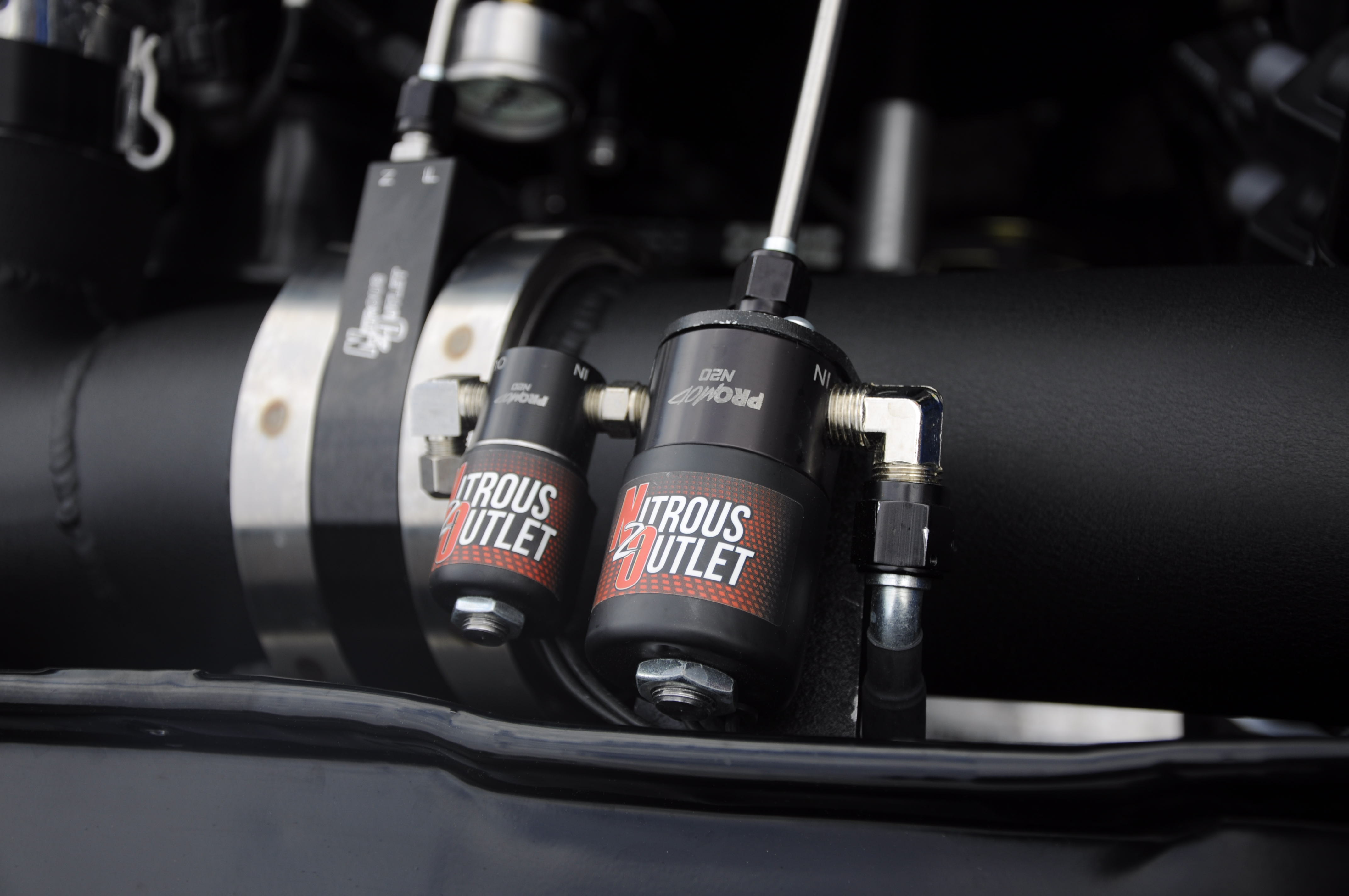
The Nitrous Outlet Interspooler is an excellent addition to both centrifugal superchargers and turbochargers alike.

Nitrous Oxide is a compressed liquid composed of two parts nitrogen and one part oxygen. Due to high combustion chamber temperatures, as the nitrous enters the combustion chamber, it breaks down, separating the nitrogen and oxygen molecules. As the bond breaks apart, the nitrogen acts as a heat absorbent, and the oxygen increases the ability to burn more fuel.

Boost is created from compressed air that is forced into the combustion chamber. The engine can receive more air due to the compressed air than it would pull in naturally, hence the term forced induction. Increasing the combustion chamber’s air pressure increases the oxygen content, which increases the ability to burn more fuel. This enhances the combustion process, which increases the cylinder pressure, returning the piston at a faster rate of speed.

LSX Mag: How does nitrous help turbo applications?

Dave Vasser: A turbo relies on exhaust gases from the engine to spin the turbine and create boost. The turbo will continue to build pressure as the power plant increases RPM, so the power increase is not instant. Engine and turbo combinations that are not perfectly matched will not be as efficient. Too small of a turbo will spin the turbo faster, creating excess heat, and too large of a turbo will have issues spooling. However, adding nitrous will instantly boost the engine’s cylinder pressure, building RPM immediately while knocking down the cylinder temperatures. 

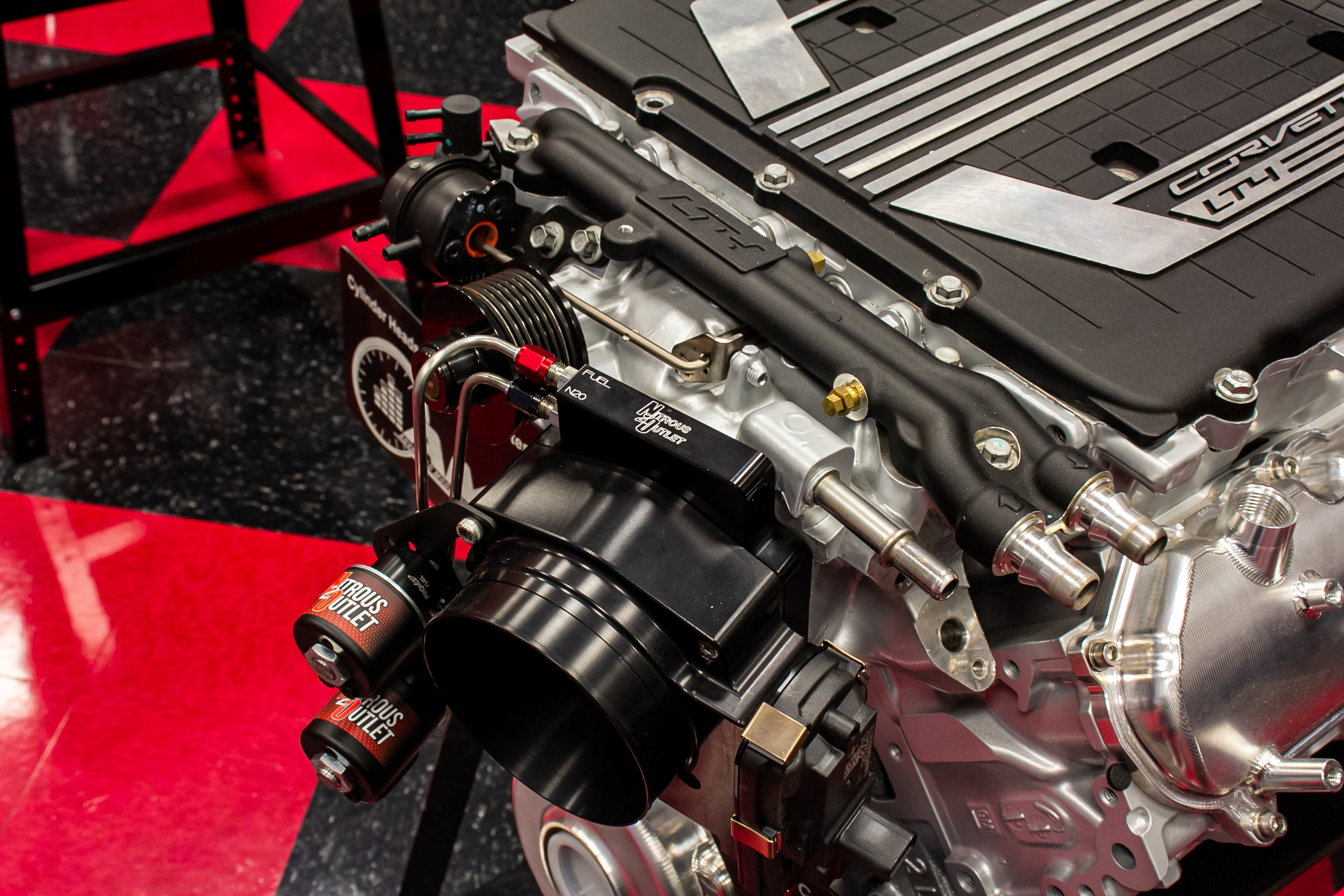
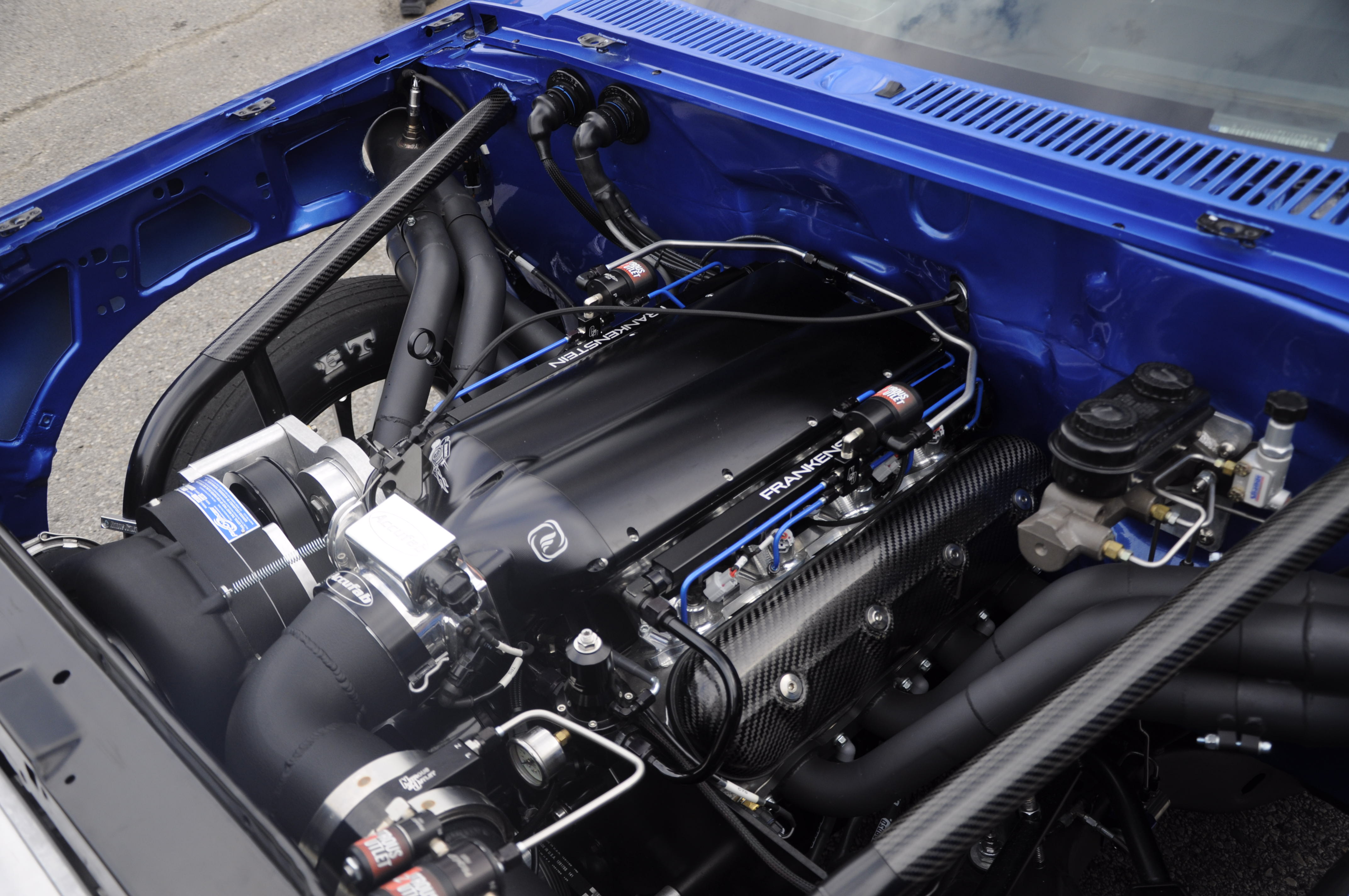
This particular engine has an Interspooler and a direct port system for the maximum with cylinder to cylinder tuning and plenty of additional horsepower on tap.

LSX Mag: How does nitrous help supercharge applications? 

Dave Vasser: Supercharger applications don’t suffer from delayed boost like turbo applications, however, they do rob some power from the engine due to how they build boost. A roots-style supercharger forces air into the engine through rotors that are driven by the engine’s crankshaft. A centrifugal-style supercharger forces air into the engine through a compressor design, similar to a turbo but the compressor is driven by the engine’s crankshaft. Both styles of superchargers will build boost as the engine gains RPM. Engine and supercharger combinations that are not perfectly matched will not be as efficient. Too small of a supercharger will spin faster, creating excess heat, and too large of a supercharger will have issues building boost. Adding nitrous will create an instant boost by providing instant cylinder pressure, making the engine build RPM instantly while knocking down the cylinder temps.

If you have a roots style supercharger, Nitrous Outlet can customize most brands by adding spray bars that discharge on the inside.

LSX Mag: Does any style of nitrous system work better than another when it comes to spraying nitrous?

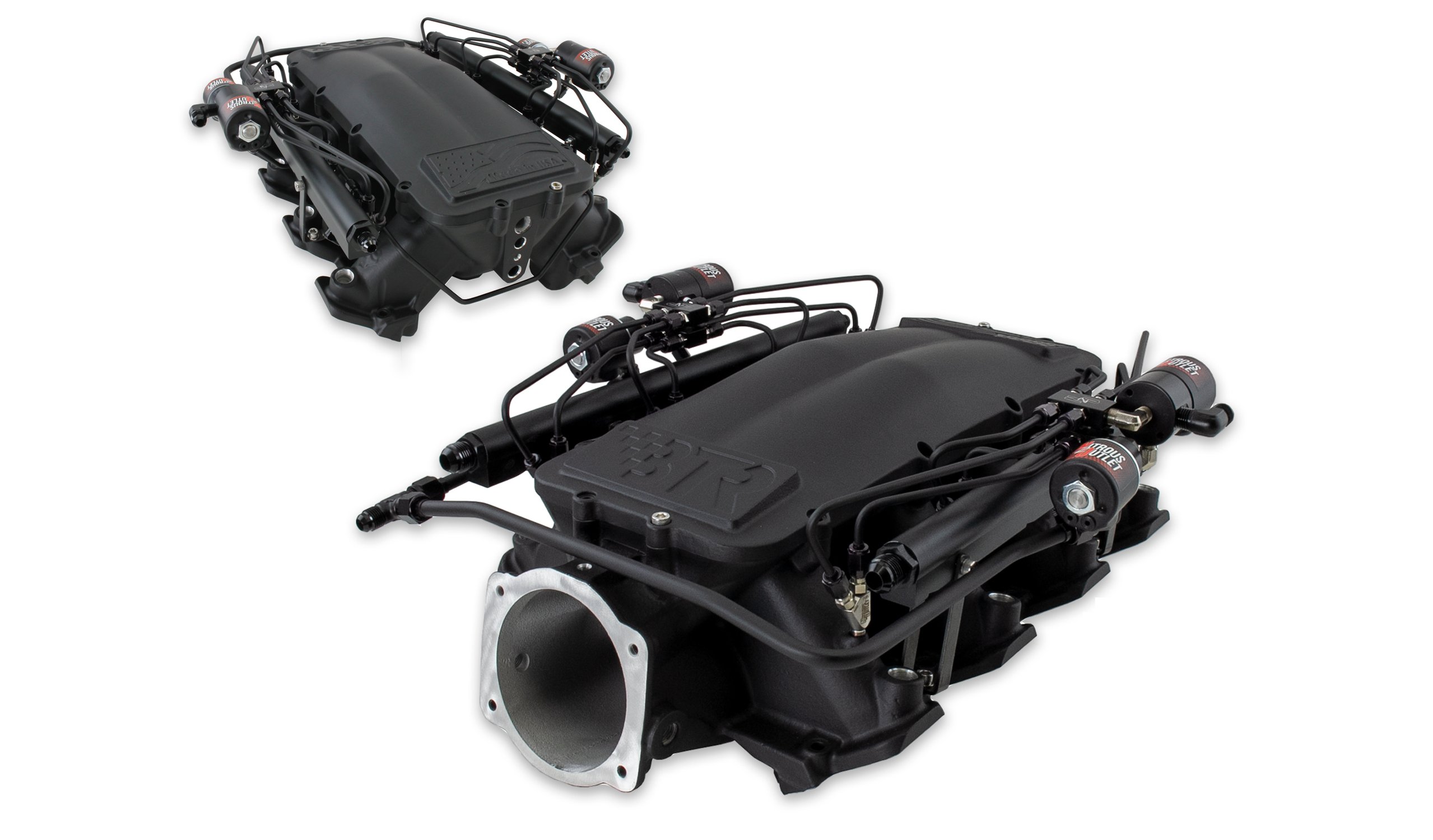
Dave Vasser: It comes down to how much nitrous is being added. If you’re injecting a lot of nitrous, a direct-port system may be your best option. A direct-port system will inject the nitrous directly into each cylinder, ensuring each cylinder is getting the same amount of nitrous. If you add a small amount of nitrous, there are many options, including a single nozzle in the air tube, an Interspooler plate system installed in the air tubing, or a throttle body plate on the intake manifold. 

The key is to saturate the air intake charge. The further back in the air intake tract, the longer the nitrous has to knock down the air temperatures. The more saturation the nitrous discharge has into the airstream, the better the distribution will be with the ability to knock down air temps. You can move the discharge point further back in the airstream on dry applications that add the nitrous system’s fuel through the injectors. On a wet system, which adds fuel with the nitrous, the discharge needs to be no further than six to eight-inches from the throttle body or intake manifold entrance. 

LSX Mag: What should you look for when running nitrous on a boosted application?

Dave Vasser: As with any performance modification, knowing the limitations of the engine components, fuel system, and ignition system are just as important as having a proper tune-up. It’s also important to keep intake air temps low to help suppress detonation. 

Nitrous plates mounted behind the throttle body are also a popular option among boosted performance enthusiasts.

LSX Mag: What does nitrous do for a boosted engine in high altitude or “bad air?”

Dave Vasser: To properly answer this question, you need to understand air density. Air pressure is dependent on air density. The more dense the air, the higher the air pressure will be, meaning more air molecules. The less-dense the air, the lower the air pressure will be, indicating fewer air molecules. 

There are three main factors that affect air pressure, which will impact an engine’s performance. 

  • An increase in elevation or altitude decreases atmospheric pressure – Atmospheric pressure is the force exerted on a surface by the number of air molecules above it as gravity pulls it to the earth’s surface. As you increase elevation or altitude from the earth’s surface, it decreases the air pressure, which means fewer air molecules.  
  • Increased intake air temps and decrease the air density – The colder the air is, the denser it becomes. The warmer the air is, the less dense it is. This means there are fewer air molecules. 
  • Water content or humidity – Moist air is less dense than dry air, which means the higher the water content, the less compact the air is. As a result, there will be fewer air molecules. 

All of the above examples will all equate to less air molecules = less oxygen = less fuel burned = less power. 

In simple terms, boosted applications compress the outside air by forcing it into the engine. If the air quality is poor, the oxygen content is too. Adding nitrous provides the oxygen content needed to burn more fuel and make instant power. 

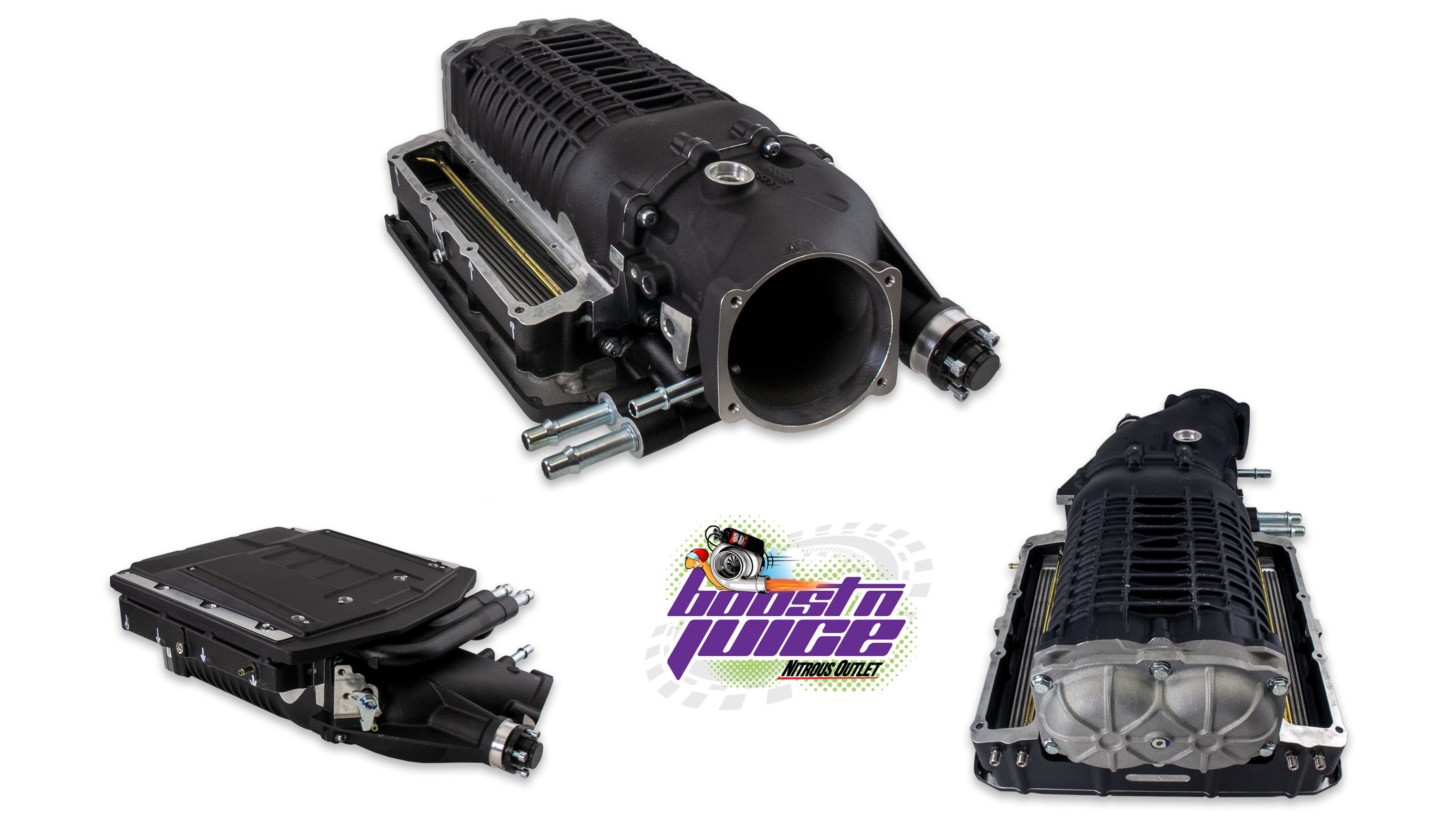
If you’re running a Whipple and want additional power and a cooler air charge, custom nitrous spray bars are the way to go.

LSX Mag: How does nitrous cool the intake air temps on boosted applications?

Dave Vasser: Forcing compressed air into an engine will build heat, which reduces the oxygen density. As nitrous leaves the discharge port and enters the airstream, it will expand, turning from a liquid to a gas with a temperature of around 129-degrees Fahrenheit below zero. This cooler temperature means the air is denser and will significantly reduce the air intake temperatures. Adding nitrous will increase horsepower, and due to its cold nature, it will act as a cooling agent. This knocks down the intake air temps and helps aid in detonation.

LSX Mag: Will you need to change your tune-up for boost and juice?

Dave Vasser: As you increase power on any application, whether it be naturally-aspirated, boosted, nitrous-assisted, or boost and juice, you will need to alter the tune. The engine will need higher octane fuel, more fuel, less timing, and a colder spark plug. 

LSX Mag: How should you address a timing map when spraying nitrous on a turbocharger or supercharger application?

Dave Vasser: You will set up the timing ramp to remove timing as the nitrous activates. The amount of timing will be dependent on how much nitrous you’re adding. The odds are that the system will increase in boost due to the improved air quality, so even if you’re adding a small amount of nitrous, adjusting the timing to compensate for the change is crucial.

LSX Mag: Do you see better results when spraying a supercharger or turbo?

Dave Vasser: Both a turbocharger and supercharger can greatly benefit from adding nitrous. The results vary with different applications. Keep in mind that keeping intake air temps down helps aid in detonation. Applications that are non-intercooled will have increased air temperatures, as well as applications that are over-spinning the blower or turbo.

Nitrous Outlet has realized the potential of boosted applications with nitrous, and they even built an S10 to test new products with. 

This S10 truck known as Stitch houses a ProCharger centrifugal supercharger along with a Nitrous Outlet Interspooler plate and a direct port system.

“We built a 1993 S10 called “Stitch” to market Nitrous Outlet’s Boost-N-Juice program. This truck is a real head-turner, and it’s a blast to drive. It currently makes around 850 horsepower on a stock LS bottom end with a set of Frankenstein LS3 heads, an F1A-94 ProCharger, and a 100 horsepower shot through the Interspooler plate,” Vasser shares. “Thompson Motorsports is currently building a 427 to replace the stock short block. Once we swap out the engine, we expect to make around 1,500 horsepower and utilize the direct-port nitrous system and a Frankenstein billet intake.”

Nitrous Outlet offers a ton of nitrous systems and accessories to set your vehicle apart from the others. These 12lb composite bottles and billet bottle brackets are just tips of the iceberg.

It’s exciting to see the market change as companies like Nitrous Outlet and others encourage the use of its products with other power adders. Obviously, there’s a lot of added benefits to running nitrous on a boosted application, so it makes sense. This potent combination will give a boosted car the best of both worlds, and who wouldn’t want that? Nitrous Outlet offers a ton of innovative nitrous systems that will work with many different boosted combinations. If you have a question, give them a call or visit their website for more information.

Posted on Leave a comment

What Is Windage In An Engine And How Do We Fight It?

When planning an engine build, one term that often pops up when discussing the bottom half of the short-block is “windage.” Now, this term shouldn’t be confused with the term “Kentucky windage,” which is something else altogether. If we use the Oxford definition, it states that windage is, “the air resistance of a moving object, such as a vessel or a rotating machine part, or the force of the wind on a stationary object.” If we drill down to automotive engines specifically, windage is defined by Canton Racing Products as, “the flow of air within the crankcase.”

Generally, when we say windage in the engine, we are referring to the effect windage has on the oil in the crankcase. All that air movement generated by motion within the crankcase can have a negative effect on the oil in the system in a number of ways. Then there is the physical effect that uncontrolled oil in your crankcase can have on the rotating assembly — drag. So let’s get to know what we are fighting, and then we’ll talk about how to effectively fight it.

Know Your Enemy — Windage’s Effects on your Engine

There are a number of avenues in which windage makes life in the crankcase less than ideal. When any liquid is churned with air, you get aeration. In the case of engine oil, aerated oil has a number of drawbacks. First, aerated oil doesn’t pump as smoothly. Excessive oil aeration can cause oil feed issues since oil pumps are designed to move fluid, not froth. Why oil-starvation issues are bad is pretty self-explanatory.

The second drawback of aerated oil is that engine oil mixed with air doesn’t dissipate heat at the same rate as clear liquid oil. Increased oil temperatures in the system lowers the actual viscosity of your oil, which reduces the oil’s ability to properly do its job within the engine. Combine elevated oil temperatures with frothing issues, and you can start to see a loss in oil pressure.

The next method through which windage can reduce your engine’s performance is through brute force. Ideally, the crankshaft would spin through clear air and only face air resistance. However, with oil splashing all around the crankcase, impacting the spinning counterweights and journal throws, that oil can cause a real and measurable amount of drag on the crankshaft.

Obviously, we try to reduce drag on the crankshaft in a multitude of ways when building an engine, so it only stands to reason that you address this source of potential power loss as well. Additionally, when the fast-moving crankshaft smacks into that oil, you (again) run the risk of oil aeration.

Knife-edging a crank is designed to reduce the counterweight’s resistance to moving through oil spray. This design, called Ultra-Shed by Callies, also profiles the trailing edge of the counterweight to direct oil away from the oncoming crankpin.

The third form of chaos that excessive windage can cause is another path to increased oil temperatures. By splashing that oil all over the cylinders and rotating assembly, it acts as a heat sink, pulling extra heat out of the components and cylinder walls and then introducing it into your oil supply.

While this can be an advantage when built into the system through piston cooling jets, in those systems, the extra heat is accounted for in the overall design of the system. (We won’t even touch the debate between the benefits of cooling the pistons vs. the drag induced by the weight of the oil sprayed onto the piston in this article.)

Fighting The Good Fight

Since we know the problems windage can cause and the methods through which it causes them, companies like Canton can effectively combat and mitigate the issue. “Mitigating windage is pretty pivotal in the design of our oil pans,” says Iann Criscuolo, Sales and Marketing Manager for Canton. “We have several features in our pans aimed solely at reducing windage.”

The engineers at Canton have four main methods through which windage is reduced or its effects mitigated. Remember, you can’t stop the movement of air that results from the crankshaft spinning through the crankcase, but you can control the oil.

First, is what is known as a crank scraper. While it doesn’t actually physically scrape the crankshaft like a razor blade against the skin, it does get quite close to the crank, physically, and traps oil coming off of the spinning crankshaft, preventing it from being slung upward into the crankcase.

The crank scraper is the simplest form of windage control. It’s often used in applications that don’t have room for a windage tray from the factory. As you can see on the right, there are even bolt-on options for factory pans.

Crank scrapers are probably the simplest form of windage control, and can even be implemented on stock oil pans in some cases. “We use crank scrapers in pans that either don’t have the clearance for, or don’t come standard with a windage tray,” says Criscuolo. “It captures droplets, breaks windage, and forces oil back to the pickup of the pan.”

Next is a feature Canton calls the “power pouch.” It operates on a principle similar to a crank scraper, but with much more engineering involved. It’s effectively a lateral “kick-out” in the oil pan, on the side of the pan in the direction of crankshaft rotation, which gives displaced, agitated oil a place to go after it has been scraped/slung off of the crankshaft.

The power pouch is a louvered kick-out only on one side of the oil pan, designed to catch oil and give it a place to slow down and collect, away from the rotating assembly.

“The pouch keeps the oil away from the rotating assembly, preventing it from getting whipped up and creating the heavy atmosphere in the crankcase,” explains Criscuolo. “Keeping oil away from the crankshaft is an effective method, and if you can’t make the pan deeper [because of application/chassis restraints], you can make it wider.” Rather than bouncing off the side of the pan, the baffled compartment adds volume to slow and trap the oil to prevent aeration and feed it back into the oil supply in a much more controlled manner.
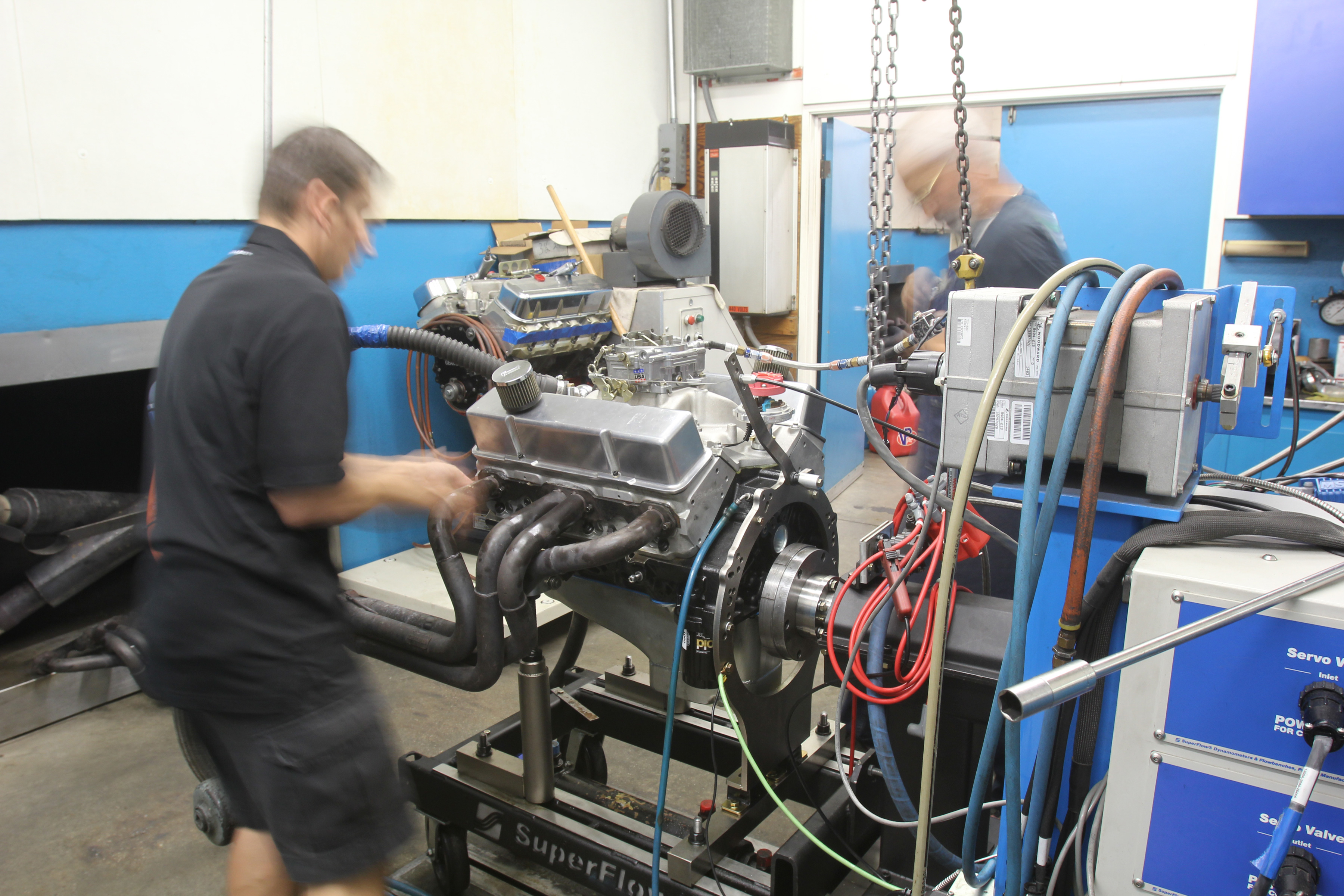
Then, there is the aptly named windage tray. These come in a number of designs and are even included on some factory engines. The idea behind a windage tray is that they provide a physical barrier between the violently moving crank with the oil it’s throwing everywhere, and the oil supply, while still allowing oil to move back into the oil supply in a smoother, calmer manner.

On the left is a one-way-screen type of windage tray, and on the right is a louvered style. Sometimes it comes down to personal preference, but as Criscuolo points out, the solid design of the louvered windage tray also breaks up airflow as well as control oil movement.

There are several ways to accomplish this, but the two main designs utilize a louvered tray and a mesh tray. “I personally prefer the louvered designs, because it’s a solid piece of metal between the crankshaft and sump to break up any splash,” says Criscuolo. “That extra surface area breaking anything up is a good thing. However, the mesh is a one-way mesh design, so it does make it more difficult for droplets to make it back through. But that solid louvered design can also break up air motion inside the crankcase.”
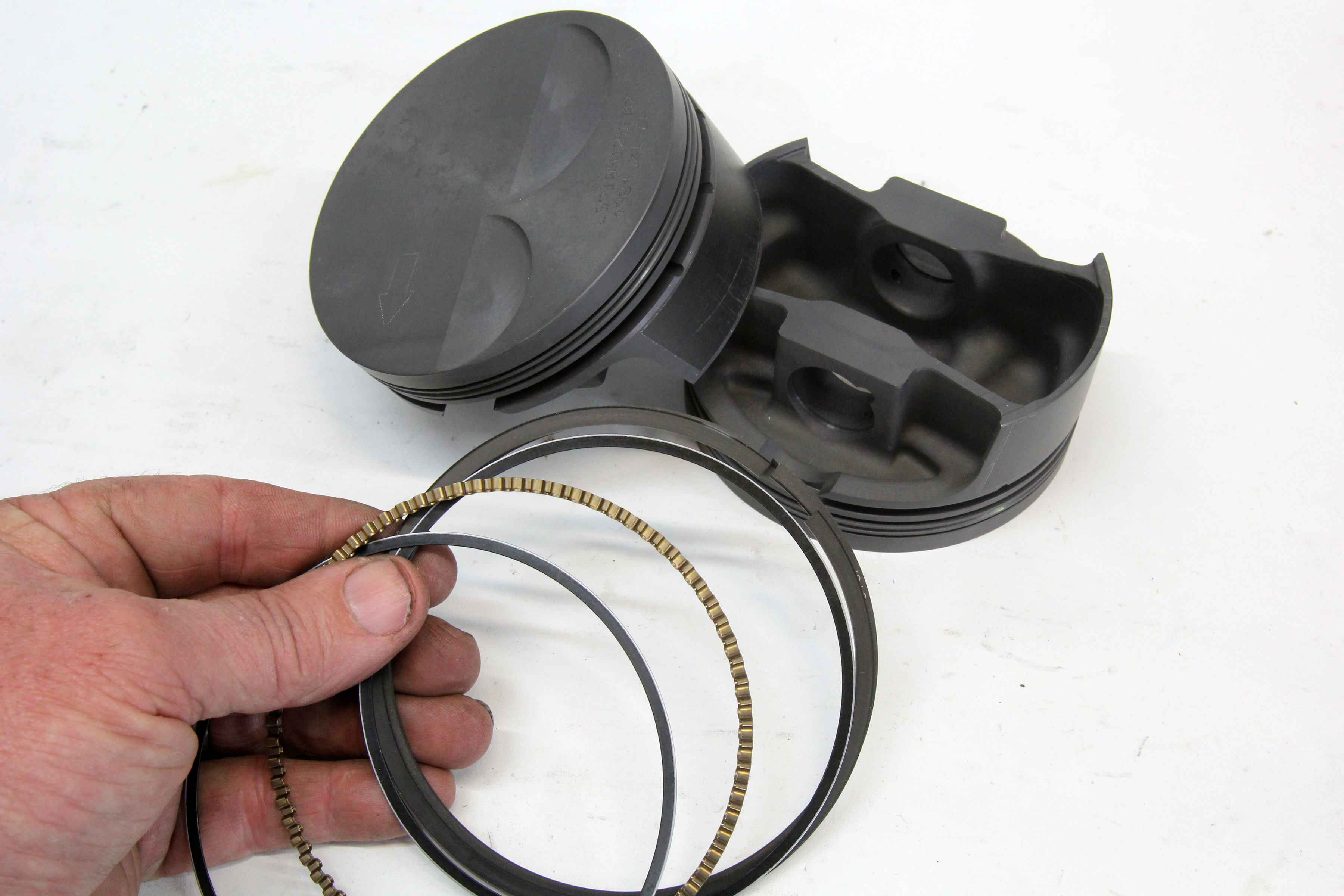
Finally, there is a windage cover for the anti-slosh baffles in the sump itself. The trap door baffles inside of Canton’s oil pans are designed to control oil slosh under fore, aft, and lateral G-forces when driving, but by incorporating a top plate, which has an opening just large enough for the oil pump pickup, it further controls the oil by preventing the turbulent air from grabbing oil out of the sump. “The plate is meant to keep the oil down in the sump and not let it get whipped back up,” Criscuolo says.
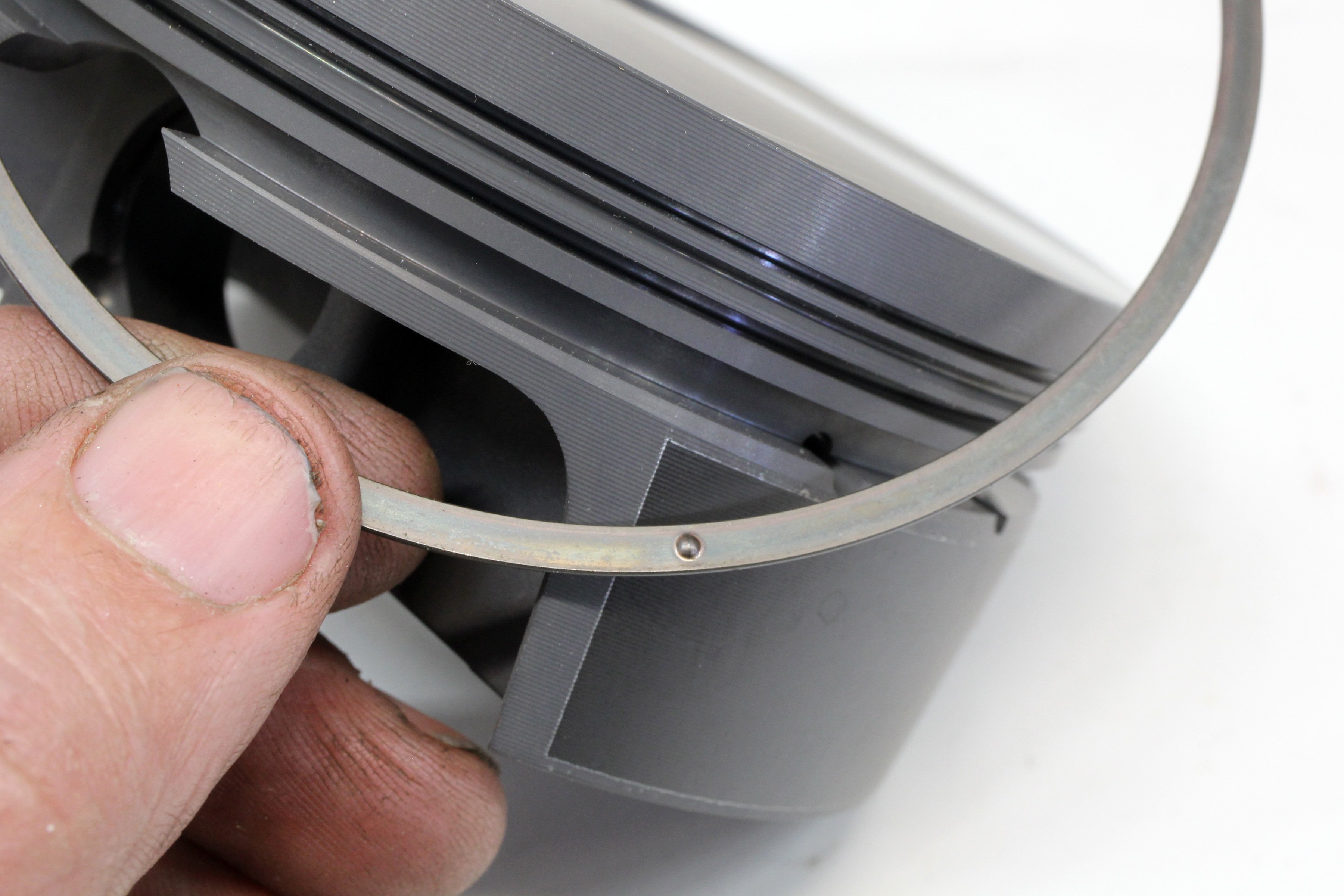
\Other Windage-Fighting Strategies

There are other ways in which windage is combated besides oil pan design. One of the more simple ones is simply through oil level. It’s long been a racer’s trick to run less than the normal amount of oil to reduce windage. While the proper oil level is a whole subject in and of itself, the idea behind running less oil is that with less volume there is less oil to slosh around, and the lower oil level is physically further from the spinning crankshaft.

Unfortunately, the risk of running less oil in your engine outweigh the reward in 99.9-percent of the cases. Besides running the risk of oil starvation under high G-forces, the reduced volume also has reduced heat capacity, which means elevated oil temperatures and the associated issues hot oil can cause. Those who run less oil than recommended in order to reduce windage are usually in competition settings, where an engine only runs for short periods, and the gains in power are worth the reduction in lifespan.

While the trap door anti-slosh baffles (left) in the sump are designed to help keep the oil pump pickup covered in oil, they also help control the splashing of the oil. Taking it a step further, Canton also incorporates a top plate to prevent vertical movement of the oil in the sump, and prevent it from being whipped up by the rotating assembly.

Another way that windage and its effect on the rotating assembly can be mitigated is through a process known as “knife-edging” the crank. That is where the leading edge of the counterweights are profiled to “slice” through any oil in its path, rather than smash through with a flat face. Callies even goes a step further with its “Ultra-Shed” counterweight profiling. That process profiles both the leading and trailing edge of the counterweight to move oil away from the counterweight, as well as direct oil away from the approaching rod journal as well.

As you can see after reading this article, windage is a common occurrence in any internal combustion engine, but its effects are intensified as engine speeds increase. This is both because velocity is an exponential component in the kinetic energy calculation, as well as the fact that with higher rotational speeds, events happen within a shorter period of time, allowing the oil less time to settle between the next event that disturbs it again.

While you might not need to go to the extremes of performance to mitigate windage, taking some steps to fight the effects of windage in your performance project will lead to tangible benefits in the long run.