
Posted on Leave a comment

Explaining Under- And Oversized Engine Bearings With King Bearings

When the subject of bearings and bearing clearance comes up, there is almost always a misunderstanding that takes place, thanks to the verbiage used in the discussion. So, today, with the help of King Engine Bearings, we’re not only going to clear the air on the terminology of under- and oversize bearings, but also some of the ways you can easily fine-tune your clearances to the half-thousandth of an inch.

Oversized Versus Undersized

The first, and most important item to clear up before we even get started is the terminology we’re going to be using. All engine bearings come in the standard (or STD) sizing for the specific application. That bearing size is designed to fall 100 percent within factory specifications for bearing housing diameter (be they main bearings or rod bearings), crankshaft journal diameter (be it a main journal or rod journal), and factory-specified oil clearance. So, if absolutely everything in your engine is to factory specifications and tolerances, standard bearings are perfect for you.

However, we live in a less-than-perfect world, and a lot of times we’re doing things that would make factory engineers cringe (officially, anyway). To address the variances in sizing and to allow for component wear, alternate-sized bearings exist. These are referred to as undersized or oversized bearings. Now, where the confusion comes in here, is that in both bearing designs, there is more material than standard. Because A) bearings are designed to work at a minimum material thickness, and making them thinner would make them weaker, and B) if your journal is too large, you can simply machine the journal.

Here you can see the various bearing sizes offered by King in their lineup.

That said, oversized bearings do exist in the King lineup. “In an oversized bearing, material is added to the outside, increasing the outside diameter,” explains King Bearings’ Guy Haynie. “Those bearings are used when material has been removed from the engine block or rods.” These bearings, in a standard bore diameter with a standard-sized journal, will reduce the oil clearance by .001 inch (.0005 inch per bearing shell). Conversely, if your main bore or rod’s big end diameter is slightly oversized, they will bring oil clearance to factory specs.

The other option is undersized bearings. “In an undersize bearing, material is added to the inside, decreasing the inside diameter,” explains Haynie. “They are used when material has been removed from the crankshaft journals.” Undersized bearings come in far more size options. Because not only do they come in the same .001-inch variation as the oversized bearings, but also in .010-inch, .020-inch, and .030-inch undersize variations, for journals that have been turned down .010-, .020- or .030-inch, respectively.

To further complicate the issue, within each of those undersize variants an oversize variation (denoted by an X in the size) exists, as well as a variant with .001 inch less clearance. What that means is that, in the King bearing lineup, options exist to go from standard, or to gain an additional .001 inch of (or “loosen up”) oil clearance. On the other side of the equation, the available undersize options are .001, .009, .010, .011, .019, .020, .021, and .030-inch of less clearance, giving you the ability to “tighten up” your clearances.

These .001-inch-undersize LS rod bearings allowed us to mix with standard-size bearing halves to pull out .0005 inch of oil clearance from our rods.

Fine Tuning Those Clearances

As you might have seen recently in LS5.0’s short-block build, we found ourselves in the middle of the clearance range in our rods. We wanted to tighten up our clearances by about .0005 (half a thousandth) of an inch. Looking at the chart, our only option appeared to be reducing the clearance by .001 inch, or twice what we wanted to take out. So, what to do?

That is where mixing bearing shells comes in. By taking a standard rod bearing lower half, and a .001-inch undersized upper half rod bearing shell, and combining them in the same connecting rod bore, our clearance is increased by half a thousandth of an inch. That brings our tolerances exactly where we want them. This is common practice among engine builders who are constantly chasing ten-thousandths of an inch, and don’t typically settle for “good enough.”

This kind of granularity gives you the ability to fine-tune your oil clearances without a trip to the machine shop the alter journal or housing diameters, with the only cost to you being a second set of bearings. A few best practices to follow, are to place the undersized bearing halves in the same positions (either all upper or all lower, not mixing and matching) throughout the engines. The next is that this is a method to get .0005 inch of variation. It’s not recommended to use bigger variances, like trying to get .005 inch of clearance change by using a standard and .010-under bearing half.

By understanding how bearing sizing works, you are not only able to understand your options when assembling your next engine, and potentially avoid another trip to the machine shop if your clearances aren’t exactly where you want them, but this knowledge can also allow you to fine-tune your bearing clearances like a pro.

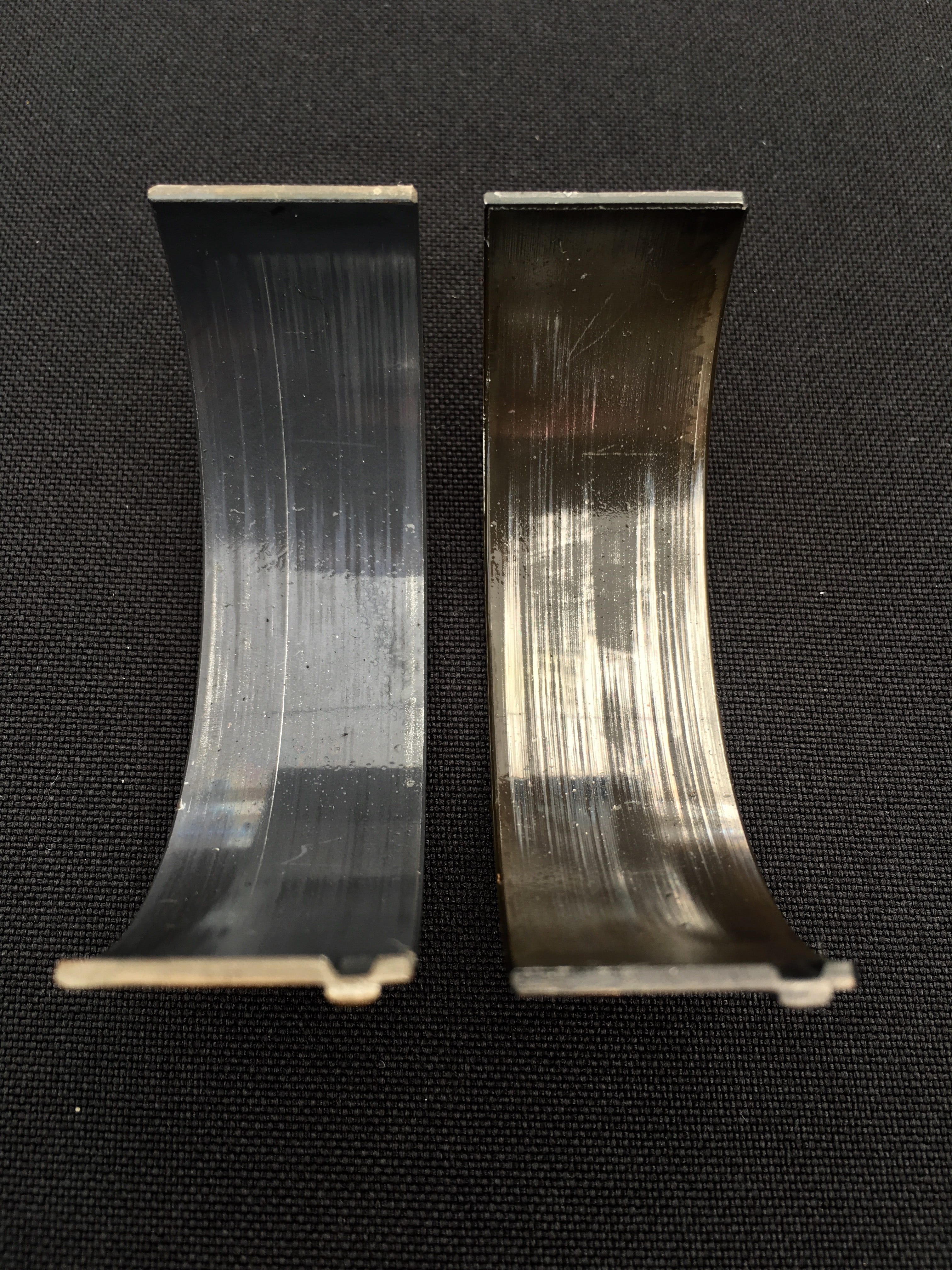
Here you can see the rod clearances with standard-sized bearings (on the left) and after swapping in half a set of .001-inch undersized bearings. On paper it should have tightened up exactly .0005 inch, but in reality we pulled a few extra tenths here and there.

Posted on Leave a comment

Explaining Under- And Oversized Engine Bearings With King Bearings

When the subject of bearings and bearing clearance comes up, there is almost always a misunderstanding that takes place, thanks to the verbiage used in the discussion. So, today, with the help of King Engine Bearings, we’re not only going to clear the air on the terminology of under- and oversize bearings, but also some of the ways you can easily fine-tune your clearances to the half-thousandth of an inch.

Oversized Versus Undersized

The first, and most important item to clear up before we even get started is the terminology we’re going to be using. All engine bearings come in the standard (or STD) sizing for the specific application. That bearing size is designed to fall 100 percent within factory specifications for bearing housing diameter (be they main bearings or rod bearings), crankshaft journal diameter (be it a main journal or rod journal), and factory-specified oil clearance. So, if absolutely everything in your engine is to factory specifications and tolerances, standard bearings are perfect for you.

However, we live in a less-than-perfect world, and a lot of times we’re doing things that would make factory engineers cringe (officially, anyway). To address the variances in sizing and to allow for component wear, alternate-sized bearings exist. These are referred to as undersized or oversized bearings. Now, where the confusion comes in here, is that in both bearing designs, there is more material than standard. Because A) bearings are designed to work at a minimum material thickness, and making them thinner would make them weaker, and B) if your journal is too large, you can simply machine the journal.

Here you can see the various bearing sizes offered by King in their lineup.

That said, oversized bearings do exist in the King lineup. “In an oversized bearing, material is added to the outside, increasing the outside diameter,” explains King Bearings’ Guy Haynie. “Those bearings are used when material has been removed from the engine block or rods.” These bearings, in a standard bore diameter with a standard-sized journal, will reduce the oil clearance by .001 inch (.0005 inch per bearing shell). Conversely, if your main bore or rod’s big end diameter is slightly oversized, they will bring oil clearance to factory specs.

The other option is undersized bearings. “In an undersize bearing, material is added to the inside, decreasing the inside diameter,” explains Haynie. “They are used when material has been removed from the crankshaft journals.” Undersized bearings come in far more size options. Because not only do they come in the same .001-inch variation as the oversized bearings, but also in .010-inch, .020-inch, and .030-inch undersize variations, for journals that have been turned down .010-, .020- or .030-inch, respectively.

To further complicate the issue, within each of those undersize variants an oversize variation (denoted by an X in the size) exists, as well as a variant with .001 inch less clearance. What that means is that, in the King bearing lineup, options exist to go from standard, or to gain an additional .001 inch of (or “loosen up”) oil clearance. On the other side of the equation, the available undersize options are .001, .009, .010, .011, .019, .020, .021, and .030-inch of less clearance, giving you the ability to “tighten up” your clearances.

These .001-inch-undersize LS rod bearings allowed us to mix with standard-size bearing halves to pull out .0005 inch of oil clearance from our rods.

Fine Tuning Those Clearances

As you might have seen recently in LS5.0’s short-block build, we found ourselves in the middle of the clearance range in our rods. We wanted to tighten up our clearances by about .0005 (half a thousandth) of an inch. Looking at the chart, our only option appeared to be reducing the clearance by .001 inch, or twice what we wanted to take out. So, what to do?

That is where mixing bearing shells comes in. By taking a standard rod bearing lower half, and a .001-inch undersized upper half rod bearing shell, and combining them in the same connecting rod bore, our clearance is increased by half a thousandth of an inch. That brings our tolerances exactly where we want them. This is common practice among engine builders who are constantly chasing ten-thousandths of an inch, and don’t typically settle for “good enough.”

This kind of granularity gives you the ability to fine-tune your oil clearances without a trip to the machine shop the alter journal or housing diameters, with the only cost to you being a second set of bearings. A few best practices to follow, are to place the undersized bearing halves in the same positions (either all upper or all lower, not mixing and matching) throughout the engines. The next is that this is a method to get .0005 inch of variation. It’s not recommended to use bigger variances, like trying to get .005 inch of clearance change by using a standard and .010-under bearing half.

By understanding how bearing sizing works, you are not only able to understand your options when assembling your next engine, and potentially avoid another trip to the machine shop if your clearances aren’t exactly where you want them, but this knowledge can also allow you to fine-tune your bearing clearances like a pro.

Here you can see the rod clearances with standard-sized bearings (on the left) and after swapping in half a set of .001-inch undersized bearings. On paper it should have tightened up exactly .0005 inch, but in reality we pulled a few extra tenths here and there.

Posted on Leave a comment

Wastegating 101: How Does A Wastegate Work, And Do You Need One?

It’s wrong to say that a diesel engine absolutely needs a turbocharger, but boy do they help. Naturally aspirated, a 7.0-liter diesel (basically the size of a new pickup engine) might only make a little over 100 horsepower, so it’s clear that boost is much-needed. That’s why virtually all modern diesel engines are turbocharged, so much so that the term turbodiesel is actually recognized as one word.

In the early years (think 1989 Dodge Ram with a Cummins), turbo systems were fairly simple. A turbo was hung off the exhaust manifold and was spun by exhaust pressure in order to feed air into the engine. That was it. No wastegate, no intercooler, no variable geometry–nothin’. As technology progressed, however, all of these things were added, as all of them are beneficial to the turbodiesel engine. One of the very first items that made its way into turbodiesels was the wastegate. But what exactly does a wastegate do?

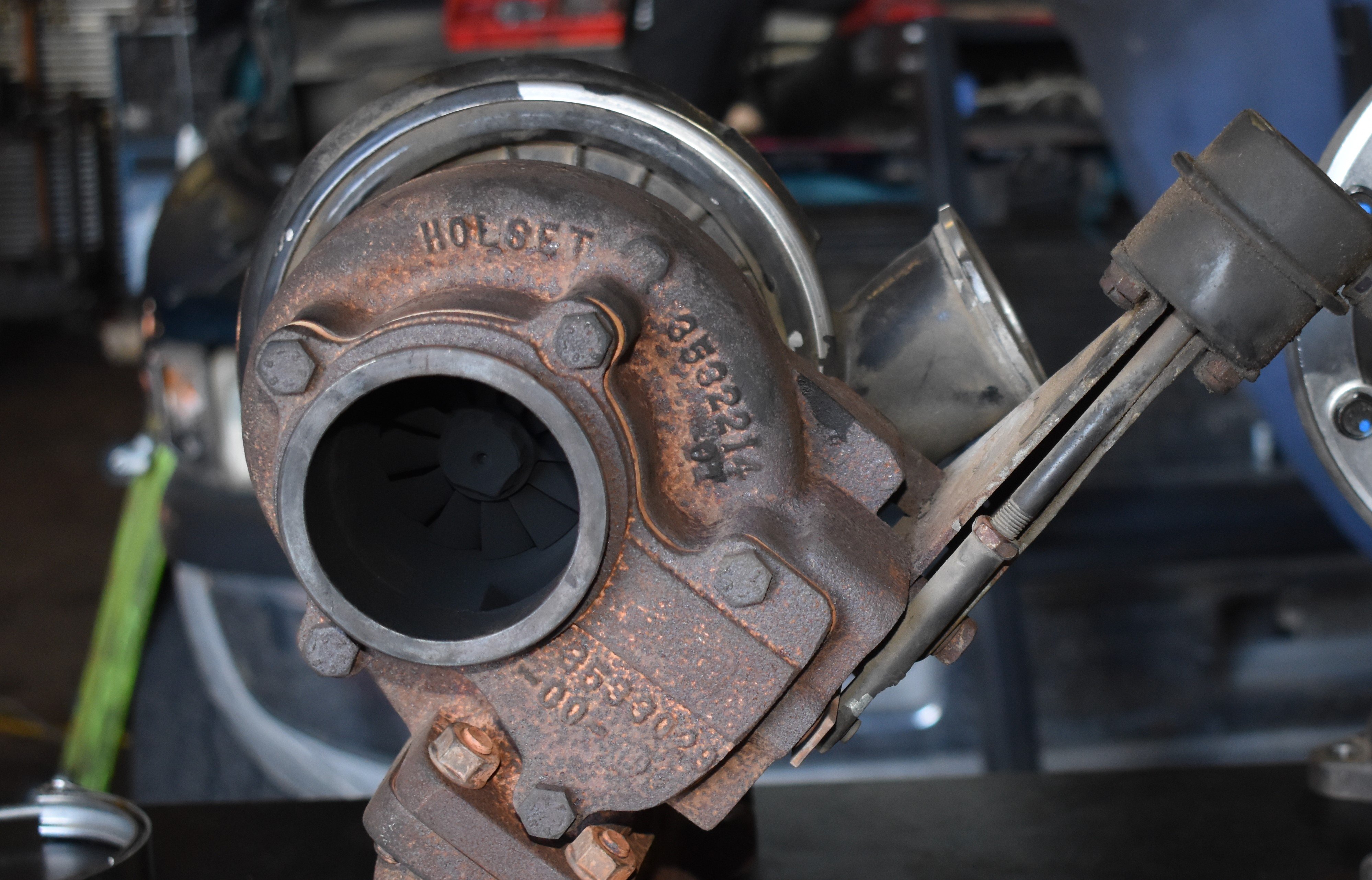
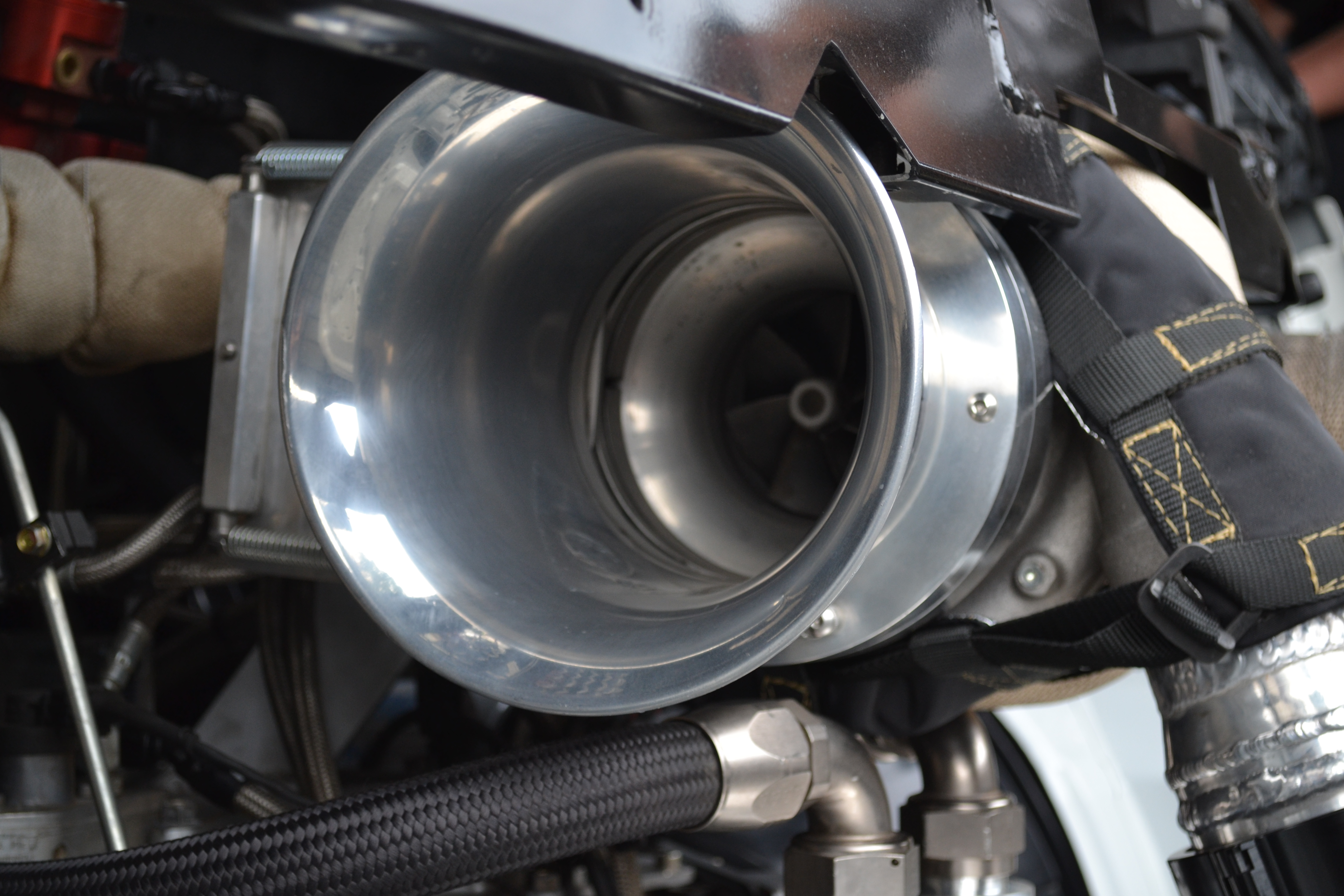
The most popular wastegate design for turbocharged diesels is the internal wastegate. It’s called this because the wastegate is incorporated into the turbine housing, and is used to bypass the turbine through a small hole right before the downpipe.

The Advantages of Running a Wastegate

Turbochargers spin at a very high rate of speed–up to 100,000 rpm in some cases–in order to windmill air into an engine at pressures that are much higher than atmospheric. A modern OEM turbo may run at 30 psi or more, while competition versions can run upwards of 70, 80, or even 100psi. In the end, though, every turbo has its limit. Over-pressurizing or over-speeding a turbo can result in catastrophic failure and that will ruin a turbo. Possibly even damage the engine.

Simply put, a wastegate bleeds off the exhaust pressure that drives the turbocharger. This in term limits the amount of boost the turbocharger creates, and also the maximum compressor speed. Score one for the turbo that was just saved. There’s more, however, as turbo sizing can also be adjusted, which means a smaller, quicker spooling exhaust side can be fitted for low-rpm response, and then pressure can be bled off up top in the rpm range. This is the main reason that Ram, Ford, and GM all went with wastegate setups; it protected the engine from damage and gave a more usable and extended rpm range.

wastegate

Sled pullers don’t normally run a wastegate because they need every last pound of boost the turbo can create in order to make maximum horsepower. The large safety blankets are installed to prevent shrapnel in case the turbo explodes.

When Don’t You Need A Wastegate?

If there are times that you need a wastegate, surely there are times when the opposite is true, and you don’t need one. Many competition vehicles that aren’t using nitrous oxide injection (we’ll get into that later) will run non-wastegate turbochargers, as they’re looking for literally the most boost pressure the turbo can produce, and are also not too concerned with elevation changes or drivability.

Other applications that run at a fairly specific rpm like tractors or generators can also get away without running a wastegate, mainly for cost reasons. But for the diesel performance industry, wastegates are beneficial.

wastegate

Exploded diagram of a wastegate. Photo courtesy Precision Turbo and Engine

How a Wastegate Works

A wastegate is a fairly simple system. Most mechanical wastegates use a simple diaphragm with a spring inside that opens at a preset pressure. This pressure can be changed anywhere from 5psi to 50psi (or more) depending on the spring setups and boost referencing available. This assembly in turn actuates a valve, that opens towards the atmosphere, venting excess pressure.

This type of wastegate is simple and effective and can be used outside the turbocharger (an external wastegate) or integrated into the turbo (internal wastegate). Variable geometry turbos can also create a wastegate effect through a nozzle or vanes, but since they are complex and computer-controlled, we’ll stick mainly to valved gates.

wastegate

In addition to wastegate springs, boost can be regulated to the top and bottom ports to control when and if the wastegate opens. This way the wastegate can almost be infinitely adjusted, down to 1psi increments.

Wastegate Tuning

At first, this may sound counter-intuitive, after all the wastegate is the control right? Technically, yes that’s correct, but there’s still a lot of “dialing in” that has to occur. A good starter spring for a wastegate is somewhere around a 15-pound spring. This means that once the turbocharger reaches 15psi, a boost line to the bottom of the diaphragm will open the wastegate and relieve some back pressure.

On a diesel, however, you may want a lot more boost, something along the order of 40 to 70 psi for most trucks, so, therefore, regulated air must be run to the top of the diaphragm to keep it shut. Adding a regulated 30-psi to the top of the gate now means that the turbo won’t overcome the spring pressure (and boost on top of it) until about 45 psi. Adding full boost to the top of the gate will effectively keep the wastegate shut; eliminating it completely.

Case Studies

Sometimes it’s best to have a few examples in order to get the hang of how something works. Here we have a couple of street trucks, a drag truck, and a sled-pulling rig all to show how a wastegate is used (or not used) on each setup.

Truck number one is a street truck. It is a 1996 Dodge Ram with minor fueling upgrades and 57mm/71mm ATS compound turbos with a single internal wastegate.

We had the pleasure of tuning this truck on the dyno with pressure monitors everywhere, so we could report how much power it made under various configurations. Before we hit the dyno, we ran it on the street where it only made 57psi with its limited fueling. That seemed low so we pinched off the wastegate line, effectively closing it. Boost hit 65psi, but the truck didn’t feel any faster.

How much back pressure can a diesel create you ask? Well, if the giant flame out of Cole Dow’s race truck is any indication, a lot. Heavy nitrous use is one application where an external wastegate is almost mandatory.

The dyno would tell the story. After our first run, the truck made 400rwhp at 65psi, but with a whopping 99psi of backpressure (or drive pressure) which was far and away from the magical 1:1 boost to drive pressure that most folks aim for. Opening the wastegate saw a drop in boost of 8psi to 57psi, but drive pressure was a mild 64psi, and the truck actually picked up in power to 432rwhp! In this case, proper wastegating netted an increase in power even at a lower boost level, due to an increase in engine efficiency.

Truck number two is a drag truck. It is a 2003 GMC 2500 with heavy fueling upgrades and tuning, a stock turbo with an internal wastegate, and a lot of nitrous.

After this truck ran 6.60s in the eighth mile we had to adjust our glasses, because there was no way it should have been that fast on the factory turbocharger. The racer had initially been running the turbo in the danger zone at nearly 40psi, but he found that by putting a larger diaphragm actuator (Banks Big Head) he could lower the boost to 30psi and just add more nitrous and run even faster! This was a case where the wastegate was being used to just keep the turbocharger alive with nitrous, since adding N2O to the mix dramatically increases drive pressure.

Truck number three is a 1999 Dodge Ram sled puller. This truck features heavy fueling upgrades and a 3.0-inch turbo with no wastegate.

Sled-pulling trucks are great examples of diesels that may be run without a wastegate, even though they make extreme amounts of boost and horsepower. Since these engines operate at an extremely high (4,000 to 6,000rpm) rev range and go down track at a fairly constant rpm (say 4,500 to 5,500rpm) they don’t necessarily need a wastegate.

Instead, the boost is controlled by very large exhaust sides and effective intercooling on the intake side. If the turbo explodes because of excess speed or pressure, a “better turbo” is simply found instead of a wastegate. It’s for this reason the best turbos for pulling can cost $5,000 or more, and while you could drive this type of setup on the street, it would be downright miserable. There have also been claims (mostly on tractors) of 100psi or more from a single turbo, which is downright insane.

The piping for turbo systems can get pretty complex on V-shaped engines, especially when compound or triple turbos are involved. Still, it’s almost always beneficial to run a wastegate.

Truck number four is another street tuck. This 2008 Ford F-250 utilizes heavy fueling upgrades, a Compound Turbo system with a VGT high-pressure turbo, and twin external wastegates.

The turbo setup on 6.4-liter Fords is a factory compound setup that includes a variable geometry high-pressure turbo. So right from the factory, they’re fairly complicated. This particular truck has probably the most extensive wastegate-tuning time on the dyno we’ve ever heard of, and took nearly 100 hours of fuel, timing, and tweaking to dial in.

After some initial runs, the truck made 730rwhp, but the tuner decided there had to be more in the combination because the 82mm turbo made enough air to flow more than 1,000rwhp. So the tweaking began. As the boost began to rise, the backpressure climbed fast, and at a little over 40 psi, the truck had a backpressure reading of more than 80psi. The trend continued until the sensor peaked at 85psi.

True backpressure was over 100psi. So, the decision was made to incorporate two external wastegates (one per bank since it was a V8) and dial it into work with the factory VGT curve. After a bunch of tweaking, the truck arrived at 67psi of boost with 84psi of backpressure, and 908 hp. It was also dead reliable and driveable, although the quick-spooling turbos ate transmissions after a few dynos run with more than 1,800 lb-ft of torque. Again some changes were made and the wastegates and VGT were used to limit power down low to 1,600 lb-ft, and the truck lived a long and happy life.

Posted on Leave a comment

Bearing Clearance and Oil Viscosity Explained

K1 – Blog

Bearing Clearance and Oil Viscosity Explained

The relationship between bearing clearance and oil viscosity is a delicate balance. Read on for more information on how to get it right!There are some fairly famous duos in the entertainment industry – Abbott and Costello, Rogers and Hammerstein, and Batman and Robin among the more illustrious. So it may not be much of a stretch of the imagination for an engine guy to include the pairing of bearing clearances with oil viscosity as a duo you should become acquainted.

The typical rule that most engine builders follow is that bearing clearance establishes the viscosity of the oil to use within a given oil temperature range. Generally, the tighter the bearing clearance, the lower the viscosity the engine can use while wider clearances require thicker oil. But there are plenty of variables that come into play that are worth investigating.

oil viscosity 01

Viscosity is a rating system for oil that rates the oil’s thickness at a given temperature. Production engines are increasingly moving to thinner, less viscous oil in search of improve fuel economy but there are performance advantages to thinner oil if the bearing clearances are somewhat tighter.

The traditional bearing clearance standard for street and most performance applications has been 0.001-inch of clearance for every one inch of crank journal diameter. So a typical small-block Chevy 2.200-inch rod journal would call for a bearing clearance of 0.0022-inch. Some add another 0.0005-inch to be safe – making that 0.0027-inch.This standard works very well especially for engines using production tolerance parts where there could be minor issues with out-of-round or tapered journals or even minor errors in measurement.

This approach isn’t quite as colloquial as it may seem. There are several contributing factors that directly affect a given bearing clearance. The top three variables are load carrying capacity, the amount of oil flow allowed by the clearance, and localized oil temperature. These three are best considered together as opposed to individually since each affects the others in important ways.

oil viscosity 02

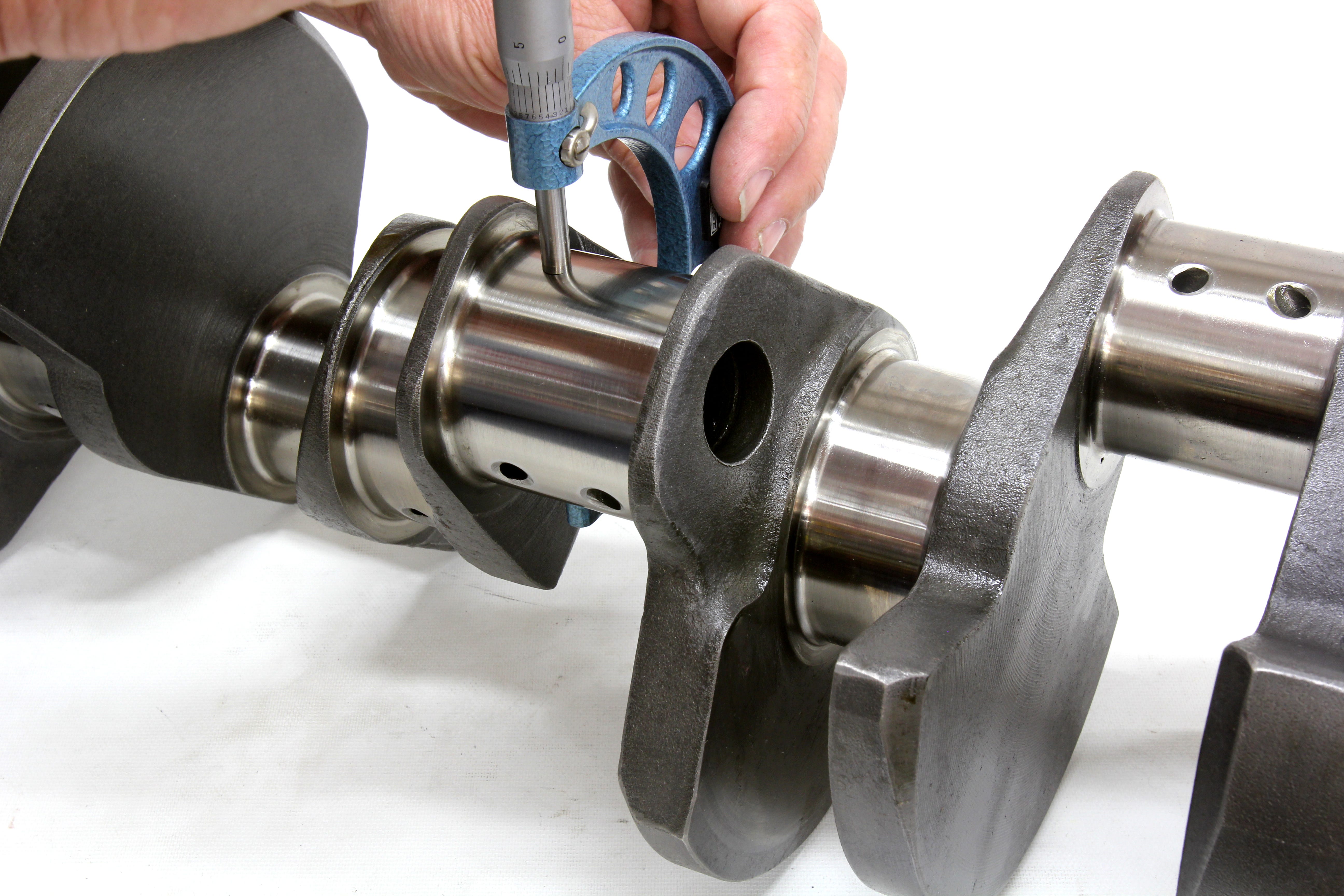
The only right way to begin accurately measuring bearing clearances is with a micrometer that can accurately measure to 0.0001-inch. That’s a tenth of a thousandth.

A bearing’s load carrying capacity is directly affected by clearance. As the clearance is tightened, load carrying capacity increases. As a generalized statement, 0.001-inch clearance offers a higher load carrying capacity than 0.002-inch using the standard 2.45-inch small-block main journal size as the example.

Load capacity increases with less clearance because it spreads the load over a wider bearing surface area, which increases the capacity. Think of this like wearing a pair of snow shoes that allow you to walk on deep snow without sinking in. Remove the shoes and your feet sink because your weight is concentrated on a smaller surface area. So as bearing clearance increases, the load carrying capacity is reduced because the load is concentrated in a smaller area.  

Bearing Oil Clearance Chart

Oil Viscosity Rod BearingClearance Main BearingClearance
20w / 5w20 < 0.0021 <0.0020
30w / 5w30 0.0021 – 0.0026 0.0020 – 0.0025
40w / 10w40 0.0026 – 0.0031 0.0025 – 0.0030
50w / 20w50 0.0031 > 0.0030 >

Common sense dictates that bearing clearance directly affects oil flow with predicable results. Reducing the clearance will increase the restriction to flow and reduce the volume of oil past the bearing. Because of this reduced flow, the localized bearing temperature will increase. If this temperature exceeds the oil’s thermal stability limit, the oil will begin to oxidize and break down, reducing its ability to lubricate. We will get into oil viscosity shortly as this plays an integrated part in this scenario.

So bearing clearance becomes a balancing act between these three factors to establish a clearance that satisfies all as efficiently as possible. This is how that 0.001-inch of clearance per one inch of journal diameter was created as the best compromise.

oil viscosity 3

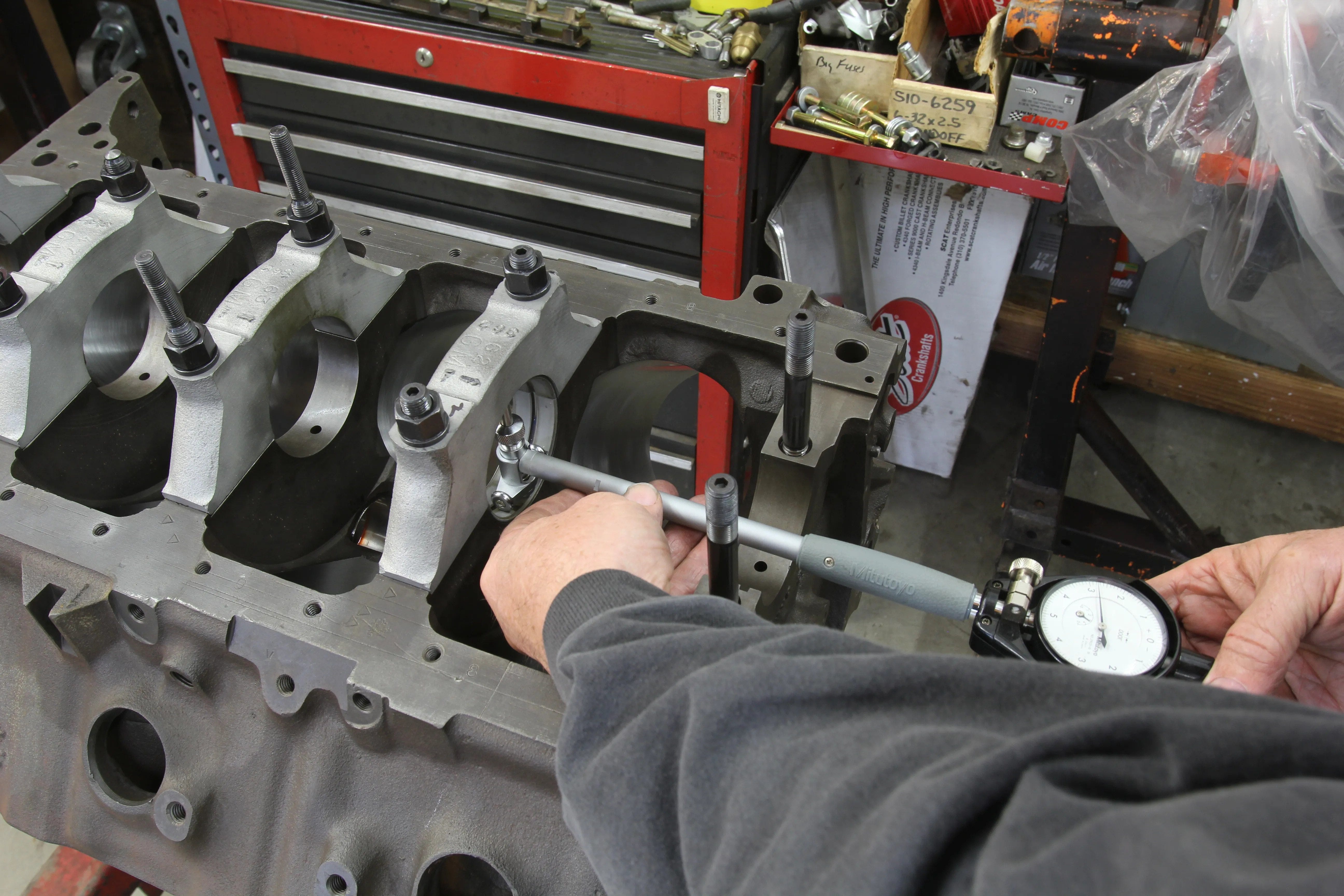
Once the journal diameter is established, use the same micrometer to set a dial bore gauge to the journal size. The clearance read by the dial bore gauge will be the bearing clearance. In this example, we’re looking at 0.0027-inch of main bearing clearance. Clearances must always be checked in the true vertical.

Perhaps this would be a good place to take a slightly closer look at exactly how those running clearances play out. Using simple round numbers, let’s start with a 2.00-inch rod journal with 0.0020-inch of clearance. This assumes we will have 0.001-inch on the top and bottom of the journal, which is true but only in a theoretical sense.

In a running engine, cylinder pressure pushes downward on the piston, reducing that 0.001-inch figure.  A loaded connecting rod at peak cylinder pressure will reduce that oil film clearance to as small as 0.0002-inch. With a static bearing clearance of 0.002-inch that means the upper half of the rod bearing has 0.0198-inch worth of clearance. This is important because this larger clearance creates a space easily filled with fresh oil for the following rotation.

oil viscosity 4

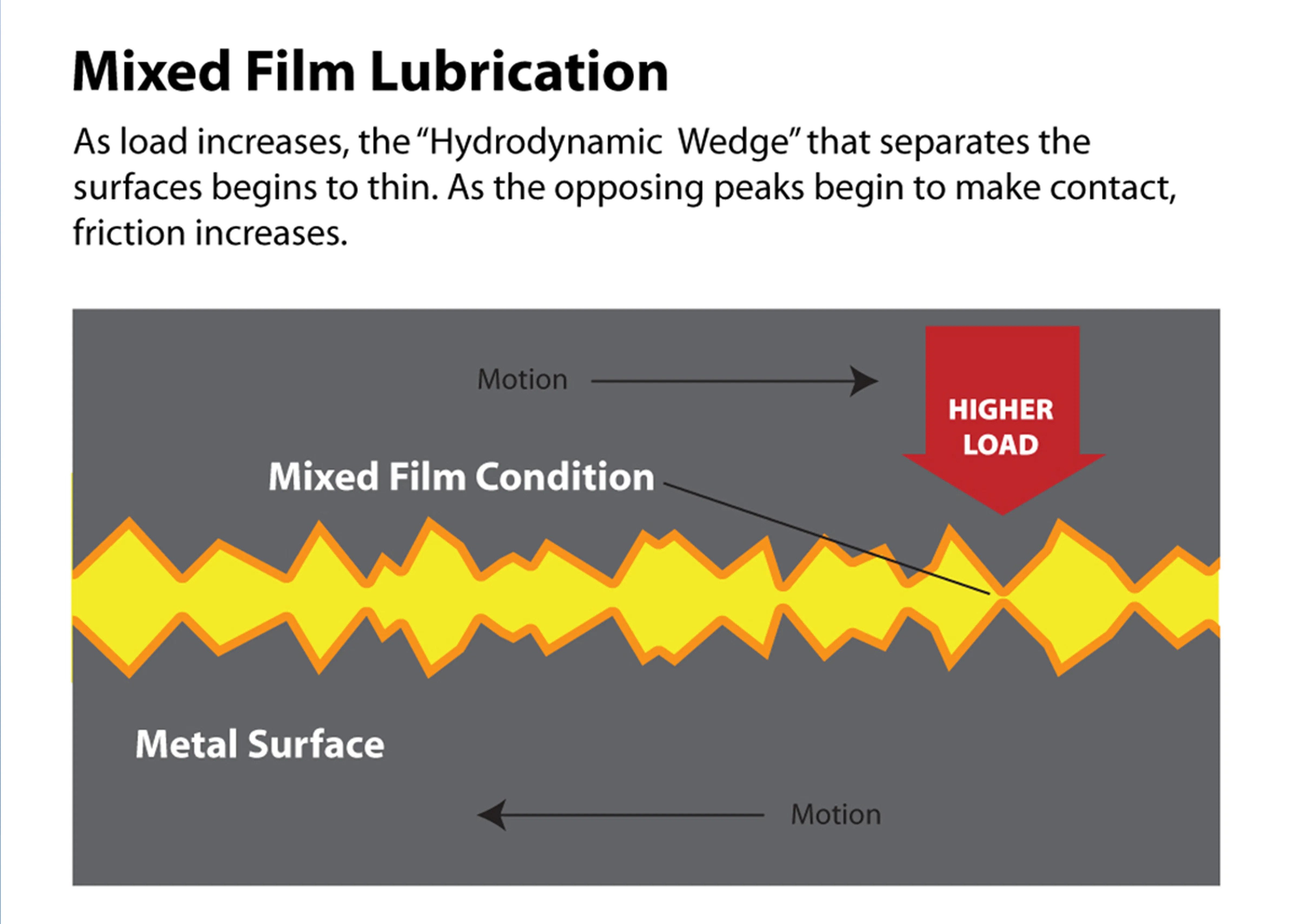
This Driven Racing illustration offers a microscopic view of what happens when operating clearances become tight. The peaks of the crankshaft journal can overlap the peaks of the bearing material causing wear. This is called a mixed film condition and can be caused by either tight clearances or an oil viscosity that is to thin perhaps caused by high oil temperature. 

This leads directly to the value of film thickness, which is created by a combination of the oil viscosity, bearing speed, and load. Oil viscosity predictably changes with temperature while the bearing speed is determined by the combination of the journal diameter and engine rpm and load is of course application dependent. All of these factors play into establishing the thickness of the film of oil. We spoke to Lake Speed, Jr., with Driven Racing Oil who used these three factors (and more) to perform a test of film thickness and stability with different oils and bearings at Shaver Racing Engines in Torrance, California.

oil viscosity 5

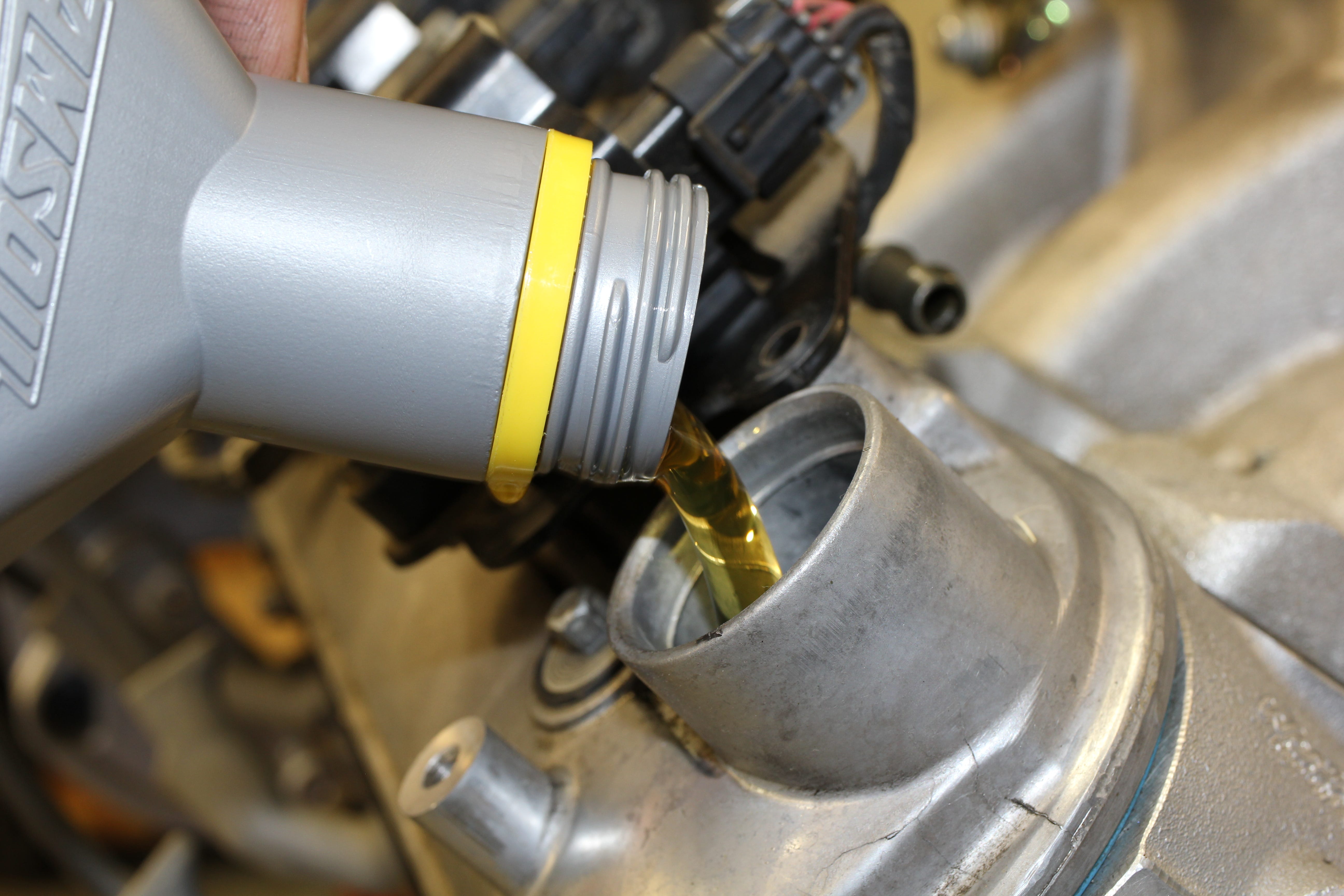
This 500 hp iron block LS generated 80-plus psi of oil pressure, so we drained the 10w30 and replaced it with 5w20 viscosity oil. From 4,000 to 6,500 the engine gained an average of 3.1 hp. The engine still produced over 70 psi peak oil pressure with the 5w20 oil so there are further gains to be realized.

His test was aimed mainly at evaluating coated bearings but it also looked at the ability of the oil to maintain its given film thickness under extreme temperature. It is commonly acknowledged that synthetics do a much better job of lubrication and protecting engine components compared to conventional oils at elevated oil temperatures. Speed’s test compared a synthetic Driven oil to a conventional Driven oil of the same viscosity and additive packages. The visual evaluation of the bearings along with a used oil analysis (UOA) revealed radically reduced physical contact between the crankshaft and the main and rod bearings with the synthetic oil. This offers specific evidence that a higher-quality synthetic offers real advantages especially with engines making big power where heat is a factor.

Ironically, Speed’s test employed a mild, 400 hp 383ci small-block Chevy at slow speeds, which can be abusive on bearings because of the extreme load. This is why lugging an engine at low speed isn’t a good idea as the loads increase dramatically. The quality of the oil played a big part in maintaining the proper lubrication barrier between the bearings and the crank journal. According to Speed, “Today’s oils have much greater load-carrying capacity that older oils.” This higher capacity spreads the load over a larger area which improves the overall capacity and avoids stress fractures that can occur in bearings due to excess load. 

All of these factors play into the final decisions around bearing clearance and viscosity.  If all we do is change to an aluminum connecting rod for example, this should require an increase in bearing clearance if for no other reason than because aluminum offers a linear rate of expansion that is roughly twice that of steel or cast iron. This will also have a direct affect on the running clearances. This however, should be carefully considered. As an example, you might think that an all-aluminum engine would demand a much different main bearing clearance compared to an all-iron version.

07

Driven Racing Oil’s Lake Speed, Jr. performed a series of tests of synthetic oil (left) versus conventional oil (right) on engine bearings in a small-block Chevy. Not surprisingly, the synthetic’s more stable oil film dramatically improved bearing wear even over a three-hour, high-load-low-rpm test. Both oils used the same viscosity and additive package so the only difference was the base oil.

Looking at this a little closer, most performance small-block Chevy aluminum blocks feature steel main caps. So now we have an aluminum block with steel main caps and the decision is whether this warrants a change in main bearing clearance. If we consider that all of the load will be applied to the steel main cap side of the engine, decreasing the main bearing clearance to account for the added growth of the aluminum block may not necessarily be a good decision. Tighter clearances also demand very careful cold weather starting and warm-up procedures because aluminum also will contract at twice the rate of iron or steel. Most engine builders we spoke to said they don’t make major clearance changes when building an aluminum block engine.

While bearings need a solid oil film to protect against wear, there are multiple factors that come into play in order to create the ideal combination of load carrying capacity and oil flow while minimizing oil temperature. This demands a careful balance of clearances, oil viscosity, and temperature control to avoid problems. The good news is as oil quality continues to improve, this thermal stability will continue to push toward lighter oil and tighter clearances with potential improvements in both durability and power.

Driven Bearing Clearance vs Oil Viscosity

Main Bearing Clearance Oil Temp Lessthan 160 F Oil Temp160-220F Oil TempOver 220 F
Iron Block      
0.0034-0.0039 10w40 or 15w40 15w50-20w50 20w60 – 60w
0.0028-0.0033  5w30 or 10w30 10w40 or 15w40 15w50-20w50
0.0022-0.0027   0w20 or 5w20  5w30 or 10w30 10w40 or 15w40
0.0016-0.0021         0w10   0w20 or 5w20  5w30 or 10w30
0.0010-0.0015         0w5         0w10   0w20 or 5w20
       
Aluminum Block      
0.0029-0.0034 10w40 or 5w40 15w50 or 20w50 20w60 or 60w
0.0023-0.0028  5w30 or 10w30 10w40 or 15w40 15w50 or 20w50
0.0018-0.0022   0w20 or 5w20 5w30 or 10w30 10w40 or 15w40
0.0012-0.0017       0w10 0w20 or 5w20 5w30 or 10w30
0.0006-0.0011       0w5 0w10 0w20 or 5w20

Connecting Rod Clearance

Clearance Oil Temp Lessthan 160 F Oil Temp160-220F Oil TempOver 220 F
Steel Rod      
0.0028-0.0033 5w30 or 10w30 10w40 or 15w40 15w50 or 20w50
0.0022-0.0027 0w20 or 5w20 5w30 or 10w30 10w40 or 15w40
0.0016-0.0021 0w10 0w20 or 5w20 5w30 or 10w30
0.0010-0.0015 Ow5 0w10 0w20 or 5w20
       
Aluminum Rod      
0.0023-0.0028 5w30 or 10w30 15w50 or 20w50 20w60 or 60w
0.0018-0.0022 0w20 or 5w20 10w40 or 15w40 15w50 or 20w50
0.0012-0.0017 0w10 5w30 or 10w30 10w40 or 15w40

This Driven Racing Oil chart (above)  illustrates some basic starting points for different engine applications. It’s important to choose the correct viscosity grade for the maximum engine oil temperature. As oil temperatures increases, the viscosity will drop. When there is a conflict between rod and main clearances, it’s always best to use the heavier of the two viscosity recommendations.  Keep in mind that these should be considered as recommended starting points for bearing clearances and oil viscosity. Individual applications can certainly vary.