
Posted on Leave a comment

Dispelling Engine Break-In Myths With High Performance Academy


Anyone who has been around high-performance engines knows the term “break-in”. In fact, it’s not uncommon to hear people talk about “break-in periods” for brand new cars, even. What, exactly, is being “broken-in”? What’s the proper procedure? Ask ten people and you are likely to get ten different answers. “This is an area where there is a huge amount of confusion and a huge amount of misinformation,” says Andre Simon of High Performance Academy, an online performance learning outlet.

First things first, what you’re doing when “breaking-in” a new performance engine – or any freshly rebuilt engine, for that matter – should be clearly defined. That is one of the largest pieces of misinformation in and of itself, according to Simon. “We must understand what it is we are actually trying to do. Some people think we are trying to bed in the bearings, or crankshaft, and that’s just not the case,” says Simon. “If you end up with metal-to-metal contact between the bearings and crankshaft journals [which would occur in a bedding process], you’re going to cause damage. Once that contact occurs, no amount of gentile running is going to fix that.”

What is actually being done during engine break-in is fairly simple – it’s the controlled bedding, or wearing-in, of the new piston rings on the hone of the cylinder walls. “We are trying to bed those rings so that they achieve a correct seal against the cylinder walls, and we have a relatively narrow window in which to do this,” relates Simon. “Once we achieve that seal, we end up with an engine that creates good power, has low blow-by, and has low oil consumption.”

“We’re using the rough surface of the hone pattern to abrade the rings and make them seat,” Simon explains. The crosshatch pattern of the hone in the cylinder like a file on the outer surface, creating a perfect fit within the bore. While that may sound simple – and really, the actual mechanics of it are – the process to actually achieve that is a delicate balancing act, as that crosshatch is only abrasive for a limited amount of time. “The reason there’s a narrow window is because that hone pattern will be broken down in time,” Simon continues.
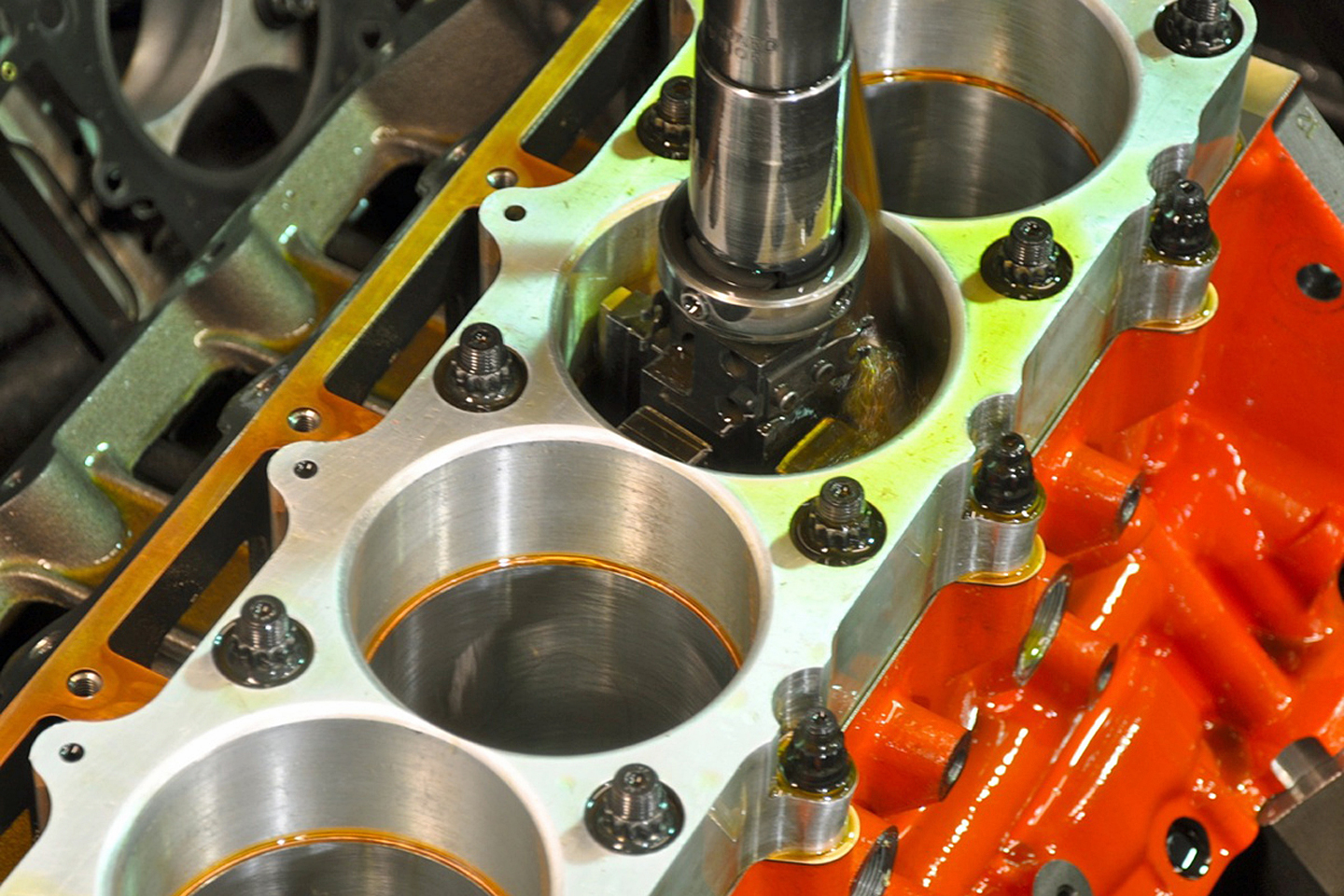
The proper cross-hatch pattern not only retains oil throughout the life of the engine, but the rough finish acts as a file to properly bed the rings in during the break-in process. However the sharp edges only last a limited amount of time. Once those edges are worn down, the ring bedding process is over, whether they’ve properly bedded to the cylinder walls or not.

Where things get complicated, is the proper way to maximize the effectiveness of that period where the crosshatch is essentially file-fitting the piston rings to the bore. “My process is one which I’ve gone though and developed through my career. It works exceptionally well, and as with most engine builders, I’m a bit superstitious about it,” says Simon. “The worst thing you can do while breaking in an engine is baby the engine or allow it to idle for extended periods, particularly when it’s hot. That will place almost no load on the rings and it will allow that hone pattern to be broken down without actually performing its job.”


However, while you don’t want a light load, you also don’t want to go to the other extreme either. “What we want to use is moderate amounts of load and moderate amounts of RPM,” explains Simon. “What happens with moderate loads, is that combustion pressure gets behind those rings, and pushes them out against the fresh hone pattern. That friction against the cylinder wall helps the bedding process along. However, that friction creates a lot of heat, so we need to be careful of that. You don’t want to go straight to wide open throttle and 8,500 rpm.”

Additionally, the lubricant used in the initial break-in period can have a large impact on how well the rings seat., and results in yet another balancing act. “The goal is to use an oil which will allow enough friction for the rings to bed in correctly. Common high-performance synthetic oil is so slippery it will actually inhibit the wear required to bed the rings in. So you don’t want to use super slick full-synthetic oils to break the engine in,” reveals Simon.

He prefers to use mineral-based oil, during break-in, as it will still protect the engine, but not be so super slippery as to be detrimental to the break-in process. There are a number of break-in specific oils on the market, which usually contain other additives to protect other parts of the engine in its early stages of life, and preferences on which one is best are about as varied as the varieties of oil themselves.

One final myth that Simon aims to bust, is extended engine break-in periods. “After a couple hundred kilometers of use, your rings are as bedded in as they’re ever going to be. After that, it’s all downhill, so you might as well get out and start enjoying your engine,” he says. “Exceedingly long break in periods are absolute rubbish.”

 

Posted on Leave a comment

How to Estimate Your Engine’s Required Fuel Flow

Posted by Jeff Behuniak on Sep 1, 2017 12:49:51 PM

We are occasionally asked, what fuel flow do I need to support my application?  Or, will your fuel filter flow enough for my engine?  These are important questions when selecting fuel filters, lines, and pumps for a performance engine.  You want to be sure that your components can deliverer the fuel needed to supply your thirsty engine.    

Fuel makes power.  Different types of fuel make different amounts of power.  By knowing the amount of power your engine makes or is expected to make and the type of fuel you will be running you can calculate your engine’s required fuel consumption and flow.

Brake-Specific Fuel Consumption

To start the calculations for fuel consumption we use the BSFC (Brake-Specific Fuel Consumption) for the fuel being used.  BSFC measures the amount of fuel needed per horsepower per hour. Fuel is measured in pounds instead of gallons.

download.jpg

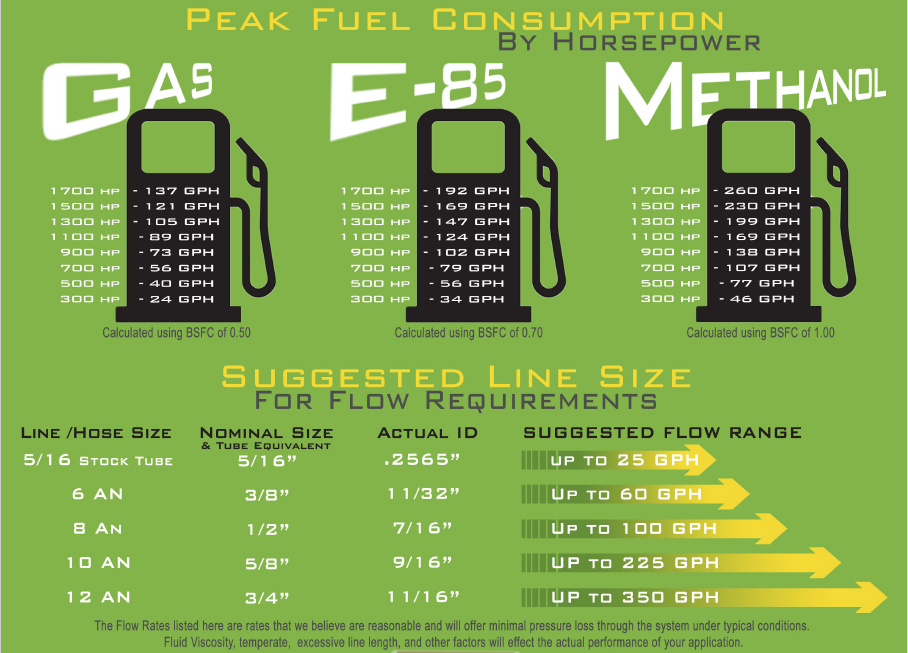
Listed below are the BSFC ranges for average efficiency Gas, E85 & Methanol engines at their peak hp output.  An engine’s BSFC can vary depending on load and RPM, these rates aim to represent the peak horsepower environment. The unit of measure here is lbs / hp / hr.

Gasoline   .45  –  .50
E85          .63  –  .70
Methanol   .90 –  1.0

You can used these BSFC values to calculate the fuel requirements for various horsepower levels.  The above BSFC number tell us that our gasoline engine requires .50 lb of fuel per horsepower per hour.  Said another way, we know for each horsepower our gas engine creates we will need .50 lbs of fuel per hour. Expressed as a formula it looks like this:

Given Horsepower  x  .50 lb fuel/hp = lbs of fuel for given horsepower

To calculate Fuel Consumption for a 400 hp Gas engine with a BSFC of .50 lbs/hp/hr:

400 hp x .50 = 200 lbs/hr    

To convert this lbs/hr to a more meaningful gallons per hour we use the conversion rate from lbs to gallons which is 6.2 lbs to 1 gallon of gas

200 lbs/hr  / 6.2 lbs/gal = 32.25 gph

And that’s it!  Now you have an approximate peak gph fuel requirement for your engine that can guide you in choosing your fuel system components.    

If you will be doing this calculation often, you can make it even easier by converting the BSFC you prefer for your fuel from the normal lbs/hp/hr unit of measure to a gal/hp/hr measure.  This way you will only need to multiply your horsepower by that figure to arrive at your GPH rate, without the need for converting from lbs to gallons after.  

BSFC .50 / 6.2  = .0806 gallons / horsepower / hour.

Again we calculate Fuel Consumption for a 400 hp Gas engine.

400 hp x .0806 = 32.24 gph 

Remember, if you are running E85 or Methanol be sure to use those BSFC values in your formula. To calculate peak fuel consumption for a 800 hp E-85 engine we can use a BSFC of .70 and the formulas below. 

800 hp x .70 = 560 lbs/hr          560 lbs/hr /  6.2 lbs/gal = 90.32 gph

OR

BSFC .70 / 6.2 = .113 gallons / horsepower / hour

800  * .113 = 90.40 gph

Note:  These gph flow rates may seem high when compared to your daily driver on the highway, but remember these are not averages, these are flow at loaded peak output.  Regarding the small differences in the numbers between the methods, that is a result in rounding differences.  


What does that GPH rate mean for my Filter?

25-902.jpg

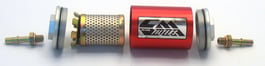
If you are using a quality fuel filter like our CM filters your filter should be out flowing the fittings and fuel lines on your car by a considerable margin. Our filter tests showed that in stock based applications with OE fittings and fuel lines in the 3/8 range the fitting and line size was the determining factor for flow.

Using our 25-902 fuel filter as an example lets see how the filter fitting size and line size relates to flow.  This filter features OEM style Ford fuel fittings specifically found on the 4.6 modular motor Mustangs.  In our testing this filter in isolation flows close to 100 GPH with around 1/2 psi resistance. It can do this because the filtration media is designed for high flow and the point of restriction is limited to the stock style fittings in and out which are short in distance.  Compare that to the long length of stock 3/8 fuel line running to and from the filter.  The long length and twist and turns in the fuel line mean resistance to flow is much greater.  In this application the stock line would not be able to flow much more then 60 GPH without significant pressure flow restriction accumulating.  

When planning your fuel delivery system we recommend first starting with an estimate of the fuel consumption your engine will require. Then determine the line size and pump to support that flow. Next choose a quality fuel filter to match your line size that uses high flow high filtration media like our CM filters.


BSFC is a great tool to quickly examine the relationship between fuel flow and horsepower.  Even though the fuel consumption required at your engine’s peak horsepower will be effected by several variables such as throttle position, RPM, and aspiration type these calculations can get you close.